Analysis of current economic conditions and policy
Forward Price Earnings Ratios
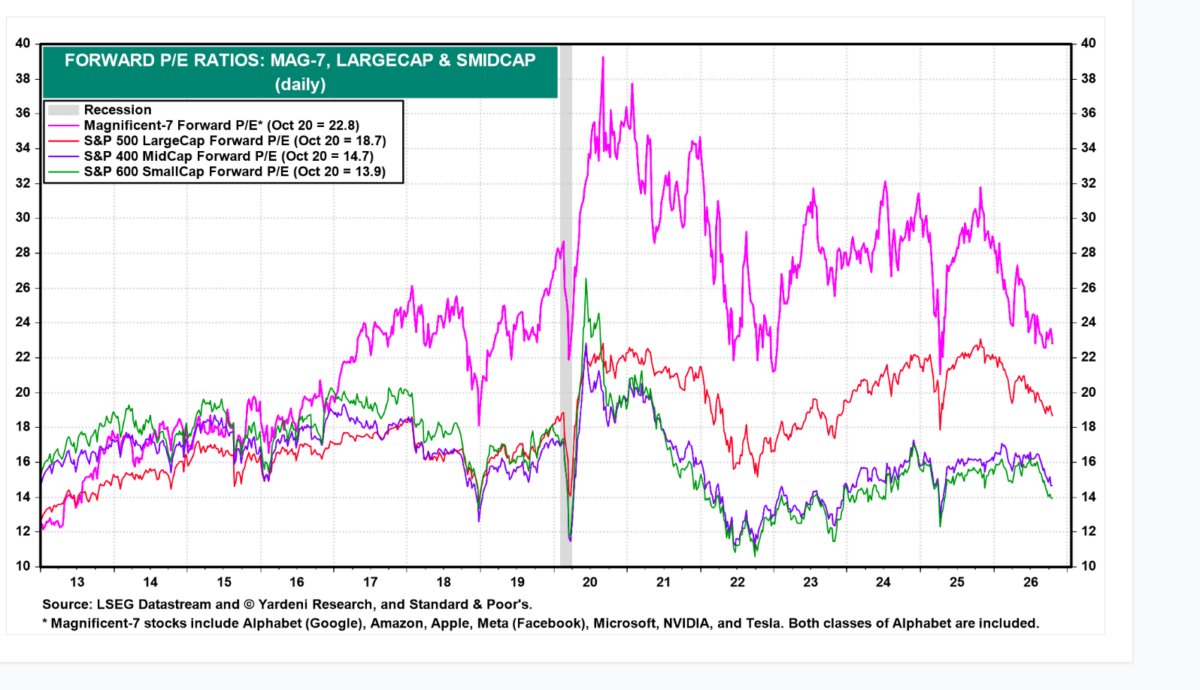
Looking pretty good — although one needs to wonder about analysts’ estimates of forward earnings…
Source: Yardeni.com, accessed 22.10.2026.
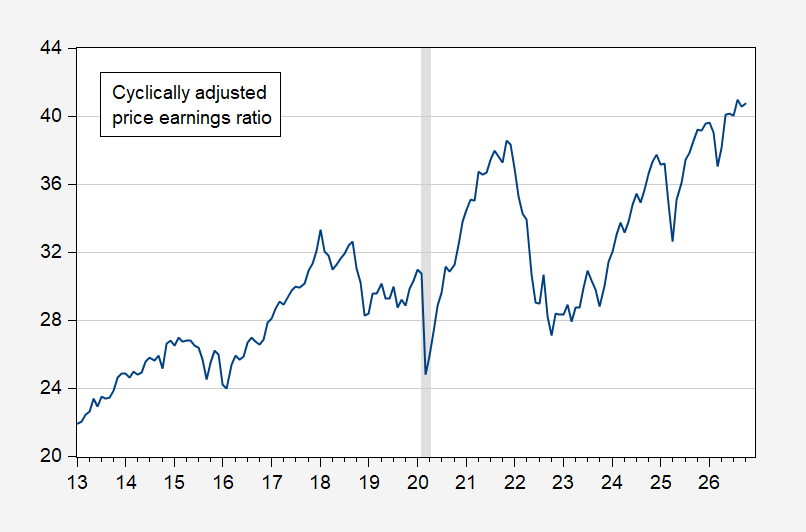
Compare against CAPE:
16 thoughts on “Forward Price Earnings Ratios”
New Deal democrat
The late Jeff Miller, a finance professor who went on to found NewArc Investments, and was the top-rated market analyst at Seeking Alpha, was rigorously mathematical in his research, and looked carefully into the matter of forward earnings estimates, so there is no need for us to reinvent the wheel.
Here are a few salient excerpts:
“ There are two widely held conclusions about corporate earnings:
Analysts are overly optimistic, so expected earnings are always too high.
At the time of corporate reports, the high “beat rate” is because expectations are too low.
“The apparent contraction is universally ignored [by]the punditry”
He then goes on to demonstrate the above proposition by means of a “squiggle chart” that I highly recommend you click over and take a look at.
He then continues:
“ The chart shows that forward earnings estimates are pretty reliable in leading actual results. If you look at an individual squiggle, you can see the 25-month history of the consensus estimate for that quarter. These often, but not always, start out too high. After the report, the estimate is (of course) on target. For estimates to be too optimistic at the start and too pessimistic at the end, there must be a crossover point – a time when the estimate is accurate. My research shows this to be about nine months before the actual report.”
Jeff subsequently re-confirmed this research in an email exchange with me.
Of course earnings estimates can be badly off, which is why stock markets can have explosive rallies and, ahem, sharp sell-offs. But Miller’s research showed that forward estimates 9 months out are usually pretty reliable.
And what do they say now? Per FactSet, earnings estimates for the S&P 500 nine months from now, at the end of Q2 of next year are about 3% higher than the record earnings reported in Q2 of this year.
Ithaqua
One wonders if, given enough money, this could lead to a market-beating investment strategy, at least in terms of expected value. A nine-month gap between an “unbiased forecast” and the actual report is long enough that I can see a market inefficiency arising, since most non-fundamentals-based strategies focus on much shorter-term price movements.
Macroduck
We know a little bit about forward vs realized (trailing) earnings. Here’s a set of charts from Yardeni, which show that earnings are a pretty good estimate of realized earnings except during recessions:
Yardeni’s charts show the pattern of optimism the NDd cites from Jeff Miller. Also, and importantly, around recessions, realized earnings turn lower well ahead of forward estimates; recessions come as a surprise to earnings forecasters. There are other non-recessionary surprised, as well. Forecasters rely on historical performance, whether they are economic, financial, crop or weather forecasters. Sudden deviation form historical patterns are hard to see coming.
Here’s what naive analysis of forward earnings estimates looks like:
“How Reliable Are Earnings Estimates?”
“…I have taken the average forward earnings estimates for the S&P 500 every week over the last 15 years and compared them to what got reported 12 months later.
“The average over that 15-year time frame is -0.15%, so basically even. This means that on average, the forward earnings estimates have pretty much equaled what got reported 12 months later.”
If you only look at average performance, you won’t notice that forward estimates fail during recessions.
What Yardeni’s charts don’t tell us is how accurate forward earnings forecasts are in bubbles and in periods when new industries are growing fast. I don’t have an answer, but I’m sure an answer can be found.
New Deal democrat
Thanks. Jeff’s chart was from Yardeni, and your link saves me the trouble of trying to update it all on my own.
Macroduck
Shiller’s CAPE is generally accepted as a forecast of performance over the next several years, but not as a forecast of corrections – CAPE doesn’t help with timing. Here’s an assessment of where CAPE currently stands:
“As of October 2026, the Shiller CAPE is 40.7×, the 98.9th percentile since 1881. Only 19 months in the record were higher, all in 1999–2000 and 2026. The absolute valuation signal is extreme; the 0.56% excess CAPE yield remains above zero, so stocks are less stretched against bonds than at the dot-com peak.”
The “United States” is suing Alaska to prevent anyone but the incumbent, Dan S. Sullivan (R) from being certified as the winner of this year’s Alaska Senate race. The excuse is that Daniel J. Sullivan is also running, and voters will be confused. The reason is that Mary Peltola (D) is in a dead heat with Dan S. Sullivan. The U.S. Supreme Court has already ruled that the Alaska Senate race can go ahead as is in a nearly identical case.
If Peltola wins, this case will be used as an excuse to challenge the seating of a Democratic Senate Majority Leader. Who knows? Maybe there be an insurrection.
Macroduck
There is a steady flow of speculation among fringe international affairs analysts about the fall of the Saudi regime. Here’s a sample:
My first thought was that there is insufficient internal dissent to pull off a revolt and too little population nearby to invade. But maybe my first thought was wrong. Saudi Arabia’s population is just over 35 million, with about 42% of that population foreign born. Yemen’s population is 43 million, nearly all native born. The Saud family has only about 15,000 members, with wealth and power held mostly by 2,000 of them. If kicking out the Saud family is what fringey folk have in mind, that seems more doable than knocking off the entire country. And good riddance; Saudi Arabia is one of the worst regimes in the world.
Saudi Arabia has long been brutal in dealing with dissent; ask Jamal Khashoggi’s wife. A good bit of Saudi military training is aimed at suppressing dissent. Last year, in a sign that maybe a relaxation is underway, security chief Abdulaziz al-Howairini announced that exiles would be allowed to return home. That was before Yemen’s Houthis began calling the Saudi regime’s ability to defend itself into question. So maybe there’s enough internal dissent to get ‘er done.
The Saudi/Pakistani/Turkish Mecca Accord seems to acknowledge that Saudi Arabia needs help defending itself; nobody is threatening Turkey and Pakistan can’t expect much help from Saudi Arabia’s police-state military. Besides, who other than China would cheese off India to maintain relations with Pakistan?
So there is evidence of internal dissent and maybe Yemen has the population to give the Saud family a hard time, if not the country.
Baffling
Wouldn’t it be ironic if a war to overthrow the iranian regime instead overthrew the saudi regime with an iranian proxy? Sounds like the plotline from an new age tom clancey novel.
Macroduck
Here’s the premise of the novel: Old men wrest power away from elites in all the Great Powers – including a former Great Power. Having power concentrated in hands of narcissists – it’s almost definitional that individuals grabbing power are narcissists – means less caution, less thoughtful policy, more radical action. Unintended consequences abound.
Regimes which exist to serve the interests of elites in the Great Powers get caught in the swirl of unintended consequences. Saudi Arabia, sure, maybe the liberal democratic order in Western Europe, maybe Israel, maybe the drift toward Russia in Eastern Europe.
Individuals’ selfish interest makes really bad policy. Hard as it is to accept, selfish group interest probably does make better policy than selfish individual interest.
Ivan
The strength of democracy is that it almost per definition will force policies towards what serves the (average citizen of the) country. It also will force open debate about policies and their ability to serve the people/country. It can be messy and dysfunctional, especially when the population is ignorant or the relentless push of the moneyed people for power has too much success. However, when it comes to making good policies, democracy has a heck of a structural advantage compared to some autocratic clown parade winging it.
joseph
I’m always amused when one points out extremely high PE values that people counter it by saying it isn’t so high if you use forward earnings.
First of all, forward earnings are imaginary while current and past earnings are factual. But more importantly, they assume that earnings will go up while the price remains unchanged. It is trivially correct that if you hold P constant and increase E that P divided by E will be a lower number. But is that really what they would have you believe — that your investment return for price over the next year will be zero — so PE will be not so big?
But, if on the other hand, price goes up as earnings go up, then the PE remains extremely elevated so what information do you gain by ginning up a lower PE using future earnings. The stock is and remains highly-priced.
Cage's Longlegs
“DOJ” officials going to polling places DURING mid-term voting to “inspect” and “ensure” federal laws are being followed. I wonder if trump’s goons will bring their swastika armbands?? Good to see Bruce Hall will have a job he finally qualifies for.
Macroduck
Meanwhile, Treasuries have had a bit of a reprieve over the past few days. The financial press is mostly crediting a flight to safety from tech shares, and fair enough. The Philly chip index fell 14% last week:
To move Treasury prices takes some heft, simply because the Treasury market is so large, so maybe there’s more going on than just the tech rout. And what do you know, credit default swaps on French government debt blew out last week, after stabilizing through the first half of October:
French 10s now trade above 5%, at the widest spread vs Bunds since the Eurozone debt crisis. Bunds also got a safe-haven bid last week, along with Treasuries.
No need to relate what’s happening in the streets of Paris, except to say that similar things are happening, mostly on a smaller scale, throughout Europe. And to point out that Marine le Pen may soon replace Macron as president. Le Pen has pledged to lower the retirement age to 62, perhaps to 60, even though French finances are a mess and France already has the lowest retirement age just about anywhere. Think MAGA with a French accent.
Optimistic but Septic
“Blended S&P 500 year-over-year earnings growth for Q3 tracks near 29.0%”
3 observations:
– 29% profit growth is a lot when GDP is growing 2% and profits/GDP are already at all time highs (13% of GDP, long-term average is 7%)
– If earnings are FLAT instead, not even decreasing(!), this PE ratio will be up 50% (28 instead of 18.7), which is untenable with a Fed rate at 4%.
– Yearly SP500 profits are $2.3T, a major AI writeoff (e.g. hyperscalers devalue OpenAI or Anthropic), even with no change in cash receipts in the real economy, could wipe off over 10% of that.
joseph
Trump is trying to overturn an election in Alaska that hasn’t even occurred yet. His complaint is that there are two Dan Sullivans on the ballot. (Or for the grammar pedants should that be two Dans Sullivan?) Trump claims this is unfair.
Well, it comes about because Alaska law has a jungle primary that puts the top four candidates on the ballot, regardless of party affiliation. But Alaska also has ranked choice voting, which means that even confusion over names has very little affect on the eventual outcome.
Keep in mind what is going on here. Back in 2008 Democrats won a filibuster proof 60 senators — except they didn’t because Republicans argued Al Franken’s election results in court for over 8 months, preventing him from being seated until July of the next year. That hampered progress on the Obamacare legislation because shortly after Franken was belatedly seated, Ted Kennedy died, further delaying the filibuster-proof 60 seats necessary for Obamacare.
That’s what Republicans have in mind here as they anticipate maybe conceding 51 seats to Democrats. Trump will do anything possible to keep his majority for the rest of his term, running out the clock, even if it means delaying election results in litigation for another two years.
joseph
Elon Musk today on Xitter: “Hitler was a far left socialist. Literally in the name of the party!”
Elon Musk tomorrow: “North Korea is a republic. Literally in the name of their country!”
I simply do not understand people who call Musk a genius. He’s a talented scammer and conman, like Trump, but dumb as a box of rocks.
The late Jeff Miller, a finance professor who went on to found NewArc Investments, and was the top-rated market analyst at Seeking Alpha, was rigorously mathematical in his research, and looked carefully into the matter of forward earnings estimates, so there is no need for us to reinvent the wheel.
His best article on this subject that I could find is this one:
https://seekingalpha.com/article/4297479-weighing-the-week-ahead-earnings-season-opportunities
Here are a few salient excerpts:
“ There are two widely held conclusions about corporate earnings:
Analysts are overly optimistic, so expected earnings are always too high.
At the time of corporate reports, the high “beat rate” is because expectations are too low.
“The apparent contraction is universally ignored [by]the punditry”
He then goes on to demonstrate the above proposition by means of a “squiggle chart” that I highly recommend you click over and take a look at.
He then continues:
“ The chart shows that forward earnings estimates are pretty reliable in leading actual results. If you look at an individual squiggle, you can see the 25-month history of the consensus estimate for that quarter. These often, but not always, start out too high. After the report, the estimate is (of course) on target. For estimates to be too optimistic at the start and too pessimistic at the end, there must be a crossover point – a time when the estimate is accurate. My research shows this to be about nine months before the actual report.”
Jeff subsequently re-confirmed this research in an email exchange with me.
Of course earnings estimates can be badly off, which is why stock markets can have explosive rallies and, ahem, sharp sell-offs. But Miller’s research showed that forward estimates 9 months out are usually pretty reliable.
And what do they say now? Per FactSet, earnings estimates for the S&P 500 nine months from now, at the end of Q2 of next year are about 3% higher than the record earnings reported in Q2 of this year.
One wonders if, given enough money, this could lead to a market-beating investment strategy, at least in terms of expected value. A nine-month gap between an “unbiased forecast” and the actual report is long enough that I can see a market inefficiency arising, since most non-fundamentals-based strategies focus on much shorter-term price movements.
We know a little bit about forward vs realized (trailing) earnings. Here’s a set of charts from Yardeni, which show that earnings are a pretty good estimate of realized earnings except during recessions:
https://yardeni.com/charts/us-stock-market/stock-market-forward-metrics/sp-500-forward-revenues-earnings-margins
Yardeni’s charts show the pattern of optimism the NDd cites from Jeff Miller. Also, and importantly, around recessions, realized earnings turn lower well ahead of forward estimates; recessions come as a surprise to earnings forecasters. There are other non-recessionary surprised, as well. Forecasters rely on historical performance, whether they are economic, financial, crop or weather forecasters. Sudden deviation form historical patterns are hard to see coming.
Here’s what naive analysis of forward earnings estimates looks like:
“How Reliable Are Earnings Estimates?”
“…I have taken the average forward earnings estimates for the S&P 500 every week over the last 15 years and compared them to what got reported 12 months later.
“The average over that 15-year time frame is -0.15%, so basically even. This means that on average, the forward earnings estimates have pretty much equaled what got reported 12 months later.”
https://www.investing.com/analysis/how-reliable-are-earnings-estimates-200657177
If you only look at average performance, you won’t notice that forward estimates fail during recessions.
What Yardeni’s charts don’t tell us is how accurate forward earnings forecasts are in bubbles and in periods when new industries are growing fast. I don’t have an answer, but I’m sure an answer can be found.
Thanks. Jeff’s chart was from Yardeni, and your link saves me the trouble of trying to update it all on my own.
Shiller’s CAPE is generally accepted as a forecast of performance over the next several years, but not as a forecast of corrections – CAPE doesn’t help with timing. Here’s an assessment of where CAPE currently stands:
“As of October 2026, the Shiller CAPE is 40.7×, the 98.9th percentile since 1881. Only 19 months in the record were higher, all in 1999–2000 and 2026. The absolute valuation signal is extreme; the 0.56% excess CAPE yield remains above zero, so stocks are less stretched against bonds than at the dot-com peak.”
https://www.thetrading.tools/shiller-cape
CAPE is based on trailing earnings. Optimists expect forward earnings to be higher than trailing earnings. That’s how markets are made.
Off topic – overturning elections:
https://www.documentcloud.org/documents/28830814-us-v-alaska/
The “United States” is suing Alaska to prevent anyone but the incumbent, Dan S. Sullivan (R) from being certified as the winner of this year’s Alaska Senate race. The excuse is that Daniel J. Sullivan is also running, and voters will be confused. The reason is that Mary Peltola (D) is in a dead heat with Dan S. Sullivan. The U.S. Supreme Court has already ruled that the Alaska Senate race can go ahead as is in a nearly identical case.
If Peltola wins, this case will be used as an excuse to challenge the seating of a Democratic Senate Majority Leader. Who knows? Maybe there be an insurrection.
There is a steady flow of speculation among fringe international affairs analysts about the fall of the Saudi regime. Here’s a sample:
https://conflictsforum.substack.com/p/the-prospective-demise-of-saudi-arabia
My first thought was that there is insufficient internal dissent to pull off a revolt and too little population nearby to invade. But maybe my first thought was wrong. Saudi Arabia’s population is just over 35 million, with about 42% of that population foreign born. Yemen’s population is 43 million, nearly all native born. The Saud family has only about 15,000 members, with wealth and power held mostly by 2,000 of them. If kicking out the Saud family is what fringey folk have in mind, that seems more doable than knocking off the entire country. And good riddance; Saudi Arabia is one of the worst regimes in the world.
Saudi Arabia has long been brutal in dealing with dissent; ask Jamal Khashoggi’s wife. A good bit of Saudi military training is aimed at suppressing dissent. Last year, in a sign that maybe a relaxation is underway, security chief Abdulaziz al-Howairini announced that exiles would be allowed to return home. That was before Yemen’s Houthis began calling the Saudi regime’s ability to defend itself into question. So maybe there’s enough internal dissent to get ‘er done.
The Saudi/Pakistani/Turkish Mecca Accord seems to acknowledge that Saudi Arabia needs help defending itself; nobody is threatening Turkey and Pakistan can’t expect much help from Saudi Arabia’s police-state military. Besides, who other than China would cheese off India to maintain relations with Pakistan?
So there is evidence of internal dissent and maybe Yemen has the population to give the Saud family a hard time, if not the country.
Wouldn’t it be ironic if a war to overthrow the iranian regime instead overthrew the saudi regime with an iranian proxy? Sounds like the plotline from an new age tom clancey novel.
Here’s the premise of the novel: Old men wrest power away from elites in all the Great Powers – including a former Great Power. Having power concentrated in hands of narcissists – it’s almost definitional that individuals grabbing power are narcissists – means less caution, less thoughtful policy, more radical action. Unintended consequences abound.
Regimes which exist to serve the interests of elites in the Great Powers get caught in the swirl of unintended consequences. Saudi Arabia, sure, maybe the liberal democratic order in Western Europe, maybe Israel, maybe the drift toward Russia in Eastern Europe.
Individuals’ selfish interest makes really bad policy. Hard as it is to accept, selfish group interest probably does make better policy than selfish individual interest.
The strength of democracy is that it almost per definition will force policies towards what serves the (average citizen of the) country. It also will force open debate about policies and their ability to serve the people/country. It can be messy and dysfunctional, especially when the population is ignorant or the relentless push of the moneyed people for power has too much success. However, when it comes to making good policies, democracy has a heck of a structural advantage compared to some autocratic clown parade winging it.
I’m always amused when one points out extremely high PE values that people counter it by saying it isn’t so high if you use forward earnings.
First of all, forward earnings are imaginary while current and past earnings are factual. But more importantly, they assume that earnings will go up while the price remains unchanged. It is trivially correct that if you hold P constant and increase E that P divided by E will be a lower number. But is that really what they would have you believe — that your investment return for price over the next year will be zero — so PE will be not so big?
But, if on the other hand, price goes up as earnings go up, then the PE remains extremely elevated so what information do you gain by ginning up a lower PE using future earnings. The stock is and remains highly-priced.
“DOJ” officials going to polling places DURING mid-term voting to “inspect” and “ensure” federal laws are being followed. I wonder if trump’s goons will bring their swastika armbands?? Good to see Bruce Hall will have a job he finally qualifies for.
Meanwhile, Treasuries have had a bit of a reprieve over the past few days. The financial press is mostly crediting a flight to safety from tech shares, and fair enough. The Philly chip index fell 14% last week:
https://finance.yahoo.com/quote/%5ESOX/
To move Treasury prices takes some heft, simply because the Treasury market is so large, so maybe there’s more going on than just the tech rout. And what do you know, credit default swaps on French government debt blew out last week, after stabilizing through the first half of October:
https://www.worldgovernmentbonds.com/cds-historical-data/france/5-years/
French 10s now trade above 5%, at the widest spread vs Bunds since the Eurozone debt crisis. Bunds also got a safe-haven bid last week, along with Treasuries.
No need to relate what’s happening in the streets of Paris, except to say that similar things are happening, mostly on a smaller scale, throughout Europe. And to point out that Marine le Pen may soon replace Macron as president. Le Pen has pledged to lower the retirement age to 62, perhaps to 60, even though French finances are a mess and France already has the lowest retirement age just about anywhere. Think MAGA with a French accent.
“Blended S&P 500 year-over-year earnings growth for Q3 tracks near 29.0%”
3 observations:
– 29% profit growth is a lot when GDP is growing 2% and profits/GDP are already at all time highs (13% of GDP, long-term average is 7%)
– If earnings are FLAT instead, not even decreasing(!), this PE ratio will be up 50% (28 instead of 18.7), which is untenable with a Fed rate at 4%.
– Yearly SP500 profits are $2.3T, a major AI writeoff (e.g. hyperscalers devalue OpenAI or Anthropic), even with no change in cash receipts in the real economy, could wipe off over 10% of that.
Trump is trying to overturn an election in Alaska that hasn’t even occurred yet. His complaint is that there are two Dan Sullivans on the ballot. (Or for the grammar pedants should that be two Dans Sullivan?) Trump claims this is unfair.
Well, it comes about because Alaska law has a jungle primary that puts the top four candidates on the ballot, regardless of party affiliation. But Alaska also has ranked choice voting, which means that even confusion over names has very little affect on the eventual outcome.
Keep in mind what is going on here. Back in 2008 Democrats won a filibuster proof 60 senators — except they didn’t because Republicans argued Al Franken’s election results in court for over 8 months, preventing him from being seated until July of the next year. That hampered progress on the Obamacare legislation because shortly after Franken was belatedly seated, Ted Kennedy died, further delaying the filibuster-proof 60 seats necessary for Obamacare.
That’s what Republicans have in mind here as they anticipate maybe conceding 51 seats to Democrats. Trump will do anything possible to keep his majority for the rest of his term, running out the clock, even if it means delaying election results in litigation for another two years.
Elon Musk today on Xitter: “Hitler was a far left socialist. Literally in the name of the party!”
Elon Musk tomorrow: “North Korea is a republic. Literally in the name of their country!”
I simply do not understand people who call Musk a genius. He’s a talented scammer and conman, like Trump, but dumb as a box of rocks.