Over $116/bbl.
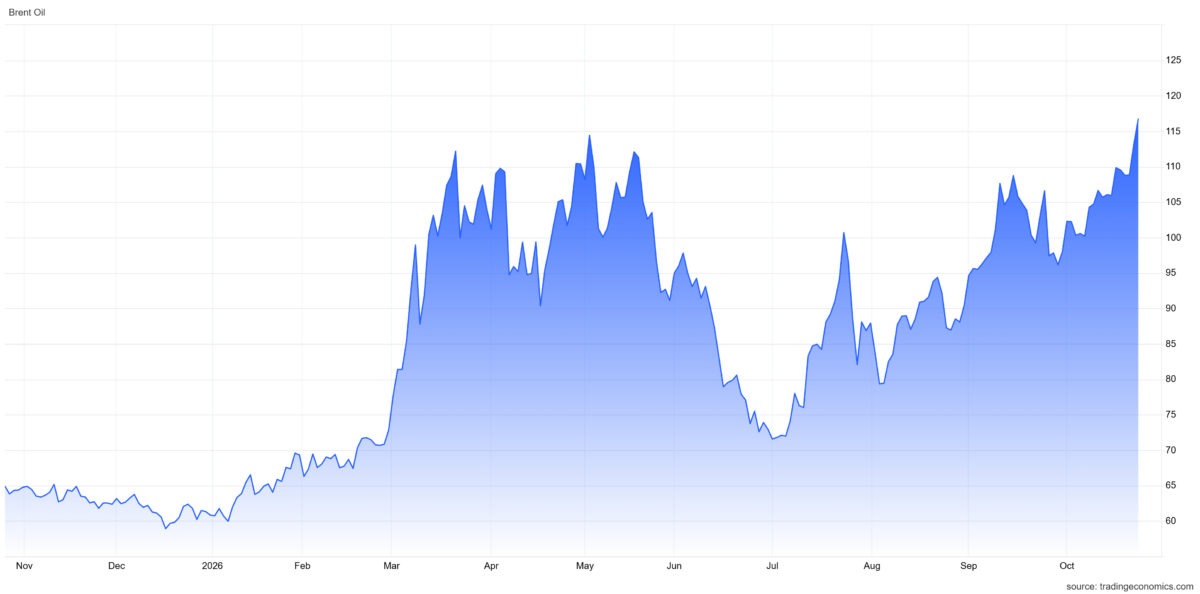
One can decompose the futures price increase into an pure expected price change, and risk premium. Robin Brooks “What’s Priced into Brent at $117?
A big risk premium has gotten priced in anticipation of a return to a “hot” war” argues that it’s largely due to risk premium increase — perhaps excessive — associated with a much signalled resumption of a “hot” war post-midterms.
Brooks bases his argument on the experience of previous supply reduction and the little change in far dated futures, and the logic makes sense. However, there have been some (big) surprises in this entire experience (including the sheer incompetence in war planning and strategic (presidential) decisionmaking), so it might be understandable that markets might place greater weight on larger disruptions than than occurred earlier.
Earlier disruptions were met with SPR releases. This one is, as well, but in a tiny scale – 2 day’s supply for a single refinery:
https://oilprice.com/Latest-Energy-News/World-News/US-Dips-Into-Strategic-Oil-Reserve-Again-Amid-Supply-Disruptions.html
This is actually a good use of the SPR, but the SPR is just about tapped out. So are reserves elsewhere. Physical supply out of the Gulf had recovered, but Iran has recently been hitting tankers and will do more of that if we bomb them. We are now facing renewed restrictions on physical supply when strategic reserves are low. Different scenario.
Early in the war, Brooks argued that the price spike was overdone, as he is doing now. Then, I disagreed and I disagree again now. I don’t think he’s completely wrong, but I think his analysis ignores business needs in the short term. A refiner which faces a loss of client loyalty if it fails to meet contract obligations, force majeur or no, might refine at a loss for a short period. Given crack spreads these days, losses may not even occur at $117/bbl.
I’m not saying $117 is the near-term equilibrium price (if such a thing exists), but rather that $117 isn’t a reflection of panic or poor thinking. Grabbing up delivery contracts at $117 may simply be a good business decision.
as of this week’s EIA report, the total of all US oil supplies, SPR & commercial, was at 695,200,000 barrels, down 20.2% from 870,774,000 barrels on April 17th, and the lowest since October 7th, 1983….
spreadsheet & graph:
https://www.eia.gov/dnav/pet/hist/LeafHandler.ashx?n=PET&s=WCRSTUS1&f=W
One more thing. Here’s Brooks:
“If supply is back to normal, there’s two remaining explanations for why prices are so high. One possibility is that demand is massively strong, which seems improbable given what’s going with the debt blow-ups in France and elsewhere.”
The “supply is back to normal” part deserves examination. Physical volumes out of the Gulf are reportedly back to normal, and we know that at least some refinery capacity is off line, both due to war and due to maintenance. Even so, prices remained well above pre-war levels, and we know why. The cost of shipping oil is as much as ten times higher now than before the war. That shipping cost represents an abnormality in the supply chain.
If bombing resumes, ships are likely to be targeted, as are loading facilities. The cost of transporting oil will increase AND physical supply will decrease.
I have been wondering how the supply of crude can be “normal” if we are effectively blocking Iran from exporting their crude. Is the “normal” part only counting the non-Iran states. We know that there was a substantial flow of crude from Iran to refineries in China.
The volumes of crude oil out of the gulf is described as “back to normal” but the refined product coming out of the gulf is still reported as reduced substantially. Not sure why it is still reduced, but I wonder how much damage the war has done to refining capacity in the gulf of Iran.
Iran hit refineries.
Well then – it must be Joe Biden’s fault somehow. Or we should blame Jimmy Carter!
interesting short position in natural gas futures; as of October 20, 2026, speculators held 505,747 short contracts in NYMEX Henry Hub natural gas against 264,475 longs…that’s a net short position that’s the equivalent of 45 days of US gas production, and it also represents 39% more natural gas than currently exists in storage in the US…
think all those elephants can get thru the eye the needle at the same time if the winter weather forecasts suddenly turn colder?
Seems like an El Niño thing. Anticipation of warm weather when gas prices are normal means sgort gas. The magnitude of the short is curious.
Gas is truly a segmented market:
https://www.aljazeera.com/economy/2026/10/23/eu-entering-winter-with-lowest-gas-reserves-on-record-iea-boss-warns?traffic_source=rss
Slok on AI outside the AI sector:
“…the AI story will be decided in the S&P 493, not the Mag 7, and so far, there is no evidence that revenue growth or margins are improving outside the tech sector.”
https://www.apollo.com/wealth/insights-news/insights/daily-spark/no-signs-of-ai-payoff-outside-the-tech-sector
Slok isn’t the first to make this observation, but he has the research to back it up.
Something similar was observed during the early years of corporate adoption of computers. Railroads needed a production base to build up along a rail line before the line became profitable. That is, in fact, analogous to some of the recent commentary on the outlook for AI returns; new AI-based industries will need to develop if AI is to pay an average return.
i don’t have the figures in front of me any more, but a story on how much was being spent for building AI infrastructure worked out to be about $17,000 per person in the US…so go figure out how they’re going to extract that much out of each and every one of us just to break even…