Two voting members of the FOMC dissented in favor of raising rates. Some context for why that stance might make sense, from Jason Furman’s EconVitals Taylor rule utility.
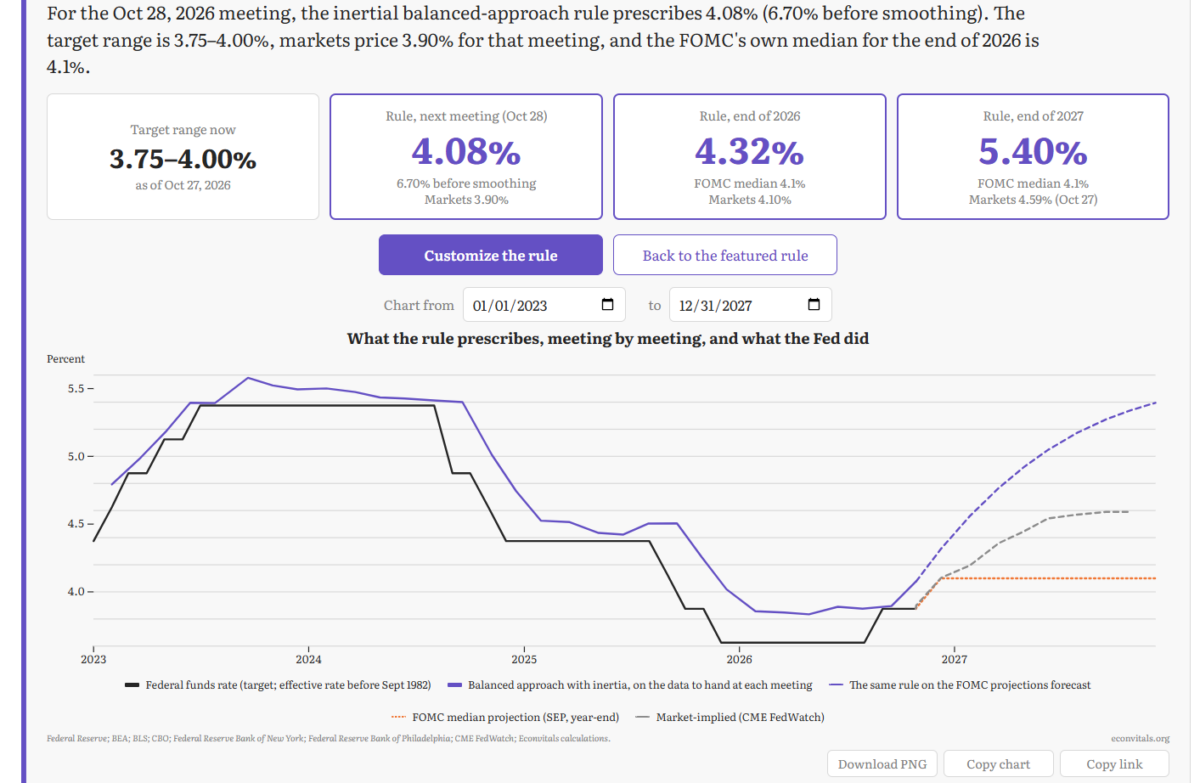
Source: EconVitals, accessed 10/28/2026.
The implication that current rates are too low vis a vis the Taylor rule is general; here’s the Atlanta Fed’s Taylor rule app as of today:
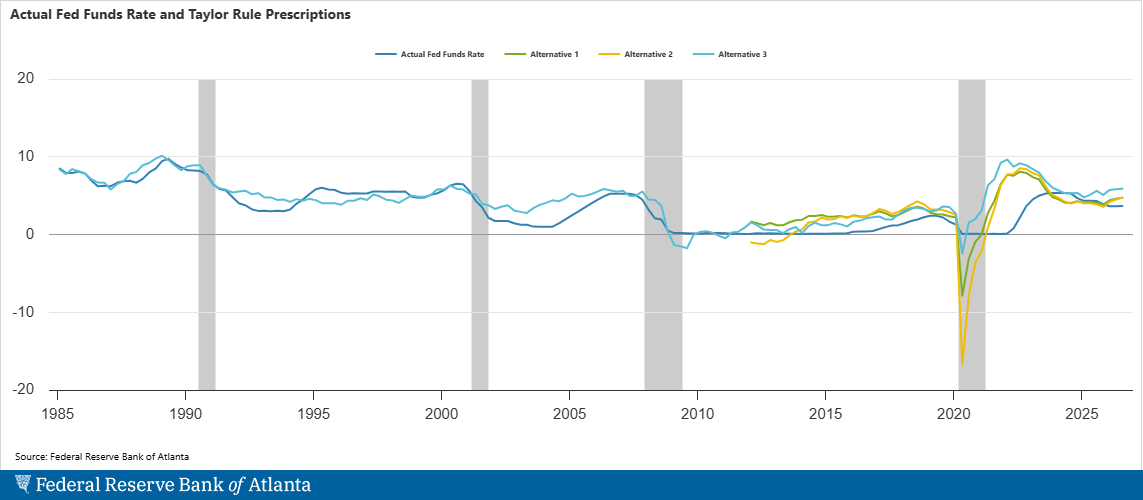
Source: Atlanta Fed, accessed 10/28/2026.
Headline from The Hill says it all:
“Federal Reserve holds interest rates steady in face of persistent inflation”
https://thehill.com/business/6174753-fed-interest-rates-decision-inflation/
The Fed had passed on hiking rates today for a political reason. That reason is to avoid giving the impression of engaging in politics – to one guy who has bullied the Fed.
A 25 basis-point difference for 6 weeks isn’t going to matter much to growth nor to inflation. However, in the period since Nixon, Fed watchers have been able to look at the record of Fed rate adjustments and see that election timing didn’t matter. Heck, ask the ghost of President Bush I.
As of today there is an obvious case of the Fed timing a rate decision to accommodate politics. That’s who we are now.
Nixonian indeed. But hey smiling Kevin DOW36000 Hassett assures us that inflation will fall very quickly.
But is raising interest rates really a good thing to do in this case? After all, this is largely government-induced inflation via tariffs and war. That’s not the same thing as a demand-driven inflation. My thought experiment is along the lines of: if the government decided to impose a tax on all purchases of everything of 0.5%, increasing by 0.5%/month, that would, in effect, bring about a 6%+ inflation rate, but raising interest rates to combat that would just be raising the price of debt in addition to the price of everything else, not fixing the underlying problem.
I really don’t know, would welcome some education on this point.
That’s an excellent point. Interest rates are a demand management tool.
The Fed has a problem. Its theory of operation relies heavily on inflation expectations, without regard to the source of inflation. The approach adopted during Powell’s tenure, and so far not replaced, involves bringing average inflation to 2% over the medium term, to maintain confidence in the 2% target. Five years of above-target inflation, fiscal, trade, immigration and military policies which induce inflation, GDP above potential and rates below what the Taylor rule prescribe amount to a formula for immediate rate hikes, to bring inflation below 2% for an extended period. The supply-side nature of inflation is a serious issue, but not one which matters under the Fed’s current operating rules.
Warsh has announced several review efforts, which may result in the adoption of new rules of monetary operation, but they haven’t produced results yet.
Personally, I think the whole Lucas-based theoretical system leaves a lot to be desired. There’s good evidence the majority of the public doesn’t even know what the Fed’s inflation target is, much less how the average over time is supposed to work. How expectations are influenced by a system most people don’t know exists has never been explained.
One thing that is clear, though, is that central banks which give in to political pressure lose control of inflation. We often hear that LBJ’s guns-and-butter fiscal policy, an oil shock and naive Keynsianism led to the inflation of the 1970s. That leaves out the fact that Nixon had a deal with the Fed Chair to keep rates low. We’d probably have suffered inflation due to fiscal expansion, and the Arab oil embargo in any case, but the earlier corruption of monetary policy very likely made it worse.
Now, we see the White House harassing the Fed and its various officers in an effort to corrupt monetary policy, and the Fed knuckling under, just a bit. Not healthy. Yesterday, the Fed had an opportunity to fly the flag. Instead, it did nothing.
I think “Not Trampis” has it right – it’s more about credibility than economics. The reality is that the fed sets one little (insignificant) rate, and the markets sets the rest. But the markets will take serious what the Fed does if they act rationally and consistently. If that is not the case then the Fed becomes part of the problem not the solution.
Yep’er. They can’t ignore their own rationale when it suits them and expect the public to maintain faith.
These are really clear explanations, thanks!
Observing federal reserve balance sheet trend since April 2026 the balance sheet has not added (QE) as much as earlier in 2026.
It seems the FOMC wants to lose public credibility