Key indicators followed by the NBER Business Cycle Dating Committee, as well as alternative indicators:
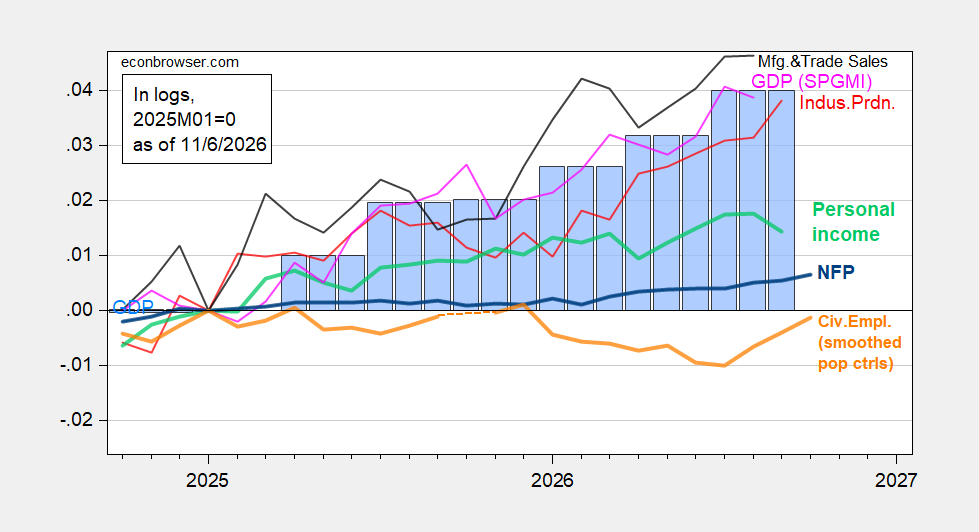
Figure 1: NFP employment (bold blue), civilian employment with smoothed population controls (bold orange), industrial production (red), personal income excluding current transfers in Ch.2017$ (bold light green), manufacturing and trade sales in Ch.2017$ (black), and monthly GDP in Ch.2017$ (pink), GDP (blue bars), all log normalized to 2025M01=0. Source: BLS via FRED, BLS, Federal Reserve, BEA 2026Q3 advance release, S&P Global Market Insights (nee Macroeconomic Advisers, IHS Markit) (10/2/2026 release), and author’s calculations.
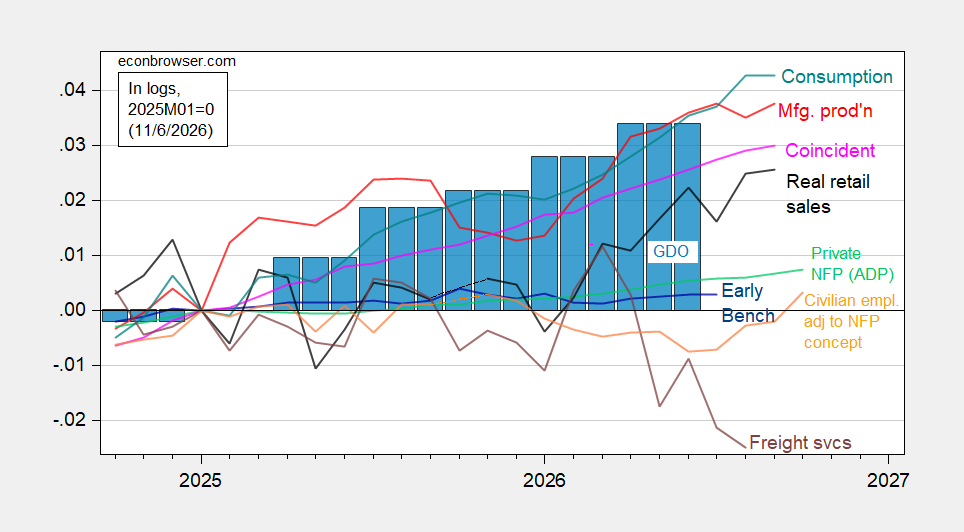
Figure 2: Civilian employment adjusted to NFP concept smoothed population controls, using experimental controls for 2025 (bold orange), manufacturing production (red), ADP private nonfarm payroll employment (light green), real retail sales, CPI deflated (black), freight services indexes (brown), and coincident index in Ch.2017$ (pink), GDO (blue bars), all log normalized to 2025M01=0. Source: BLS, ADP via FRED, Philadelphia Fed, Philadelphia Fed, Bureau of Transportation Statistics, Federal Reserve via FRED, BEA 2026Q3 advance release, and author’s calculations.
All measures of employment (BLS CES, BLS CPS, and ADP) are now rising, in contrast to 2026H1, although not at the pace of output. However, consumption and retail sales were flat in September, while personal income fell.
Other indicators of the labor market:
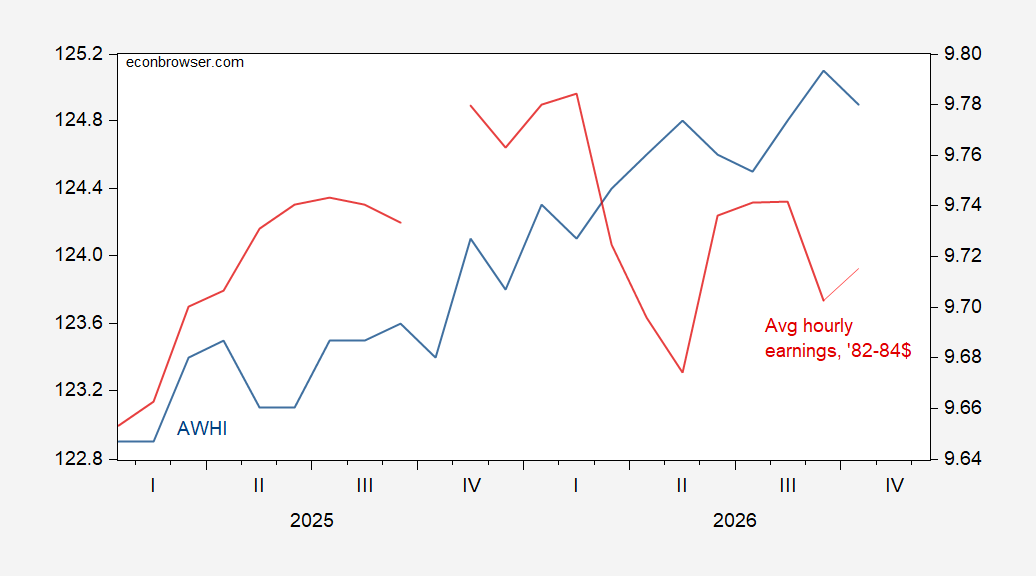
Figure 3: Aggregate weekly hours index (blue, left log scale), average hourly earnings in 1982-84$ (red, right scale). October 2026 average hourly earnings observation is based on CPI nowcast. Source: BLS, Cleveland Fed, and author’s calculations.
When the overall economy is doing relatively well while household spending and income is flat, some combination of business and government activity accounts for the healthy look of top-line data. Data center investment, transfers from households to oil companies and war are a good fit. AI investment is looking shakey, as is the war, though war spending is likely to persist for years, as weapons stockpiles are replenished. The transfer to oil companies, when it ends, will give households more to spend elsewhere.
Here’s a look at some broad financial indicators, most of which look OK.
Bank credit growth is modest:
https://fred.stlouisfed.org/graph/?g=20BMq
Corporate bonds issuance is modest:
https://fred.stlouisfed.org/graph/?g=20BMX
Corporate debt/equity ratio is low:
https://fred.stlouisfed.org/graph/?g=20BN0
The debt/equity ratio is eroding as I write this, due to deflation of AI-sector equity values. Full-economy debt metrics hide the concentration of borrowing by the AI sector and excludes all the special financing trickery being used by the tech sector. In other words, financial risk is higher than the broad metrics indicate.
There’s lots more, but I’m gonna spare you for now.
Well, Susie Wiles is out. Trump learned nothing from his thumping and doubles down on the crazy by replacing Wiles with one of the most despicable people in his administration, Stephen Miller.
Here are the cabinet and top executive officials Trump has fired: Kristi Noem, Pam Bondi, Tulsi Gabbard, Lori Chavez-DeRemer, Trisha McLaughlin, Harmeet Dhillon, Katie Zacharia and now Susie Wiles.
Hmm. Coincidence?
Suzie reportedly offered to “make it easy” for the toddler-in-chief by resigning. There’s no way in which she is to blame for Republican losses, because those losses were policy-driven and she has been focused on process. She is, however, eminently employable outside of government. Leaving while her old cronies are still in power is two years of money in the bank.
Stephen Miller, on the other hand, is all about policy. This changing of the guard, in addition to being another example of misogyny, also represents a refusal to accept that voters have rejected the toddler’s policies. Miller has been with the toddler since 2016, and has his fingerprints in every bad decision the toddler has made. Miller stays? Get ready for more bad decisions.
One more happy irony from the mid-terms elections…
With Texas now in Democratic hands, and Democrats aware that AI being all “move fast and break things” made voters really angry, where are the tech bros going to go? The tech bros kept thundering about moving out of California and heading to Texas. Texas already has the second-highest number of data centers, right behind Virginia. Virginia moved to stop new data centers from being built before the election. Now, Texas is going to do the same.
So, tech bros, leave California. Go ahead. Guam, maybe? Or the vacuum of space, like Elon wants, ’cause heat dissipates so quickly in a vacuum.
Spoiled brats, just like the finance guys who endlessly threaten to leave NYC because of taxes, but never actually leave.
Ironically, the Democrats may save these techbros from themselves. As it is, each of them is spending a trillion dollars because all the other guys are spending a trillion dollars in a race to keep ahead of each other. If the Democrats slam the brakes on data centers, they will all be spending at a more leisurely, sane pace. It’s an addiction intervention, cutting off their cocaine supply. They should thank us.