Suppose the AI capital investment boom recedes as asset valuations deflate. Some thoughts on implications.
First, as has been well discussed, the capital investment surge is offset — in terms of GDP — to a large extent by imports. In an accounting sense, this is shown in Figure 1.
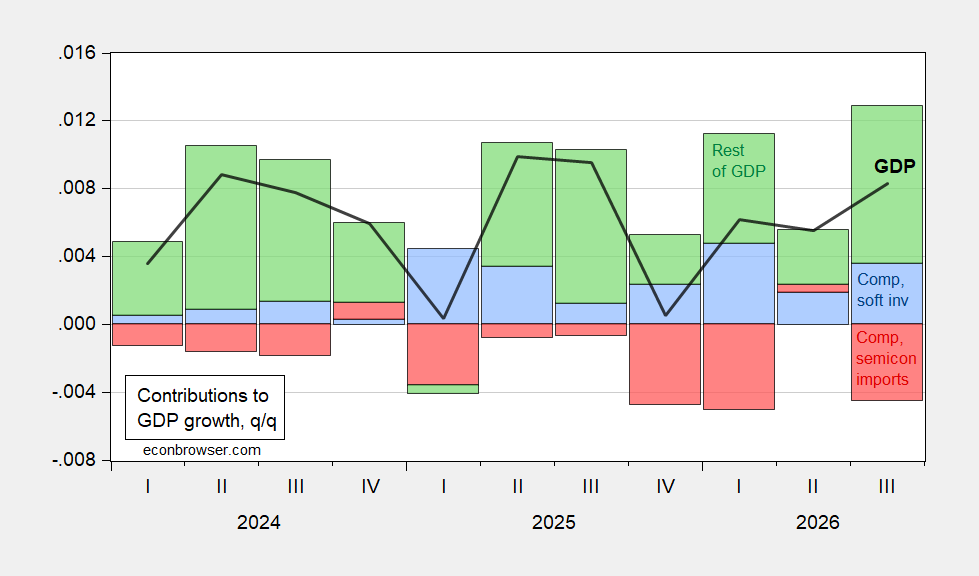
Figure 1: Quarter on Quarter GDP growth (black line), contributions to quarter on quarter GDP growth from computer and software investment (blue bar), from imports of computers, peripherals, and semiconductors (red bar), rest of GP (green bar) (all not annualized). Source: BEA, author’s calculations.
While data center construction is not included in the capital expenditure component, adding it in through 2025 (the extent of the available data) would not change the overall picture.
However, in order to assess what would happen to the economy overall, at the very least, one would want to think about Keynesian multipliers (from investment, from imports). If the multipliers are about the same for the two categories, then we’re close to a wash on an end to the boom, at least GDP-wise.
On the other hand, the capex boom is being driven by great expectations regarding the payoff from AI. If expectations are reduced, by either the collision of spending plans vs. financing abilities, or by changes in the perceived policy environment, then asset prices will decline, resulting in a decline in consumption, relative to what would have otherwise occurred.
Since I have no crystal ball regarding what will happen to AI-related asset prices, I’ll just take as a benchmark what happens if there’s no recovery in Q4 in stock market capitalization. Then household net worth will decline, implying (holding all else constant) a slowdown in consumption growth.
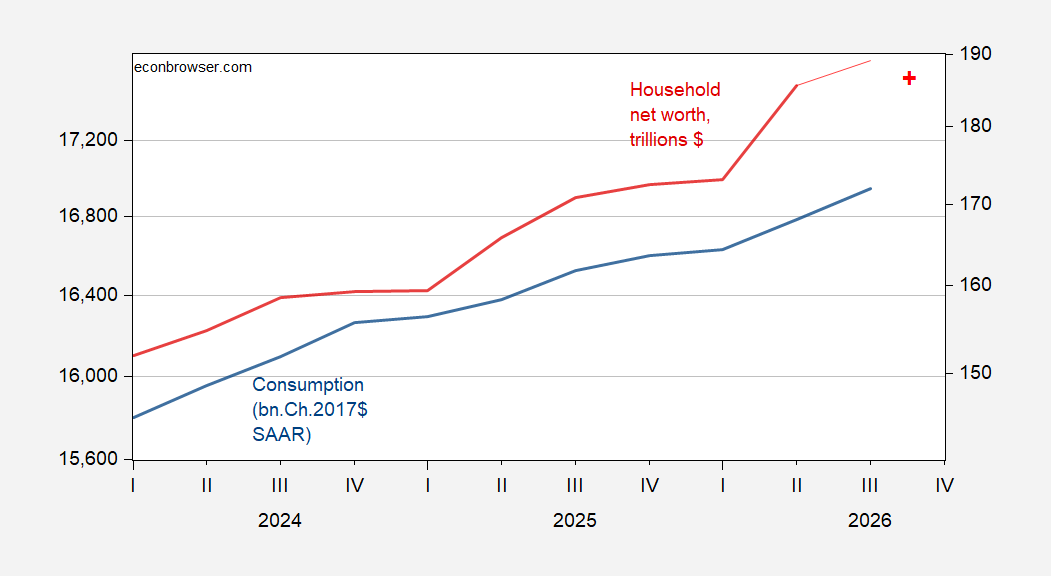
Figure 2: Consumption, in bn.Ch.2017$, SAAR (blue, left log scale), household net worth in trillions of $ (bold dark red, right log scale), implied net worth assuming non-equity net worth remains constant, $3.4 trillion increase in stock market capitalization (red line, right log scale), $3 trillion reduction (red +). Source: BEA, Federal Reserve Flow of Funds (bold red), author’s calculations.
Bigot and Espic (2026) estimate that about half of the 2% consumption growth recorded in 2025 was due to an increase in equity market wealth. This estimate is based upon a marginal propensity to consume out of wealth of about 0.027 (2.7 cents per dollar equity wealth).
With consumption growing at 2.5% in the year ending Q3, the knock on effect would not send GDP growth negative, holding all else constant. And that seems to be a sort of consensus. That being said, a disorderly adjustment in financial markets in response to an AI recalibration is likely to bring elevated uncertainty, which itself depresses aggregate demand. So who knows.