Today, in “Democrats Promised to Fix the Economy. What Can They Really Do?” (WSJ), Grossman, Whalen and Bade argue that Democrats can do very little to lower the cost of living.
Whether they can [make the economy work] isn’t assured, despite the party’s pending control of the House and Senate. Many demands are beyond the reach of lawmakers to fix. The main tools of Congress, taxes and spending, are limited and slow-moving—and lawmakers still face Trump’s veto.
The new majority may struggle to stop the war in Iran, which has driven up energy prices in the months since President Trump’s decision to attack. Gasoline prices, largely set by global energy markets, could remain high even if the war ends.
In the Senate, Democrats are teeing up votes to repeal Trump’s tariffs on Canada, part of his global trade war that has contributed to rising prices. Yet they acknowledge that stricter limits to presidential tariff authority—which Trump has taken to its limits worldwide—could be vetoed and would likely have to wait for another administration.
I’ll just make one observations, based upon the top item on my list of cost of living reduction measures :
The effective tariff rate is now down from the highs of the past, in part through the failure of subsequently implemented measures to make up for the “reciprocal tariffs” implemented in 2025. Further backsliding (despite the 301 cases wending their way through).
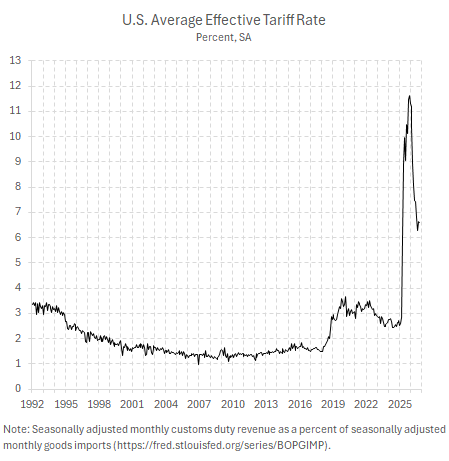
Source: Pawel Skrzypczynski.
If Congress can pressure the administration on this widely unpopular (and possibly legally contentious) policy program, one major price pressure will be mitigated (although some effects will linger, such as the hit to fertilizer prices hitting agriculture around the the world).
I’m less sanguine about Congressional pressure to mitigate the Administration’s anti-immigration program (conflicting signals from Trump, but talk is cheap), as well as coming to a resolution of passage through the Strait of Hormuz. But who knows.
We will have divided government for the next two years. Divided government mostly means that things don’t happen, not that they do happen. Democrats will be able to pass a limited amount of legislation, because Republicans can filibuster non-budget bills. They were previously able to prevent Republicans from passing non-budget bills, mostly because Republicans were not interested in legislation that Democrats would vote for. So while the election has wrought change, that change is mostly not in legislation passed into law.
Democrats will be wise not to promise much, other than restraining the felon-in-chief where they can. They can pass legislation which will be vetoed, as a way of telling the public what’s possible with the felon (and Republican presidents generally) is not in office.
There’s a rhetorical issue at work. Democrats need to promise no more than they can deliver for the next two years, so that as little blame as possible falls on them for any hardship during that time. Republicans will naturally tell voters that Democrats are to blame for things over which Democrats have no control.
There’s another rhetorical issue at work, one which Duncan Black (Eschaton blog) mentions frequently. The mainstream press holds Democrats to a different set of standards than Republicans. If course Republicans lie and engage in slander and race-baiting; not worth mentioning. Republicans also seem able to remain in office when unseemly sexual behavior is uncovered. If Democrats engage in unseemly sexual behavior, there’s no end of Tsk-tsking in the press.
In the case of the WSJ article, did Democrats actually promise better economic outcomes? Or is that just a typically pro-Republican newspaper loading Democrats down with a burden?
Yes, Democrats should promise no more than they can deliver, but the WSJ should tell the truth about what promises have been made
Democrats win big, then oil prices fall hard. Brent fell 16% last week and is down nearly 5% today. The election may not be the driving factor in the price decline, but even so, the public could get that impression.
A likely explanation for the timing is that either Iran, the felon-in-chief, or both, were holding back from negotiating a resolution until they had a clearer idea of their own post-election leverage. With election results in, all parties have a clearer idea of the state of play, and it’s time to move forward.
Trump says no more bombing as long as negotiations are underway. Iran says Hormuz can be opened in 2 days, as long as the U.S. is willing to accept Iran’s terms, which are much like the terms agreed to in April, before the U.S. broke the ceasefire. Oil traders say “sell”.
If the felon-in-chief doesn’t allow a deal, oil prices will bounce and he’ll get the blame. That has been the case for some time, and the felon refused to budge right up until his Party got slaughtered in the election, so maybe he’ll drag his feet again – who knows?
It’s my understanding that supply and demand for crude oil has finally gotten into balance. Supply from the gulf has recovered substantially and supply from outside the gulf has increased substantially.
The increase in price up to the US election was probably driven by fear that either Trump or Iran would do something bad to try and influence the election. That fear drops the day after the election and prices go back towards what it should be if purely driven by supply and demand.