Today we are pleased to present a guest contribution written by Ayhan Kose and Franziska Ohnsorge, respectively Director and Manager in the World Bank’s Prospects Group. The findings, interpretations, and conclusions expressed in this blog are entirely those of the authors. They do not necessarily represent the views of the World Bank, its Executive Directors, or the countries they represent.
Author Archives: Menzie Chinn
Covid-19 Fatalities, Excess Fatalities, Forecasts
From CDC, Atlantic/Covid Tracking Project, and IHME:
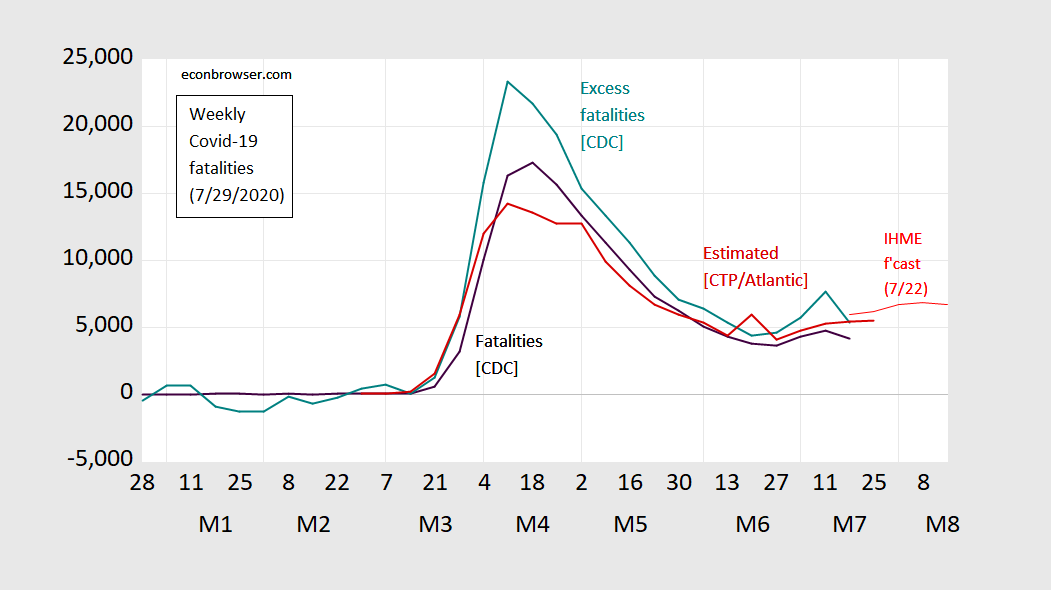
Figure 1: Weekly fatalities due to Covid-19 as reported to CDC for weeks ending on indicated dates (black), excess fatalities calculated as actual minus expected (teal), fatalities as tabulated by The Covid Tracking Project/Atlantic (dark red), IHME forecast (light red), all on log scale. Source: CDC 7/29/2020 vintage, Covid Tracking Project/Atlantic accessed 7/29/2020, IHME forecast of 7/22/2020, and author’s calculations.
Two observations: (1) the unofficial count is rising; (2) recent weeks’ (about a month’s worth) CDC data are subject to severe undercounting, so inferring recent trends on the basis of CDC data is not advisable.
From week ending February 29th through the week ending June 27th, the cumulative CDC fatality tally is 127.3 thousand. Cumulative excess fatalities is 164.8 thousand, implying an additional 37.5 thousand Covid-19 fatalities above the official tally over this period.
Covid-19 Fatalities per Million
See figure below:
Guest Contribution: “International Factor Payments and the Pandemic”
Today we are fortunate to have as a guest contributor Joseph Joyce, Professor of Economics and M. Margaret Ball Professor of International Relations at Wellesley College.
The Dollar’s Value under Pressure
The dollar’s value has come under pressure recently. Does this mean the dollar’s role as a key international currency is at threat?
Collapsing Confidence in Public Health/Macroeconomic Management
Consumer sentiment declines; economic policy uncertainty on the rise; real interest rates declining. It’s all in the graph below.
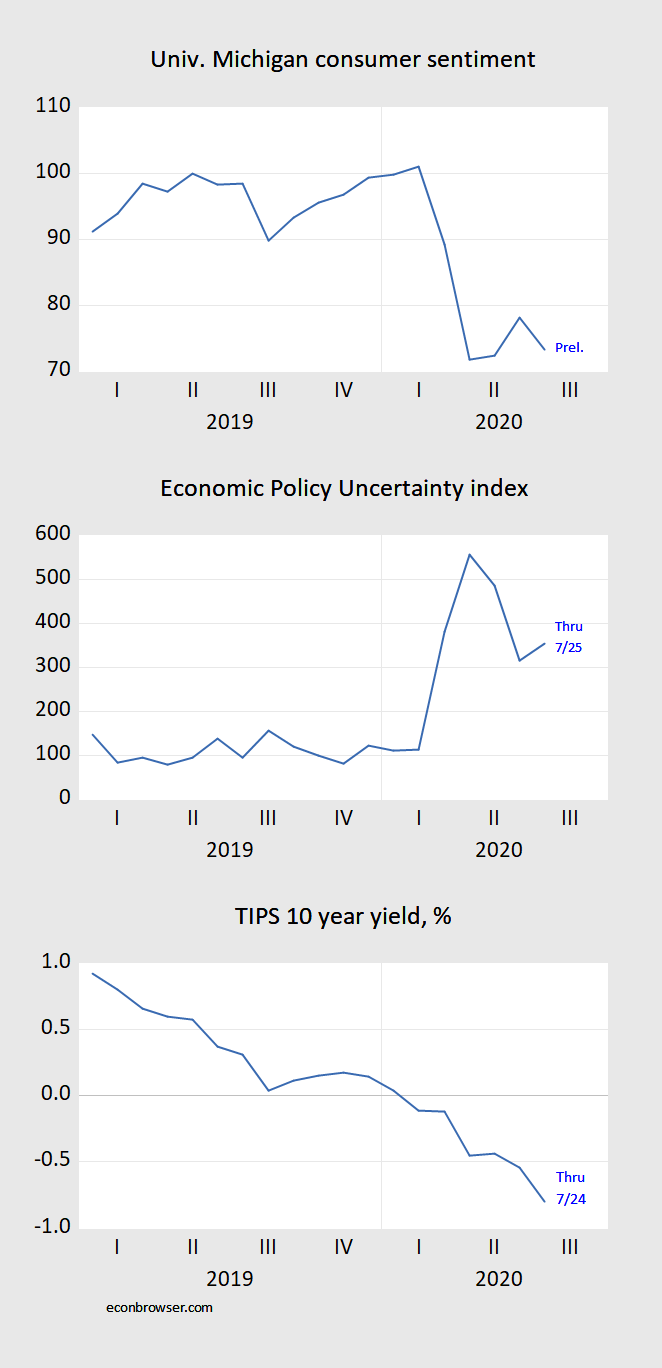
Figure 1: University of Michigan consumer sentiment (top), Economic Policy Uncertainty Index (middle), TIPS 10 year constant maturity yield, % (bottom). U Mich sentiment is preliminary for July, EPU in July is thru 7/25/2020, TIPS in July is thru 7/24/2020. Source: University of Michigan and Treasury via FRED, policyuncertainty.com.
Congressional Research Service: “Fiscal Policy and Recovery from the COVID19 Recession”
From the summary of the document, which reviews the literature and current macroeconomic state of play. Some key findings are germane to the current intra-Republican party debate over how to proceed with the current recovery package. I know it is the triump of hope over experience to think they will accede to expertise, but here goes.
Business Cycle Indicators, 24 July 2020
Reverse radical or V-ish (or W?)
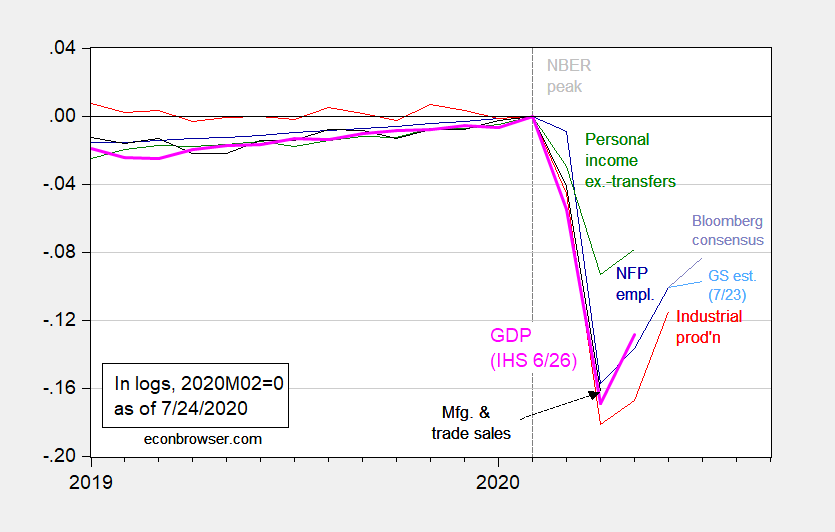
Figure 1: Nonfarm payroll employment (blue), industrial production (red), personal income excluding transfers in Ch.2012$ (green), manufacturing and trade sales in Ch.2012$ (black), and monthly GDP in Ch.2012$ (pink), Bloomberg consensus estimate at 7/24 (blue gray), Goldman Sachs Employment Tracker estimate based on data thru 7/7 (sky blue), all log normalized to 2019M02=0. Source: BLS, Federal Reserve, BEA, via FRED, Macroeconomic Advisers (6/26 release), Bloomberg, Goldman Sachs (7/23/2020), NBER, and author’s calculations.
Guest Contribution: “Is China’s economic growth lower than officially announced?”
Today, we are fortunate to present a guest contribution written by Laurent Ferrara (SKEMA Business School and QuantCube Technology), Alice Froidevaux (QuantCube Technology) and Thanh-Long Huynh (QuantCube Technology).
A Reminder: The Advance Estimate of Q2 GDP Growth Is…an Estimate
For instance, Goldman Sachs presents two forecasts for Q2 growth (SAAR): one for advance, and one for final. As of 7/19, the forecast of the advance release was -29.0%, and final was -33.0% (Seasonally Adjusted at Annual Rates, SAAR). Something to remember when contemplating the near future.