Around midmonth I often check the Wisconsin Department of Workforce Development to see their reporting of state employment statistics in advance of the BLS release (tomorrow, for the September figures). Oddly, today, the DWD released statistics for September, without any detailed tables, in an abbreviated press release (compare with last month’s release to see what I’m saying). In order to figure out the revised August numbers (and actual level of September preliminary numbers) one had to go back to earlier releases and add and subtract.
Author Archives: Menzie Chinn
“We’re Doing a Great Job” in Puerto Rico
I just saw the President re-state this point in a press conference with the Governor of Puerto Rico. He also just said (if I heard it right) that the Federal response deserves a “10” score. Here are some key graphs.
The Association between China-based Job Displacement and Drug Overdose Deaths
A recent White House internal memo has suggested a causal relationship between the decline in manufacturing jobs and a host of social ills, including the opioid epidemic. Here is a graphical/geographic comparison of two variables that are related to these factors.
Recession Watch, October 2017
Where do we stand?
Guest Contribution: “10 Lessons for China 10 years after the subprime financial crisis “
Today we are fortunate to present a guest contribution written by Alessandro Rebucci, Associate Professor, and Jiatao Liu, at the Carey School of Business at Johns Hopkins University.
Continue reading
A Curiously Non-Quantitative Assessment of Deregulation Effects on Economic Growth
And a funny choice of citations.
Two Pictures from the September Employment Situation
Consensus (Bloomberg) had been for +100,000 (range 0 to 140,000); print was -33,000.
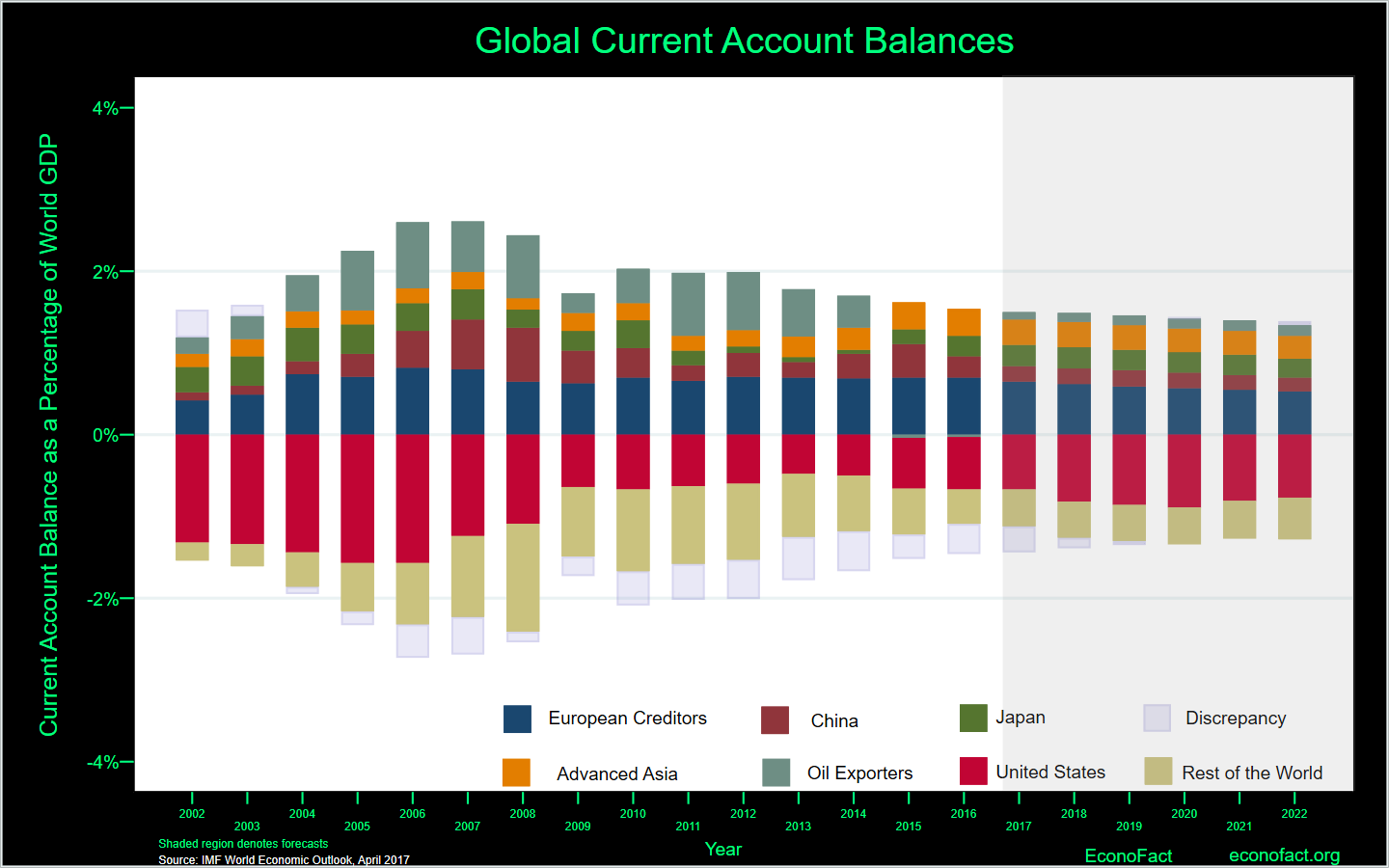
EconoFact: “Are Global Imbalances a Source of Concern?”
That’s the title of a new EconoFact piece. Here is the key depiction of some key current account balances, past and (possibly) future.
Mass Shooting Casualties in America as of October 2
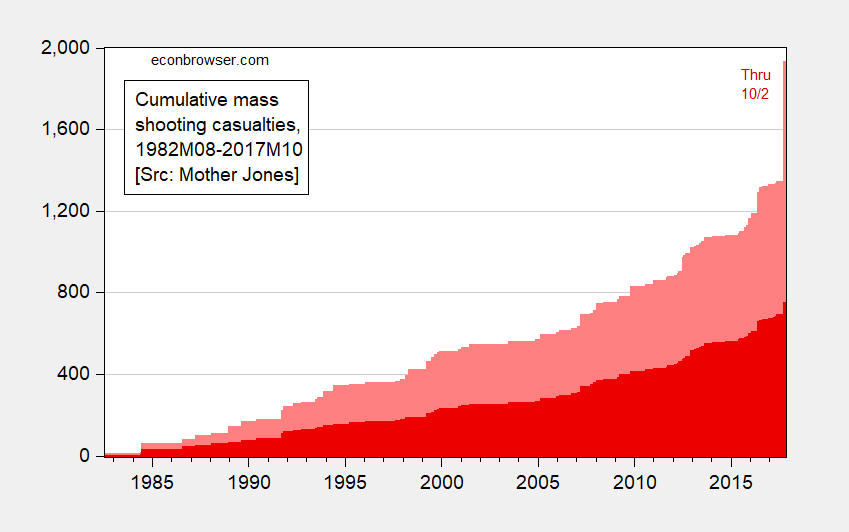
Figure 1: Cumulative sum of mass shooting casualties, beginning in 1982M08; deaths (red), wounded (pink). October observation for data through 10/2. Source: Mother Jones.
Return of the Tooth Fairies
(as referenced by Larry Summers, quoted in this post).
As I watched Secretary Mnuchin on Meet the Press (before discussing his taxpayer funded trip to view the recent eclipse) state :
…the president is not going to sign something that he believes is going to increase the deficit.
I was struck by an overwhelming sense of déjà vu. Of course, the caveat “he believes” is important. Mnuchin mentions “dynamic scoring”, but most economists agree that it is not plausible that the tax cuts as currently sketched out would lead to a revenue neutral outcome.