Wisconsin continues to lag the other regional economies
Author Archives: Menzie Chinn
Time for Some Traffic
Total vehicle miles driven in the United States have not re-attained pre-recession peaks.
“The Jeep Plant Mitt Romney Said Was Moving to China Is Hiring 1,000 Workers in Ohio”
That’s the point of a Bloomberg article:
Anyway, that Jeep plant? It didn’t move to China. And it’s actually doing quite well. No, scratch that: It’s going gangbusters. Demand for Jeeps is so high that Chrysler workers are clocking 60 hours a week and still can’t keep up.
Figure 1 illustrates the context.
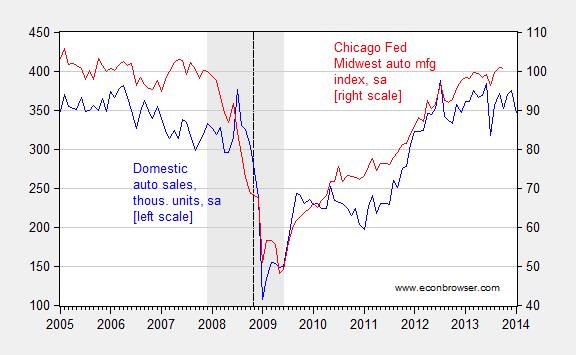
Figure 1: Auto and motor vehicle sales, thousands of units (blue, left scale), and Chicago Fed motor vehicle manufacturing index, 2007=100 (red, right scale), both seasonally adjusted. NBER defined recession dates shaded gray. Vertical dashed line at “Let Detroit Go Bankrupt”. Source: FRED.
Update, 3/16, 6PM Pacific: Reader Patrick R. Sullivan writes:
Looking at Figure 1, I’d say that sales of cars are pathetic. Only back to the level of 2005. And that after years of far below normal sales figures, which should have resulted in pent-up demand. This is nothing to brag about for this economy.
I think it is useful when thinking about production trends to consider the end-use of the product. One interesting point is that vehicle miles driven has declined, and is essentially flat, despite the fact that GDP has exceeded pre-recession peaks. This is shown in Figure 2.
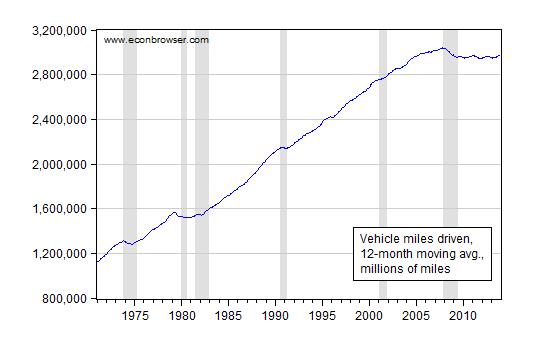
Figure 2: Vehicle miles driven, 12 month moving average, in millions. NBER defined recession dates shaded gray. Source: Federal Highway Administration via FRED.
Wisconsin January Private Nonfarm Payroll Employment Flat
The rest of the Nation continues to grow.
The Wisconsin Department of Workforce Development has released preliminary January employment figures, incorporating incorporating backward revisions to earlier months’ data. [1]
“Fiscal Policy Re-Assessed”
From an article in the La Follette Policy Review:
In 2010 as the Great Recession was releasing its grip on the world’s economy, the United Kingdom’s newly elected Conservative-Liberal government embarked upon a policy of fiscal consolidation—higher taxes and drastically reduced spending—with the aim of stabilizing the ratio of government debt to gross domestic product (GDP) while spurring economic growth….
Guest Contribution: “Regional Trade Agreements with Labor Clauses”
The effects on labor standards and trade
Today we are fortunate to have a guest contribution written by Isao Kamata, Assistant Professor of Public Affairs and Economics at the University of Wisconsin, Madison. This post is based upon this working paper; the paper also circulates as a Research Institute of Economy, Trade and Industry (RIETI) discussion paper.
Economic Report of the President, 2014
Released today, available here.
The Geographical Dispersion of U.S. Inflation
Most accounts of inflation focus on national statistics. While the national series is still low, in some select locations, it’s even lower.
GDP Forecasts: Administration, CBO, SPF, and ARIMA
Accompanying the release of the President’s budget (link corrected 3/5 1:20) was the Administration’s forecasts, including forecasts of GDP. These forecasts are produced by the Troika (Treasury, CEA, OMB). Some observers have asked “Is the White House’s 3.1% growth forecast still too rosy?”. Time for some comparisons.
Interpreting the Great Recession in a Classical Framework
If a collapse in aggregate demand is not at fault, then was an aggregate supply shift? A quick-and-dirty evaluation using some back-of-the-envelope calculations