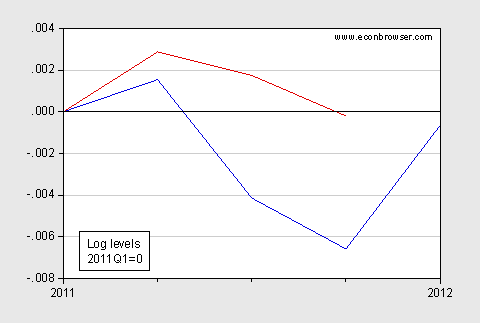
The news is well-known now: There the UK is in the first double dip recession since 1975 thanks to among other things the government’s contractionary fiscal policies. This recovery is in fact worse than that of the Great Depression [Macroscope] Here are three other observations that might not be so obvious: (1) Growth has been lackluster ever since the election of the coalition government in May 2010; (2) growth under the program of austerity has compared poorly against the (admittedly insufficiently stimulative) fiscal policy framework in the US, and; (3) UK GDP growth has been lackluster even with the depreciated pound, which is interesting given that exchange rates can act as a shock absorber.
Author Archives: Menzie Chinn
No Need to Wait until June 5
From WisPolitics today:
Walker warned that job losses might again ramp up in Wisconsin if either Barrett or Falk are elected in the June 5 recall…
Labor Market Interventions and Learning from Other Countries
As documented in Box 1-2 in the IMF’s latest World Economic Outlook, unemployment in the advanced economies remained persistently high. That brings to the fore how to best deal with adjusting the labor force so as to bring down structural unemployment (although obviously higher aggregate demand would help). In my view, there is the “are there no poorhouses?” approach (cut unemployment benefits, etc. and thus reduce the natural rate of unemployment). The other is to use evidence-based approaches to improve the labor force quality, and improve job matching, thereby decreasing structural unemployment. This alternative is discussed in a recent La Follette Policy Report, by Robert Haveman, Carolyn Heinrich, and Timothy Smeeding, entitled “Policy Responses to the Recent
Poor Performance of the U.S. Labor Market”:
What Are These Two Time Series?
Gasoline Price Trends According to Futures
From the WSJ yesterday:
After a sizzling start to the year, gasoline futures prices are sliding, easing pressures on drivers and the U.S. economy and raising the prospect that prices at the pump could be headed lower still.
Recovery and Rebalancing
Several new items regarding assessing recoveries, here and abroad; and the prospects for rebalancing.
A Little Less Unscorable
In a previous post, I noted that Governor Romney’s budget plan was essentially unscorable (as he himself stated [0]) because he was so vague on the tax expenditures he was going to eliminate. That fog of obfuscation lifted slightly yesterday, with Governor Romney’s not-for-public attribution comments to donors. From Sara Murray, in the WSJ:
The current recovery in historical context
Or why Ed Lazear should have heeded R&R a bit more.
From “Credit: A Starring Role in the Downturn,” by Òscar Jordà, based on an examination of 14 advanced economies over 140 years:
We are unlikely to learn how the United States will recover from the Great Recession by examining other post-World War II downturns. In the United States, the past six decades have completely lacked another financial event like the one experienced from 2007 to 2009. …
Some Implications of the Trade Release
So-so news, and how we can sustain net export growth
From BEA/Census:
The U.S. Census Bureau and the U.S. Bureau of Economic Analysis, through the Department of
Commerce, announced today that total February exports of $181.2 billion and imports of $227.2
billion resulted in a goods and services deficit of $46.0 billion, down from $52.5 billion in
January, revised. February exports were $0.2 billion more than January exports of $180.9 billion.
February imports were $6.3 billion less than January imports of $233.4 billion.
Professor Lazear Doubles Down on 1980/82 = 2007
Professor Lazear on CNBC yesterday reiterates and unhedges his thesis that the causes of the 1980 and 1982 recessions are essentially the same as that of the 2007-09 recession.