The Collapse in Relation to GDP
In an earlier post, I discussed the startling decline in US imports [0]. Brad Setser has also reported on this phenomenon. This decline is not restricted to the United States, as noted in an OECD report released last week (h/t Torsten Slok):
Dow Jones Economic Sentiment Index
Dow Jones has begun publication of a new Economic Sentiment Index, which is based on a text mining analysis of five million news articles referencing the U.S. economy since 1990, rating words such as “recession” and “depression” as negative and “recovery” and “rebound” as positive.
Auto woes open a new chapter
April sales of light vehicles manufactured in North America were down by about a third from the values seen a year ago. And a year ago we were already seeing recession-level values for auto sales.
Some Reflections on CEA Chair Christina Romer’s JEC Testimony
This is a slightly revised version of a piece that appeared on the Washington Post’s The Hearing today.
In her testimony before the Joint Economic Committee today, Dr. Romer, Chair of the CEA, presented an explication of the progress of the financial crisis and the economic downturn, the anticipated effects of the measures undertaken and planned, and the outlook going forward. On most points, we’re in agreement, so I’ll only highlight some key issues of interest.
Further progress for initial claims for unemployment insurance
The Labor Department reported today that initial claims for unemployment insurance fell by 14,000 during the most recent available week. That brings the 4-week average down for the third consecutive week and puts it 3.3% below the peak reached April 9.
Good economic news?
Today’s GDP numbers were about what I was expecting. Although economic activity continued its sharp decline, if we continue to follow the script, things should improve.
Links for 2009-04-28
Washington University Professor James Morley on typical recession shapes and why they suggest we might see a strong recovery.
Harvard Professor Lucian Bebchuk on how to buy troubled assets while avoiding some of the problems pointed out by many analysts.
Oil 101 looks like a useful new book by commodity trader Morgan Downey.
And the Shadow Open Market Committee is back in business.
The Decline in US Imports
I’ve been thinking about trying to convey exactly how startling the drop in U.S. imports has been. First, take a look how much non-oil goods imports (in real terms) have dropped, relative to, for instance, GDP.
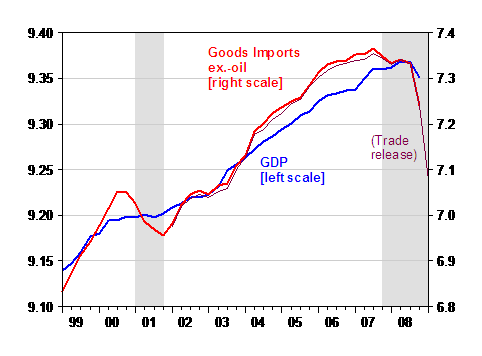
Figure 1: Log GDP (blue, left scale), log goods import ex.-oil from NIPA (red, right scale), estimated from trade release (purple, right scale), all in Ch.2000$, SAAR. 2009q1 estimate is based on actual January and February data and March estimate incorporating continued 5% decline from February. NBER recession dates shaded gray. Source: BEA, GDP final release of 26 March 2009, February trade release, NBER, and author’s calculations.
Oil shocks and recessions
Here I provide some more background on the relation between oil price increases and economic recessions.
Two Books
…and the Financial and Economic Crisis
I don’t read very many books. At least not during the academic year. But I have read two books recently that are quite germane to thinking about the buildup to the financial crisis, and thinking about how to respond to the current economic downturn. The first is Akerlof and Shiller’s Animal Spirits. The second one is actually not yet out — it’s Justin Fox’s The Myth of the Rational Market (I got a prepublication copy; here’s a hint of it). They are both important books, well worth reading.