From Kevin Hassett on Sunday’s Face the Nation:
…let’s start with the [U.Michigan] consumer sentiment number, because that was a number that was very striking to me and to you. I know when it came in very, very low, and what we did is we went to their website and we looked that they actually break it out by political affiliation, so they have it for Democrats, independents, and Republicans. And if you look at it, consumer sentiment at the sort of peak of the Biden inflation, the stagflation was way above 100 and it’s dropped all the way down into the low 30s now, about the lowest it’s ever been for Democrats, but for Republicans it’s held about steady, and if you look at it, independents and Democrats are really highly correlated, which suggests to us that their sample is Democrats, and so if you go to consumer confidence, which is something that’s actually, I think, a more scientific survey, the consumer confidence is consistent with all the other positive numbers we’re seeing right now.
OK, it’s true Democratic/lean Democratic align with Independents in the U.Mich survey:
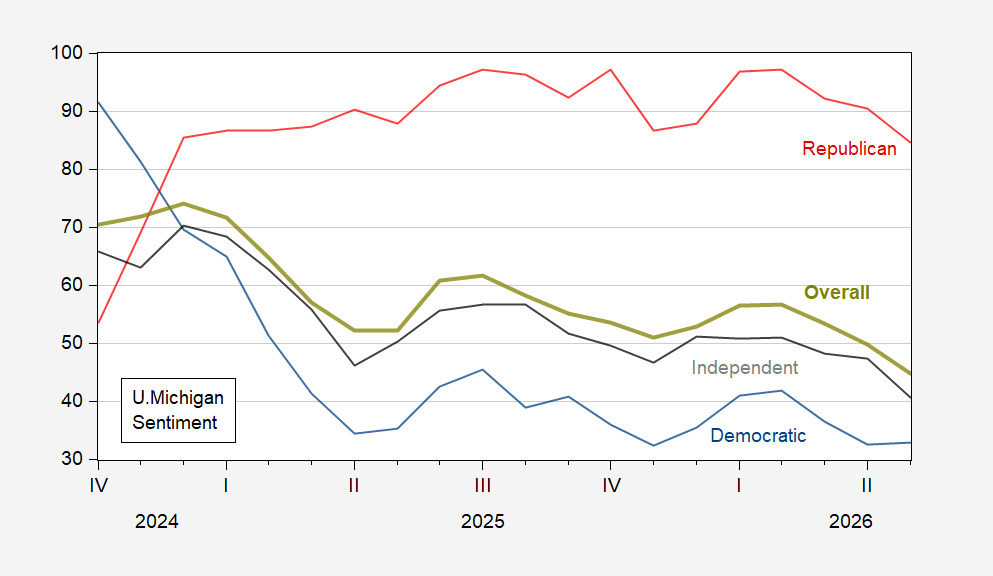
Figure 1: U.Michigan Consumer Sentiment Overall (bold chartreuse), Democratic/lean Democratic (blue), Republican/lean Republican (red), Independent (gray). Source: U.Michigan.
I’m not sure that definitionally makes self-identified Independents as functionally equivalent to Democrats/lean Democratic. Maybe they’re in working off the same information set.
Let’s take Hassett’s means of identifying Democrats as valid; you’d then think we’d see a radically different picture for the Conference Board’s Confidence index. We don’t.
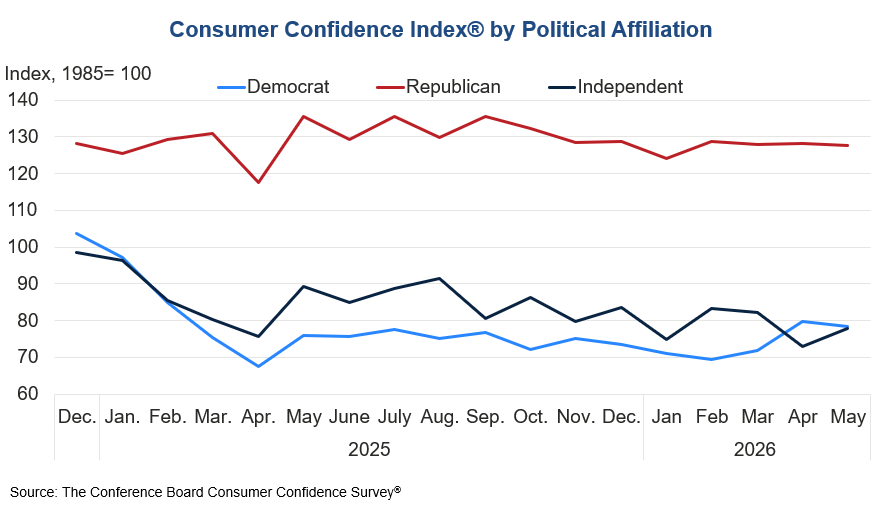
In point of fact, the Independents and Democratic/lean Democratic respondents track each other even more closely. By Hassetts logic, the Conference Board’s index is even more biased than the U.Michigan Surveys of Consumers’ index. The above graph was provided in the article reporting the Conference Board number — so no excuses that it was hidden.
I’ll add this to the following pile:
There is a way of assessing whether weighting is a problem; we can go outside of consumer sentiment surveys for validation. If we look at voter approval of various governmental policies, such as immigration enforcement, housing, tariffs and the war in Iran, approval is very low. Similarly, if we look at issues for which voters hold politicians responsible, such as inflation and affordability, approval is very low. Low approval matches low consumer confidence. So we have reason to think consumer confidence data are not skewed by overweighting Democrats.
We also know that Republicans are generally more approving of current policy than are independents and Democrats, so again, we have reason to think confidence surveys are not overweighted to Democrats.
If Hassett wants to see independents as just Democrats in disguise, let him. All the more fun on election day. Hassett’s “independents are just Democrats” claim is simply desperate spin. He can’t say what the data obviously indicate, that the public knows his his boss’s policies are hurting them, so he just spouts nonsense. That’s his job.
Reality and facts have a liberal slant. So there’s that.
Off topic – corporate debt issuance:
https://www.sifma.org/research/statistics/us-corporate-bonds-statistics
SIFMA reports that corporate issuance in April was up 28% from year ago. Just one month, so maybe a quirk? Nope. Corporate issuance was up 70% in Q1 over Q4:
https://www.sifma.org/research/statistics/research-quarterly-fixed-income-issuance-and-trading
Tech issuance is at a new high, but doesn’t account for the bulk of issuance. However, tech firms have indicated soending plans for this year that suggest tech borrowing will run at a record pace all year. There is aldo a pretty heavy slate of M&A recently, including Union Pacific/Norfolk, Paramount/Warner, Paramount/CNN and JPM’s just-announced $20 billion binge, there’s plenty of non-productive, monopoly-rent-chasing which requires cash.