From BOFIT today:
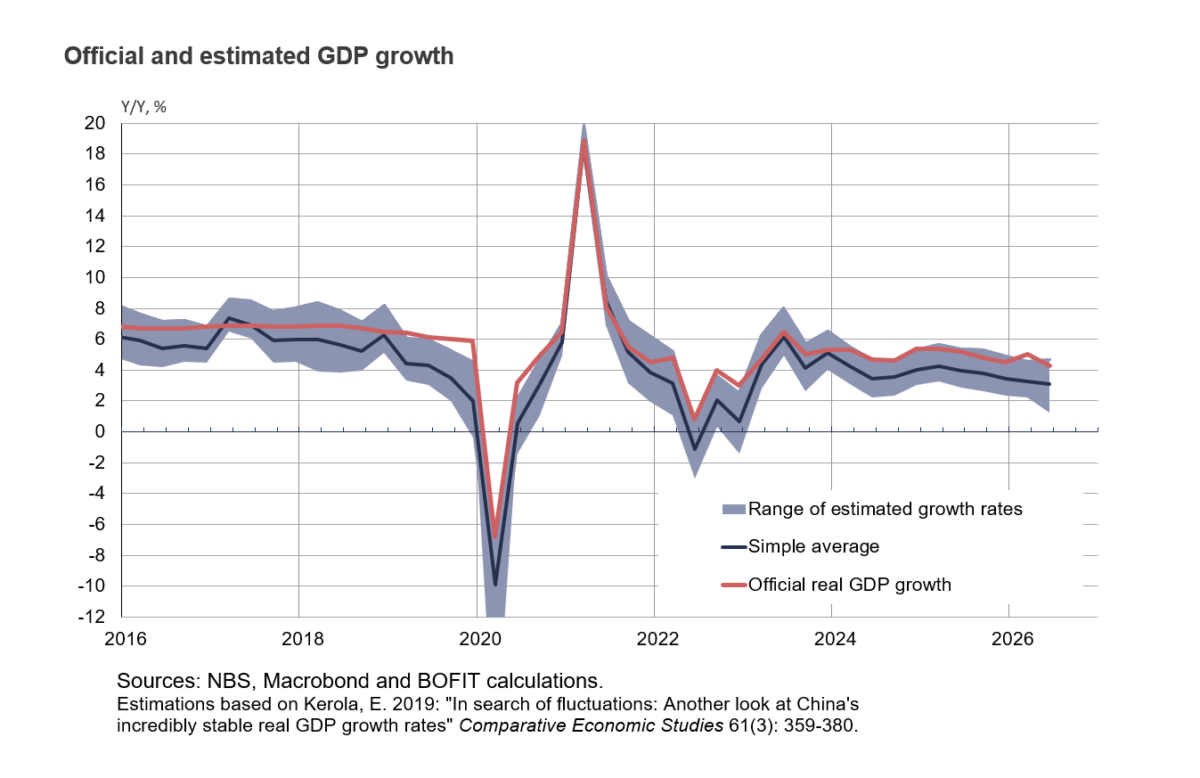
From the analysis:
Official figures show the Chinese economy grew by 4.3 % y-o-y in the second quarter of this year (up 3.6 % q-o-q annually adjusted), missing China’s official 4.5–5 % target range for the year. Weak household demand and lower fixed investment reduced growth from 5 % y-o-y in the first quarter (up 5.3 % q-o-q). BOFIT’s alternative GDP calculations indicate Q2 growth slowed to 3.1 % y-o-y (3.2 % in 1Q). Our estimated alternative GDP growth rate band also widened considerably (1.2–4.7 %). The IMF’s updated World Economic Outlook released earlier this month raised its Chinese GDP growth forecast for 2026 by 0.2 percentage points to 4.6 %, and by 0.1 percentage points to 4.1 % for 2027.
China CAT from the SF Fed which incorporates import data provides estimates only through Q4; it too suggests official above alternative estimates of GDP growth.
Since the Chinese overall population (and working age population) have been decreasing for the past 5 years (about 0.2% per year), these seem like pretty good numbers still. Imagine if US GDP per capita was growing 3% a year!
I’d love to see every GDP graph displayed with a GDP per capita graph (which is a better measure of a nation’s progress IMO).
A question that always needs to be asked is: how much debt is required to generate growth? How much new debt is required to generate new oitput? Total debt matters, but new debt is a key issue for assessing growth. Debt efficiency is a big deal over the medium to long term.
There’s good and bad news. China’s total non-financial debt is near 200% of GDP, but the pace of growth has flattened out considerably over the past decade. That’s to say, recent growth has not come at the cost of piles of new debt. Of course, the old piles of debt are still a big problem, but there’s progress.
https://www.dallasfed.org/research/economics/2025/1223
Reports that Pakistan is working to set up talks between the U.S. and Iran have pulled oil prices down today. Not talks, but efforts to renew talks.
But this is Friday. Friday is when the grifter-in-chief allows some sort of good news to stabilize stocks. Then, on the weekend, when stocks cannot fall, he does dymb things. Monday, prices fall, Tuesday is for TACO.
The pattern isn’t set in stone, but it’s fairly reliable. It’s also evidence that, at some level, he knows his decisions are bad. Otherwise, there wouldn’t be this pattern.
Russia suspends its bond sales:
https://www.briefs.co/news/russia-halts-ofz-auctions-as-rate-outlook-uncertain/
Crud. Where was my head?
I have a guess about why bank deposits are down: oil revenues are down. I don’t have any evidence that slack oil revenues are the reason for a shortfall in deposits, but it would make sense. Timing is right, flow of funds is right. Should have been the first thing I thought.
Another interesting thing is that Putin has made a couple of public takeovers of companies – presumably as a mixture of punishing owners and raising public funds.
Putin’s deal from 25 years ago was that oligarchs got to rob the country of resources, provided they supported him and stayed out of politics. But Putin desperately needs more money, so the kleptocrats are getting nervous and trying to move more wealth out of Russia, before it’s too late.
Furthermore, the raising of sales taxes from 20% to 22% has not increased revenues because more people avoid taxed purchases. Ukraine has been “helping” that transition by attacking Wildberries warehouses. That company is the Russian equivalent of Amazon – and it would be very risky for them to do things “under the table”. The destruction of their warehouses is a 3-for-1. It undermines Russian tax revenues, harm the owners and creates another reason for Russians to hate the war.
Yep. Interesting as all get out. Probably not the end of the world for Russia’s debt management, but it is another symptom of serious economic troubles.
Ukraine is doing everything it humanely can to bring the war home to Russian civilians – no bombing of hospitals or apartment buildings like Russia does. The borrowing problem is a side effect of the war and particularly of the bombing campaign against oil facilities.
One thing I don’t have a clue about is what’s causing the decline in bank deposits. Banks are big buyers of OFZs, so it stand to reason banks are at the center of the problem. Deposits are down, so no need for new OFZs. Why are deposits down? Dunno. Plenty of room for “Oh, the economy is under stress ” but that’s not an answer, it’s just hand waving.
https://www.bbc.com/news/articles/cglj255jk8ko may be part of it.
Makes good sense.
so inflation has a relationship to the cash economy. when people hoard cash, the government loses control over the economy. we get black markets and all of that. just curious how that relationship will develop with the digital cash world. in some ways it is even more anonymous, but in others it is not because of all the digital fingerprints. as the modern world moves from actual cash to digital dollars, what happens in these black market economies? do people continue to hoard digital cash, if there is no real cash to put under the mattress? because real cash is going to have a finite shelf life, in my opinion. does gold come back into vogue?