EPU and Trade Policy Uncertainty:
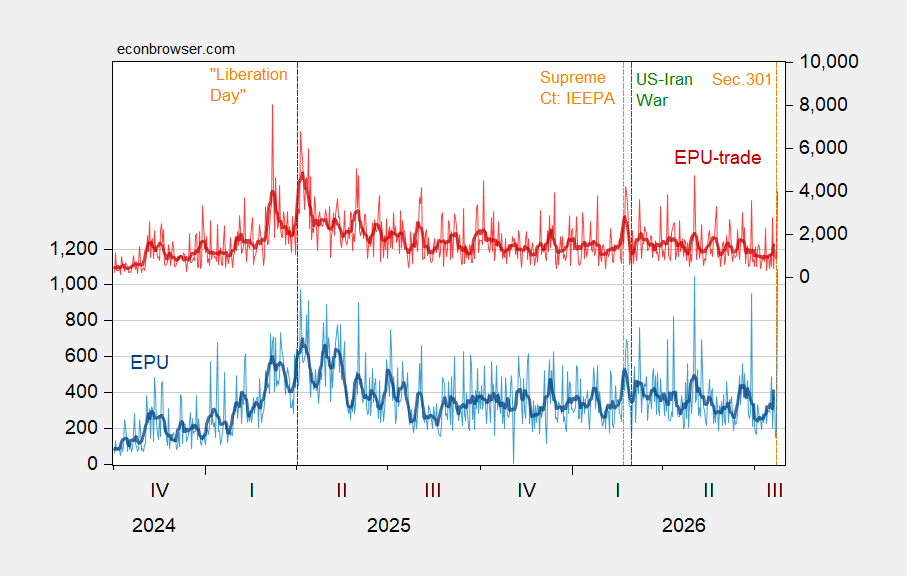
Figure 1: Economic Policy Uncertainty (blue, left scale), 7 day centered moving average (bold dark blue, left scale), EPU-Trade Category (pink, right scale), 7 day centered moving average (bold red, right scale). Source: Policyuncertainty.com accessed 7/25/2026.
Hence, even if the new Section 301 tariffs merely maintain the effective tariff rates under Section 122, trade policy uncertainty seems heightened (note the Section 338 tariffs threatened against Canada are only a few days before the new Section 301 tariffs).
truthout.org/articles/pentagon-quietly-revises-death-count-of-us-troops-in-iran-war-from-18-to-14
18 US soldiers have died in Trump’s pathetic invasion of Iran but it seems four of those deaths now do not count. The pretty boy Sec. of “War” and Donald “bone spurs” Trump are absolute disgraces.
Reality rears its ugly head:
https://www.nytimes.com/2026/07/25/us/politics/trump-iran-military.html
The war-criminal-in-chief has decided against an escalation of the war in Iran because he has used up most of our defensive weaponry.
Meanwhile, Russia’s largest oil export terminal hasn’t loaded a tanker since Tuesday:
https://oilprice.com/Latest-Energy-News/World-News/Russias-Biggest-Black-Sea-Oil-Port-Goes-Quiet-as-Drone-Threat-Grows.html
“Sheskharis exported an average of about 650,000 barrels per day during the first half of the year.”
Speaking of spikes, here’s the 3:2:1 crack spread:
https://en.macromicro.me/series/4934/crude-oil-cracking-spread
Product prices are near the highest, relative to crude oil prices, on record.
Here’s Krugman on the implication:
“From the point of view of end users, this is the same as if crude prices had risen an extra $40 per barrel. In effect, the world is coping with the equivalent of $140 oil even though the headline price is “only” around $100.”
https://paulkrugman.substack.com/p/quagmire-of-the-vanities
The extra $40/bbl ends up as profit.
Bibi is in town this week, and our war-criminal-in-chief will be surrounded by his own most warmongering warmongers for the visit. If we can’t afford to escalate because we’re nearly out of defensive weapons, but the war bros can’t talk about anything but war out of repect for Lindsey Graham, they’ll need to cook up something bad so they can thump their chests and feel good.
Can’t wait.
A nice short and informative article on electricity cost. Even with Trumps best efforts it still makes more sense to go solar and wind for new production. However combined cycle gas plants are still being build.
https://www.utilitydive.com/news/renewables-remain-cheapest-lcoe-rising-lazard/825443/
Nice link. Funny how consultants hide pitically unpalatable news in obscure language, but at least Lazard has the courage to deliver that news.
‘Lazard noted that the cost structure is different across generation types, with renewable energy being predominantly capital cost-driven “while conventional technologies carry higher fuel and variable cost components — a dynamic that drives technology-specific economics across use cases and reinforces the need for a diverse generation fleet.”’
In other words, the “energy” in renewable energy is free, while for fossil fuels and nuclear energy, you pay both capital and fuel costs. That helps explain the overall lower cost of renewables. Lazard’s conclusion -“use cases” and “the need for a disverse generation fleet” – seems intentionally obtuse. Simplified, it seems to mean there is overlap between the low-end-of-the-range cost of gas generation and the high-end for renewables, while nuclear power is priced out of competition.
If I understand cost structures rightly, a project with most of its costs as up-front capital – like renewables – thrives most in a low-interest-rate environment. As a sort of shorthand analysis, it would be interesting to see capital cost per megawatt across types. I’d guess that low up-front capital cost is what makes gas generation attractive in some cases, for instance, when financing with junk bonds.
Notably, Lazard finds that all costs are rising – capital equipment, interest costs, fuel. This leads to another bit of obtuse writing, saying that optimizing existing generation capacity is cheaper than building new. In simple terms, lean on conservation. We’ve been saying that for two generations, yet here we are, mining crypto and splurging on AI that can’t pay for itself.
texas just spent billions on gas powered plants to serve as backups in peak demand situations. plants that will sit idle 99% of the time. rather than invest in battery type devices, which can serve peak times as well as low production periods of renewables. we spent billions on power plants that operate 1% of the time. just to spite the renewable industry-thank you governor abbot!
recently read about sand batteries being used in Northern Europe for heating and cooling. seems to me we have a myriad of technologies perfectly adaptable to every storage of free renewable fuels. so why do we continue to build power plants that run on fuels that actually cost money? we are fighting a war in Iran right now, to protect these exact types of costly fuels. ridiculous.
Batteries and energy storage price are so low that the idea of having actual power plants on standby for peak demand situations is idiotic. Texas doing it anyway has nothing to do with rational planning and everything to do with corruption.
interesting billboard I saw on the highway this morning. picture of president xi, with a quote that “you are the one paying for the tariffs, not me.” the tariff propaganda machine is playing on both sides. just wondering how long the billboard will remain up, before trump minions tear it down due to nation security risks?