One of the explanations for the “new normal” in employment growth is not deficient aggregate demand, but deficient labor force growth. The NYT article “Employers Fear Labor Shortage as Many Immigrants Lose Protected Status” lays it out:
… on Monday, about 350,000 T.P.S. recipients from Haiti and several other countries will lose their work permits in the first wave of fallout from the Supreme Court ruling. About 190,000 Salvadoran beneficiaries could be next to lose their status when it expires in September.
“For particular places and particular industries, tens of thousands of workers no longer able to legally work is going to be a very big hit,” said Alexander Arnon, the director of policy analysis at the Penn Wharton Budget Model, a nonpartisan research organization that has analyzed the economic impacts of T.P.S. workers.
This is on top of the crackdown on migrants the administration has been pursuing. Heavily affected by these measures would be health care/social services and construction. The former has been a main constituent of employment growth over the last year.
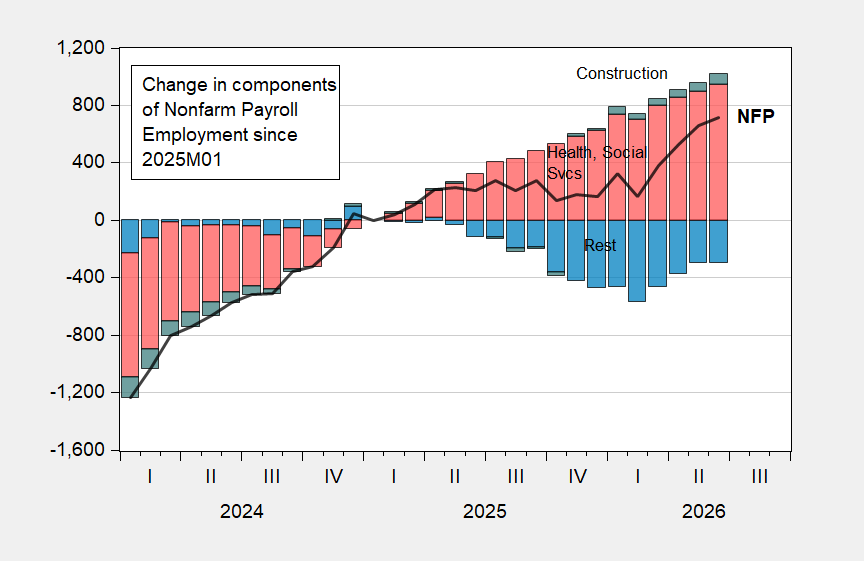
Figure 1: Change since 2025M01 in total nonfarm payroll (NFP) employment (bold black line), hoealth care and social services employment (salmon bar), construction (green bar), rest of NFP (blue bar), all in 000’s, s.a. Source: BLS and author’s calculations.
Nah, TPS numbers are fictional, you have to understand. They are mythical numbers that doesn’t adjust for demographics or keep up with self deportation or transfer to permanent status. The Biden Administration had massive deportations the last 18 months of their administration and I bet many are still counting them. Immigration accounting sucks even by the border patrol. The large surge of immigration into the upper Plains and Inter mountain west destroys this argument. I only have 331,000 in total with TPS. Only half are job age.
Menzie, its called a K expansion. Look it up. A paper leverage boom is fake and phoney. Immigration is the last thing we need. Cause the bust is coming.
An expert has graced us with his presence. We could learn so much, if only he spoke English.
Yes I learned so much. Including that if a number doesn’t adjust for immigration, delta on measurements and phases of the moon – then they are fictional. Nothing can be learned from numbers unless they are perfect – or defined by the one and only expert. Oh for the arrogance of idiots, where should we find our entertainment?
Reality is reality. Hearing most of the Haitians they are looking for in Ohio and Illinois were gone 2-3 years ago makes you question why media can’t keep up or bother paying attention. Is it because they want to sell dialectical bs??? Me thinks so.
Its partly why people are miserable. Selling dialectics over reality. Add in technology that make people miserable, you got a real problem.
Johnnydean/Shadowdude/Realtruth/Zanny/Xenogear/JackBlackie/Lava/Truther/Pitts/Ernest/Stephen/Economicsman: I really can't figure out what you are trying to convey here.
We always assume that somewhere in the delusional brains of these internet clowns and their word salat, there is some kind of logic and basic message, that they can decipher and deliver to the world – but what if there isn’t? What if it’s all just scrambled neurons and endorphin rewards, disconnected from rational thought?
maybe Prof. Chinn needs to add a bot detector. are you a human? choose the picture with the gasoline pump.
Someone is upholding the food system, caregiving, low-skilled healthcare and construction, and it sure ain’t US citizens. You should come up with a plan now to blame these non-existent, deported immigrants when it all starts to crumble. That’s what we want anyway, right?
Off topic – rates and markets:
https://www.cmegroup.com/markets/interest-rates/cme-fedwatch-tool.html
The FOMC announces its rate decision tomorrow. Current pricing puts odds at 70% for no hike, 30% for a hike. That’s not the biggest mystery an FOMC meeting has ever presented, but it’s enough to induce some significant price activity in other markets. Among other things, margin debt is high, and margin borrowing is closely tied to the funds rate. We don’t get a summary of economic projections tomorrow, so with Warsh delivering as little information as possible, most of the “communication” will be the rate decision.
Pricing for the September rate decision puts odds of a 25 basis point hike at 56%. If a decision to leave rates unchanged tomorrow brings down the odds of a September hike, that could induce even more price action in asset markets – prices higher.
What with the mini-melt is AI-linked stocks and Iran commenting on Bibi’s visit to DC with missiles, there’s more going on than just rates. Increased uncertainty about the outlook for rates, though, makes Fed days a bigger than usual issue for asset prices.
For the S