Following further on Jim’s assessment on slow but steady headline GDP growth, core GDP growth remains strong. But GDP growth relies on AI related investment spending.
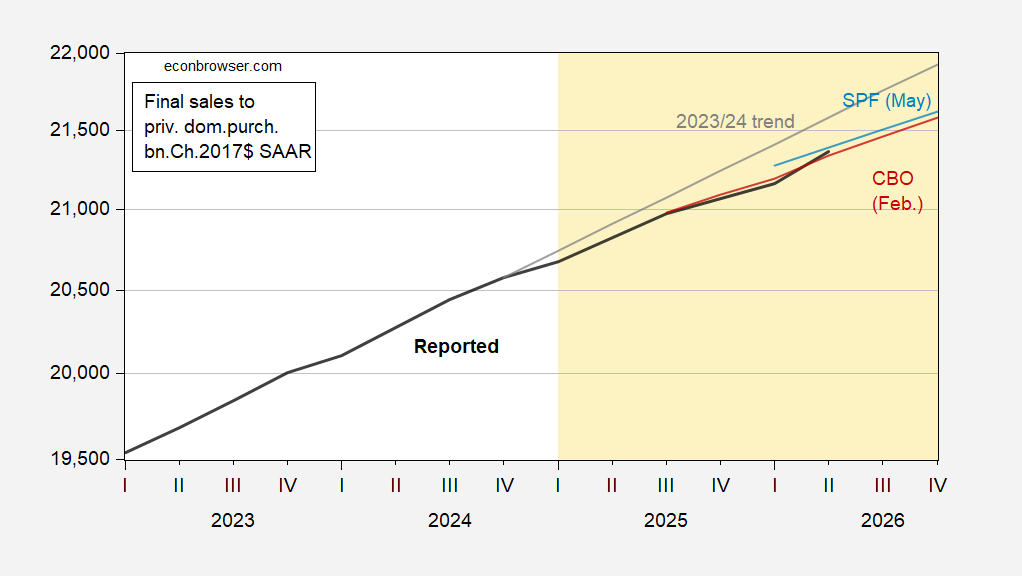
Figure 1: Final sales to private domestic purchasers (bold black), 2023/24 trend (gray), CBO February projection (red), May SPF median forecast (light blue), all in bn.Ch.2017$ SAAR. Source: BEA 2026Q2 advance release, February CBO Budget and Economic Outlook, Philadephia Fed, and author’s calculations.
While core GDP is growing faster than GDP, actual is below 2023/24 trend.
As for the importance of direct AI related expenditures, with the exception of Q2, the effect seems like a wash in an accounting sense, given information equipment and software investment vs. computer and semiconductor imports:
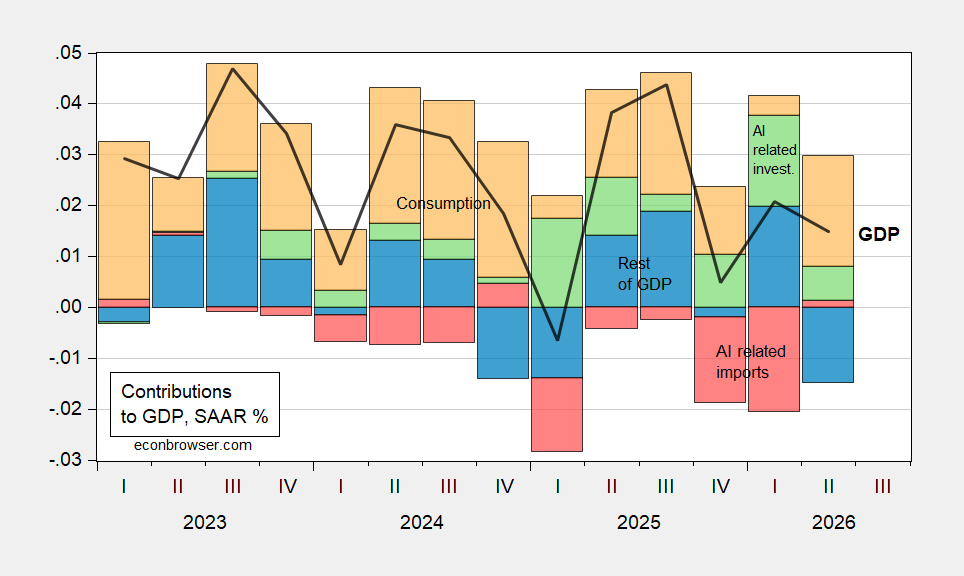
FIgure 2: GDP growth SAAR (bold black), information equipment and software investment contribution (green bar), computer and semiconductor imports contribution (red bar), consumption (yellow bar), rest of GDP (blue bar). Source: BEA and author’s calculations.
This is an accounting decomposition (see details of tabulation). The AI boom has also shown up in added wealth; Bigot and Espic (2026) argue that about half of 2025 consumption growth (2%) was attributable to the increase in wealth, based on differentiating wealth effects from high income vs. low income households. Real household net worth increased 5% in 2025. Assuming flat real household wealth in 2026 (something like a 7% SP500 drop from June to December would do the trick), that would subtract about one percentage point of consumption growth, so around 2/3 of a percentage point of GDP growth.
Where do these measures stand right now?
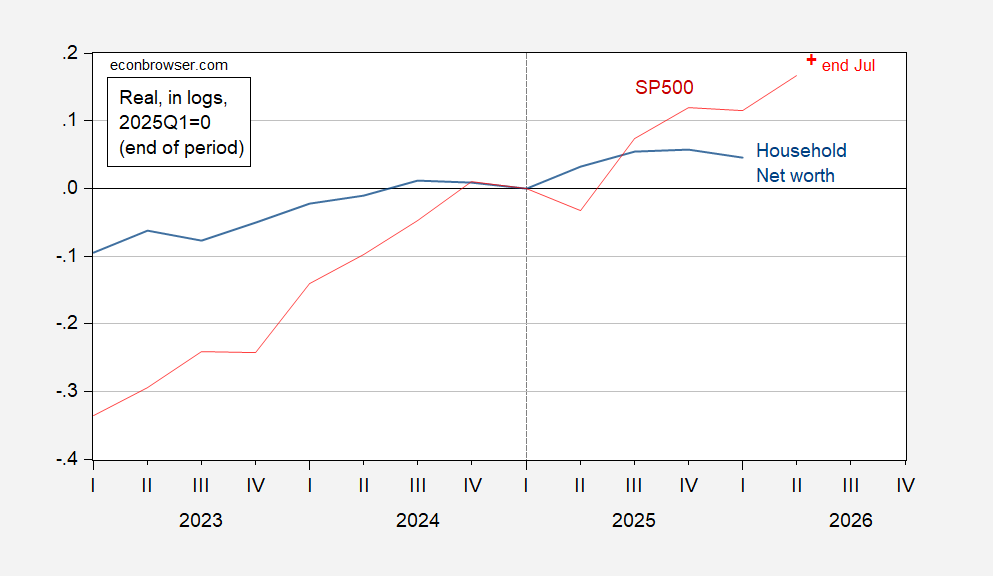
Figure 3: Real household net worth (blue), SP500 (red), both in logs 2025Q1 equal 0, end of period. Deflated using PCE deflator. July PCE is Cleveland Fed nowcast. Source: Federal Reserve Board Flow of Funds, BEA, SP/Dow Jones via FRED, Cleveland Fed, and author’s calculations.
So long as equity markets stay buoyant (dependent in part AI prospects), then aggregate demand will remain strong.
As for part of the AI universe, here’re total returns (unweighted) for the Magnificent 7 vs. SP500.
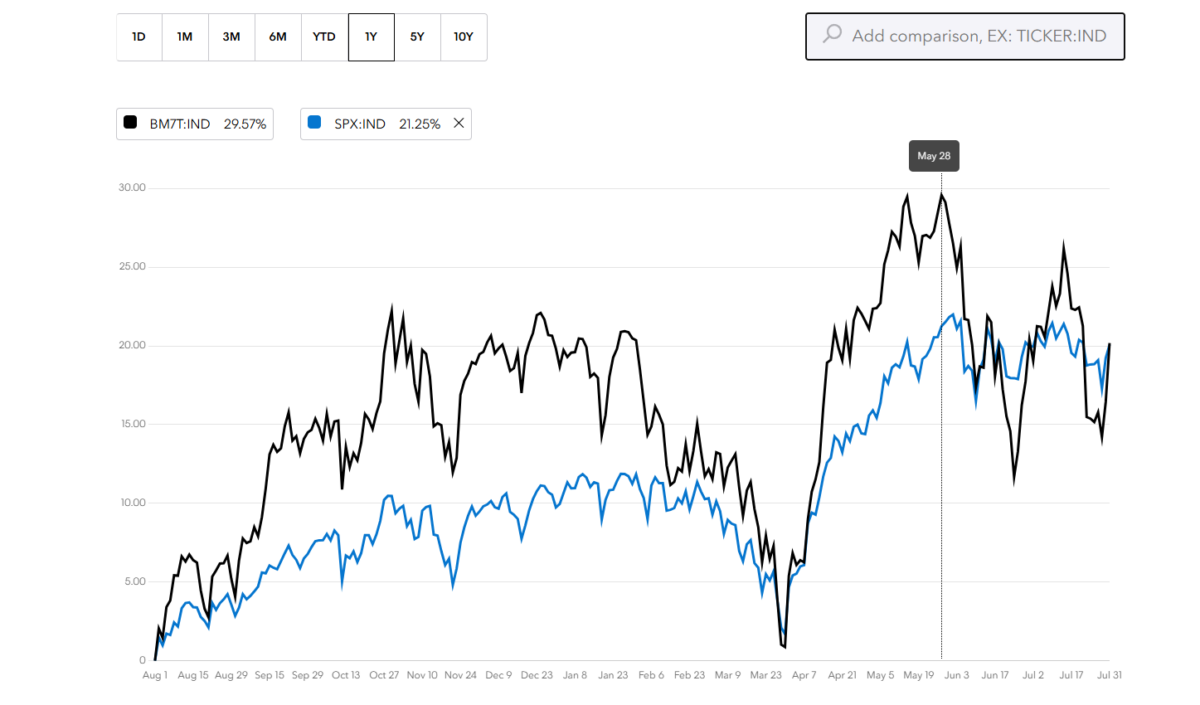
Source: Bloomberg, accessed August 1, 2026.
“So long as equity markets stay buoyant (dependent in part AI prospects), then aggregate demand will remain strong.”
Why did I just think back to early 2001?
Looks like yen intervention was more extensive than I thought:
https://www.japantimes.co.jp/business/2026/08/01/economy/us-treasury-yen-support/
Two days of BoJ yen buying, and the Fed – on behalf of Treasury – buying yen for euros. In the past, Treasury wouldn’t sell euros without ECB permission, but who knows these days? Maybe this was the Fed on behalf of Treasury on behalf of the ECB? Or maybe the FT is mistaken.
Notice that the Japan Times article manages to suck up to Bessent while also getting giddy about the effectiveness of the intervention. Sounds like a bias to me – like maybe a source has an ax to grind.
The conventional view is that sterilized intervention, which doesn’t change economic fundamentals, doesn’t have any medium-term effect on exchange rates. Of course, policy makers aren’t necessarily focused on the medium term.