Implications from the Atlanta Fed Taylor Rule utility default settings:
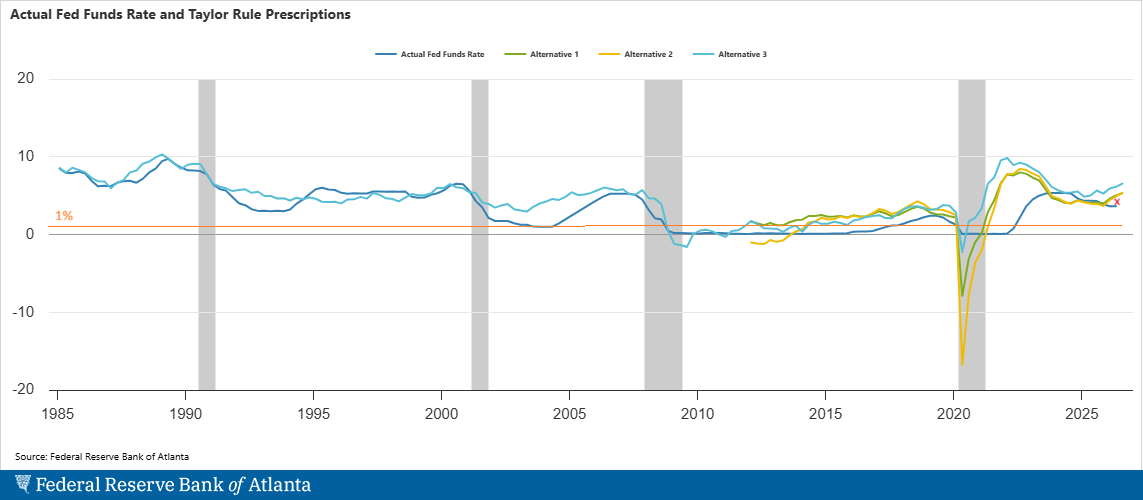
Red x denotes 3.88%, orange line Trump’s 1% prescription.
Readings for targets are 5.32% to 6.54%, vs. 3.88% actual today.
Implications from the Atlanta Fed Taylor Rule utility default settings:
Red x denotes 3.88%, orange line Trump’s 1% prescription.
Readings for targets are 5.32% to 6.54%, vs. 3.88% actual today.
Just for fun, try substituting the professional forecasters’ inflation forecast for the 4-quarter PCE average in running Taylor rule estimates, reason being that the PCE average is backward-looking over a period in which inflation has risen.
What you’ll find is that the recommended funds rate target jumps up into the 7%+ to 8%+ range. As long as our war-criminal-in-chief refuse to open Hormuz, we should probably be using inflation forecasts, not backward-looking inflation performance, in running the Taylor rule.
Fed folk obviously pay attention to the Taylor rule, but have never been willing to adopt a rule-based policy regime. One reason is that the Taylor rule accounts for neither the Fed’s dual mandate nor financial dislocation. Still, the Taylor rule is a really good tool.
One big problem Fed officials have to deal with is that oil prices are for now largely driven by the whims of one demented narcissist, and so are not easily forecastable (if “forecastable” is a word). Fed folk look at futures prices and at market-based inflation estimates for guidance on the inflation outlook, but those are less helpful now than in normal time. Market-derived nflation expectations have been running below realized inflation over the course of the war and oil futures prices have been quite volatile. Bringing professional inflation forecasts into the rate-setting discussion is the responsible thing to do.
Off topic – currency conniving:
https://archive.is/NnAZn#selection-1583.0-1583.59
Saudi Arabia has withdrawn from a China-backed payments system meant to circumvent reliance on dollar-based systems. Saudi Arabia has ducked questions about U.S. pressure to withdraw. The Bank for International Settlements withdrew in two years ago, reportedly under pressure from the U.S.
Assuming the BIS did, in fact, withdraw due to U.S. pressure, it happened during the Biden Administration. That makes the Saudi decision look a bit less like the result of Bessent’s determination to force allies – Japan in particular – to continue to fund U.S. deficits. That said, I’m still mighty suspicious that Bessent and the felon-in-chief have a hand in this, given the felon’s threat to impose 100% tariffs on any nation which circumvents dollar-based payment systems. Without Saudi oil money, the volume running through China’s system will be considerably smaller. Volume and broad coverage are critical to the success of any such system.
Is this kinda like your mother-in-law getting into an MMA cage match with your tax auditor?? (Orange creature in White House vs Beijing)
They have not really withdrawn as they were never in it. Nor do they matter that much. The dollar value of their surplus only makes up 11% of total dollars, most reserves are held privately by the globalist rich. About 80%.
From the first sentence of the article:
“Saudi Arabia has withdrawn from a Beijing-led digital currency programme…”
Unless you can offer something other than your own opinion, I’ll stick with what thw FT states.
As to Saudi Arabia not mattering all that much, payment systems are used to handle flows, not stocks. Saudi reserve holdings are a stock. It’s not clear what you mean by “The dollar value of their surplus”, but 11% doesn’t qualify as large or small unless we know what standard we’re using. And if you consider total trade or investment flows of all the non-Chinese particilants in China’s payment program, I think you’ll find Saudi Arabia accounts for more than 11%.
It’s easy to dismiss just about anything as trivial, but making the argument is often less easy. But thanks for playing.
What has always bothered me about the Taylor Rule is that he derived it empirically by fitting observations of past monetary policy but then turned the descriptive into a prescriptive without a lot of justification.
This may be the epitome of hypocrisy on my part, but mainly I think Taylor likes the prescription because it fits his math skills so perfectly. I’ve never liked it either unless you like slop/grot quick answers. But then I think DSGE is not as good as IS-LM so what the hell do I know??
Imagine a 1% rate during Clinton’s 2nd term. Can we say hyperinflation? Of course Trump could claim rapid nominal GDP growth!