Estimates for 2026Q2, Q3, compared to 2000.
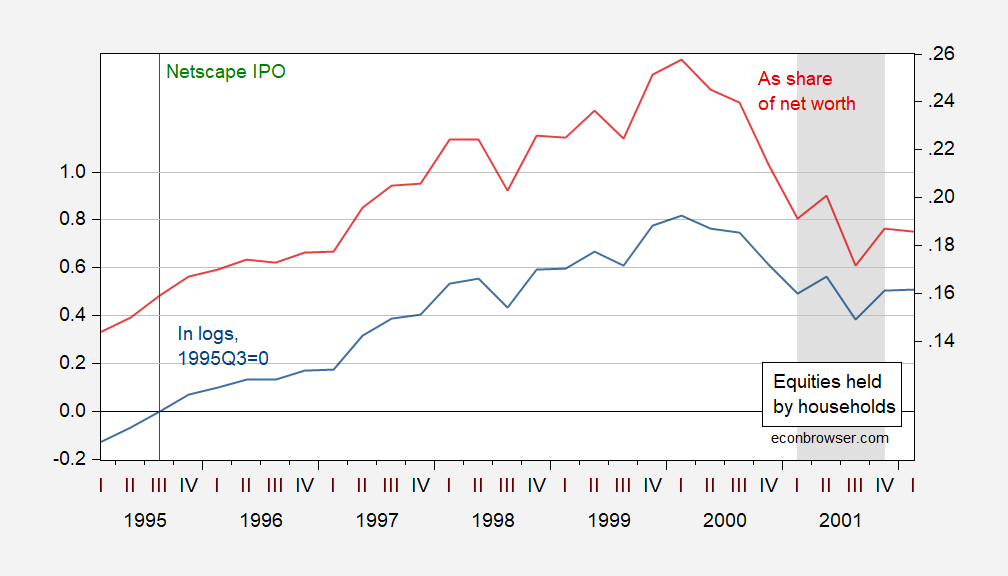
Figure 1: PCE deflated equities and mutual funds held by households, in logs 1995Q3=0 (blue, left scale), equities and mutual funds held by households as a share of net worth (red, right scale). NBER defined peak-to-trough recession dates shaded gray. Source: Board of Governors of Federal Reserve, Flow of Funds, BEA, NBER and author’s calculations.
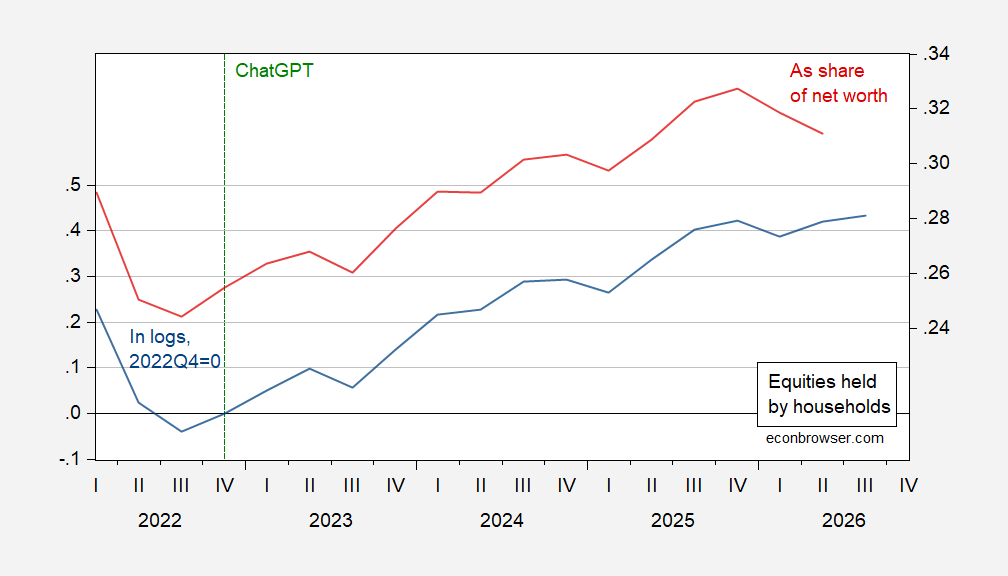
Figure 2: PCE deflated equities and mutual funds held by households, in logs 1995Q3=0 (blue, left scale), equities and mutual funds held by households as a share of net worth (red, right scale). 2026Q2 and Q3 equity holdings estimated from first log differences regression holdings on SP500 value, 2022-2026. Source: Board of Governors of Federal Reserve, Flow of Funds, BEA, NBER and author’s calculations.
Equity holdings have risen by less so far (a bit over 40% compared to 60% to peak in 2000), while the share of household net worth is right now higher (31% vs. 26% in 2000). What would be the impact on consumption? It used to be that analysts would distinguish between paper and real wealth (real estate, etc.). Beach, Gamber and Moran (2025) note the decline in the MPC out of wealth can be explained by increasing wealth heterogeneity/concentration. They estimate the MPC in 2000 was about 3.4 cents on the dollar, while that as of 2019 was about 2.6 cents on the dollar.
A $3 trillion reduction in wealth — about that experienced last week — would then amount to an $80 billion reduction in consumption. Q3 nominal consumption was at at about $22.5 trillion (SAAR), so this is a small reduction in and of itself. However, were the trend to shift along with a one-time drop, then the reduction in consumption would be much more noticeable.
I just wanted to to point out that you don’t have to wait for the second or fourth week of the following month to get an update on consumer spending. Redbook’s weekly retail spending data, shown here:
https://tradingeconomics.com/united-states/redbook-index
Has been on target showing the nominal YoY% trend in both retail sales and personal consumption of goods:
https://fred.stlouisfed.org/graph/fredgraph.png?g=20GQY&height=490
If the sell-off in equities begins to affect spending, you’ll get a heads up the next week, rather than waiting for the next month.
Off topic – the next election:
https://thehill.com/homenews/senate/6204697-democrats-expand-2028-senate-map/
For those interested in election math, The Hill’s piece offers a baseline for the 2028 Senate elections. Assuming voters do in 2028 exactly what they did this year, Democrats will be within reach of a 60-seat majority in the Senate in two years. If there are no defectors, that would allow more legislation than has been possible in many years. Defectors are, however, a serious possibility. Think of Sinema, Manchin and Fetterman.
It is a truism that financial markets “like” divided government because the worst plans of both parties are bottled up. Surprises, which tend to change ROI, are limited. The filibuster works in the same way as divided government, limiting what laws Congress can pass. If Democrats have just 60 Senate seats, a Sinema or a Manchin or a Fetterman can scuttle the legislative plans of the majority, but may not always choose to do so. Budgets will be easy work for Democrats, even without 60 Senate seats – no Republicans needed.
The assumption that voters will do the same in 2028 as in 2026 is iffy, of course, but the president’s party generally pays a price when voters are unhappy. The war isn’t over. Immigration raids continue. Housing is still really costly. Inflation is high and prices will remain high even if inflation is tamed.
The race is on.
be careful about extrapolating into 2028. what you do the next two years will be critical. in Texas, the blue wave was not jut the result of a population suddenly waking up ands embracing democratic policies. Texas has had a decade of corruption and very flawed candidates, who viewed the voters with disdain as they pursued their own ideological agendas. Texas turned blue in dramatic fashion because of very flawed individuals as the top of the ticket-paxton and abbott-not simply policy changes. not sure if you can count on that happening for you again in 2028. so better get your act together over the next two years democrats, if you want to remain in power.
Off-topic – Demographics of Russia – The latest data regarding Russian demographics from the Federal State Statistics Service (Rosstat) is from an internal data leak published by hacker groups in November 2026. Putin has destroyed Russia – already challenged by an declining population – The loss of 400,000+ predominantly young men eliminates not just current labor, but future families. This sharpens the “demographic echo” of the 1990s—a period when birth rates also collapsed—leaving Russia with a severely depleted generation of young adults entering their prime reproductive years by 2030 and 2040. The 750,000+ individuals who fled since 2022 represent a highly educated, high-fertility demographic. Permanently shifting their future children to foreign population registers. I’ve been thinking for awhile that this devastating war for Russia will drop it out of the G10 (by nominal GDP) and if it continues for another year – out of the G15.
Also I am reading reports that the war is becoming more lethal for Russia – In Sept 2026 – Ukraine estimated more than 50,000 Russian causalities on the front line – and are predicting 60,000 to 70,000 in coming months.
Having a deranged, criminal, ethno-nationalist dictator and gang of oligarchs in charge is not good for the general population.
If something cannot go on forever, it will stop.
— Herbert Stein
Russia’s turn toward attacks on civilians looks like a recognition that battlefield losses aren’t doing Russia much good. Tens of thousands of new dead for moving the battle forward or holding the line against invaders is longstanding Russian doctrine. Ukraine hasn’t invaded and the battle isn’t moving. Standard doctrine has failed. Drones are very effective at spotting and killing anything that moves on the battlefield, Russia is the aggressor, so must move, so Russian troops die.
We keep hearing about a call up of troops, then we hear Putin is opposed. The talk of a troop call up may be floated by generals – and politicians – relying on conventional doctrine, while Putin thinks about maintaining public support – or rather acquiescence.
Still, the numbers are bad. Lots of death and no mass call up means Russia will run low on troops relatively soon, probably already. Stein was right; something has to change.
In addition to running low on troops (which could be fixed by general mobilization), they are also running low on funds. They recently cut public spending on non-military items by 10-20% and also cut the incentives for recruiting soldiers. Ukraines attack on their refineries (which continue) have cut government income.
It is completely crazy for them to think that their ballistic missile attacks on Ukraine can force a surrender – but that seems to be the current strategy. Lots of third world countries work perfectly fine without a grid – Ukraine could too (in an absolutely worst case scenario).
Don’t forget that Trump’s pal in DPRK is happy to send troops to fight in Ukraine (though only while Russia can still pay — I wonder if Kim is getting any payment in gold).
Also, Russia reportedly has stepped up unannounced mobilization, using methods that somewhat resemble what ICE does in the US (one Russian method has been to contact men and tell them that they need to come in to correct some problem with their paperwork). Reportedly, they have been using a ca.2022 authorization as legal cover for carrying out current activities without something as visible as a new authorization.
So far there is little evidence of North Korea adding troops into the occupied Ukraine. They have almost exclusively been stationed on Russian territory to defend Kursk oblast. They also represent a fairly small number – less than one month worth of Russian casualties. The problem has been with direct communication while under fire between Russian and NK soldiers.
What Russia desperately needs is more cannon fodder to send into the kill zone. They recently recruited from Africa, but that also has issues with communication as well as with trying to pretend that you are a Ukrainian civilian while sneaking behind the front line.
The 2022 mobilization lost Russia more young men fleeing the country than it gained soldiers for the front line. They may be afraid that any visible large scale mobilization would be even worse than first time around. I am not sure their society would have any future if they lost another 1 million young men fleeing the country.
Independent confirmation of Russia’s war dead:
https://www.euronews.com/2026/11/08/rosstat-hack-data-obtained-suggests-over-390000-russian-deaths-in-ukraine-war