“When Trump visited the island territory last October, OFFICIALS told him in a briefing 16 PEOPLE had died from Maria.” The Washington Post. This was long AFTER the hurricane took place. Over many months it went to 64 PEOPLE. Then, like magic, “3000 PEOPLE KILLED.” They hired……..GWU Research to tell them how many people had died in Puerto Rico (how would they not know this?). This method was never done with previous hurricanes because other jurisdictions know how many people were killed. FIFTY TIMES LAST ORIGINAL NUMBER – NO WAY!
Author Archives: Menzie Chinn
Recalling the Beginning of the Lost Decades
Lehman Brothers, the global financial crisis and ensuing great recession, plus ten.
Continue reading
Excess Casualties in Puerto Rico, According to Mr. Trump
From Mr. Trump, this morning:
3000 people did not die in the two hurricanes that hit Puerto Rico. When I left the Island, AFTER the storm had hit, they had anywhere from 6 to 18 deaths. As time went by it did not go up by much. Then, a long time later, they started to report really large numbers, like 3000……..This was done by the Democrats in order to make me look as bad as possible when I was successfully raising Billions of Dollars to help rebuild Puerto Rico. If a person died for any reason, like old age, just add them onto the list. Bad politics. I love Puerto Rico!
“Unsung Success” in Puerto Rico
Following up on examples of the incredible and unsung success of the recovery effort in Puerto Rico described by Mr. Trump, from Begnaud/CBSNews:
What may be millions of water bottles. meant for victims of Hurricane Maria, have been sitting on a runway in Ceiba, Puerto Rico, since last year, according to @FEMA, which confirmed the news to me, late tonight, after pictures, posted today on social media, went viral.
If 2975 dead is a success, what does a failure look like?
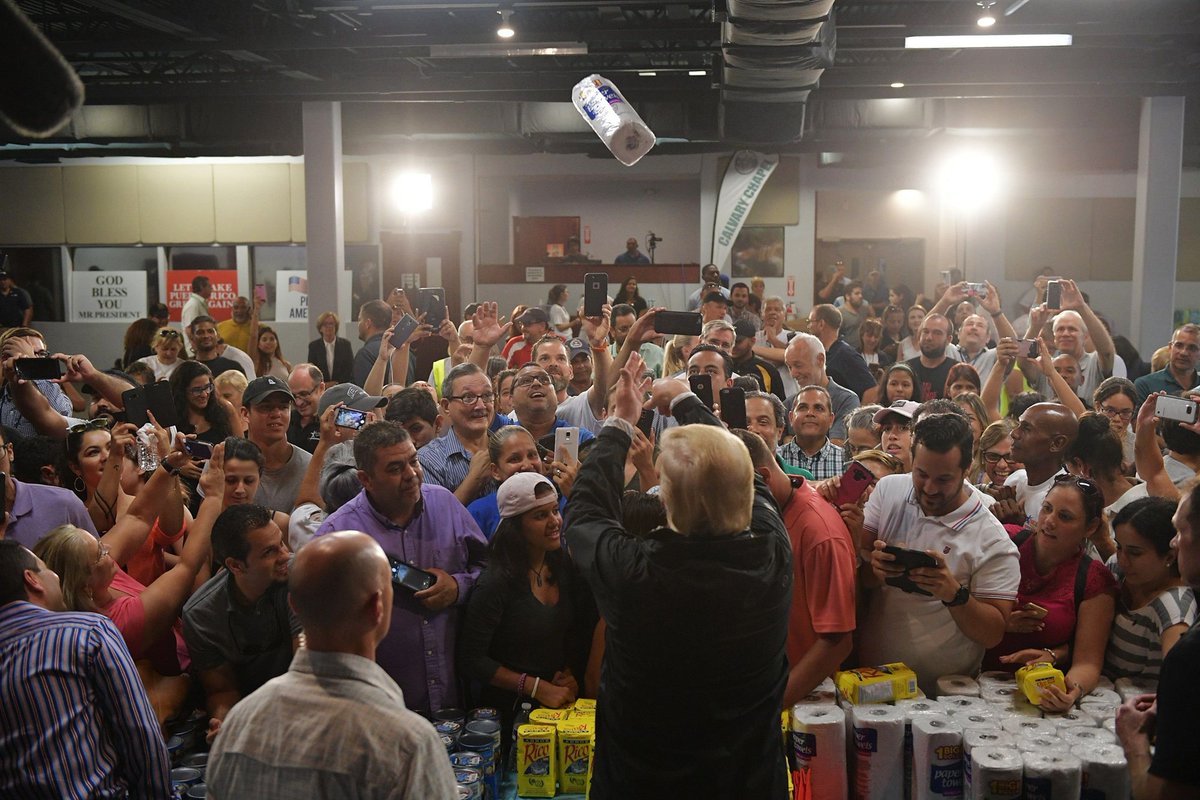
But Mr. Trump did pass out some paper towel rolls.
Econbrowser, on the Day Lehman Brothers Closed
Back to the Real Side of the Economy: Recession Watch (9/15/2008)
Only on a day like today does an over 1 percent decrease in industrial output move to third page. But this item (and this hilarious article h/t Economists View) reminded me to update the indicators used by the NBER BCDC are headed. Their trajectories are, in general, not too comforting.
Puerto Rico Austerity-Induced Excess Mortality Exceeds That of Hurricane Maria?
A commentator [1] has recently concluded that excess mortality due to austerity in Puerto Rico exceeds that attributable to Hurricane Maria and its aftermath. I take issue with that conclusion.
Chinn-Ito Financial Openness Index Updated to 2016
Manufacturing Employment and Output
Today’s employment situation release depicted a picture of continuing recovery in the labor market. One interesting aspect is what is happening to the tradables sector, which I proxy with the manufacturing sector. There, the advance data indicate a slight decline.
“The United States is going to become the warehouse for global soybean supplies”
That’s a quote from Paul Burke, regional director for North Asia at the U.S. Soybean Export Council, in Time. He continues “This is the realization that we’re coming to within the trade within the last couple of weeks.”
The Trade Deficit Rises
From Goldman Sachs (Hatzius, et al.) today, interpreting today’s July trade release:
The trade deficit rose to $50.1bn in July, from a revised $45.7bn in June. Total exports fell 1.0%, as the total drop in exports ($2.1bn) was comprised primarily of declines in civilian aircraft ($1.6bn) and soybeans ($0.7bn). The decline in soybeans exports likely reflects payback following a sharp increase in June ahead of Chinese retaliatory tariffs. Total imports (+0.9%) rose, reflecting increases in both petroleum imports (+3.7%) as well as nonpetroleum imports (+0.6%).