Income distribution statistics come out annually, but net worth (asset/liability) distribution comes out quarterly.
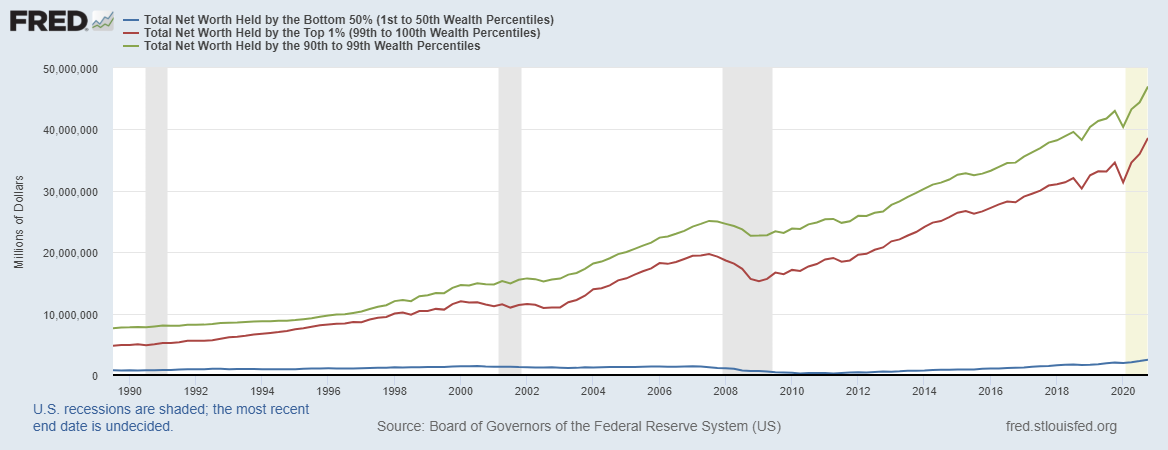
Source: Federal Reserve Board, Financial Accounts of the United States, via FRED.
Income distribution statistics come out annually, but net worth (asset/liability) distribution comes out quarterly.
Source: Federal Reserve Board, Financial Accounts of the United States, via FRED.
Euro area GDP continues to drop in Q1, while the US recovery accelerates.
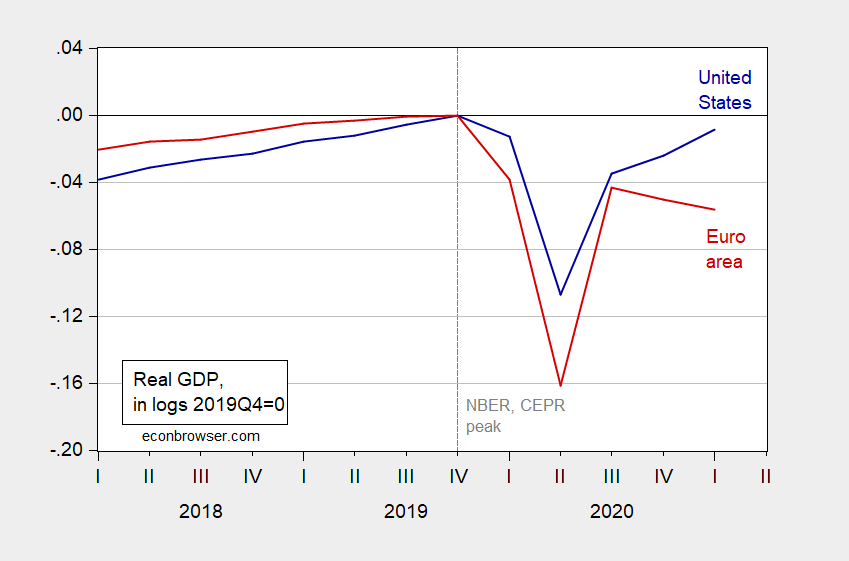
Figure 1: US real GDP (blue), Euro Area 19 real GDP (red), both in logs, 2019Q4=0. Source: BEA, European Union, and author’s calculations.
The US recovery has benefited from a tremendous amount of fiscal stimulus and — finally — a reasonable pandemic response (including an effective vaccination rollout).
While aggregate consumption has surpassed peak levels, it hasn’t returned to trend. Furthermore, the composition has changed drastically.
There’s a rumored plan by Senators Romney and Sinema to raise the minimum wage to $11. Assuming the phase is four years (as in the proposed Cotton plan to raise to $10) starting in June 2021, the trajectory of the real minimum wage looks like:
Retail sales jumped 9.8% m/m, exceed Bloomberg consensus of 5.9%. Sales ex-food services rose 9.4% in nominal terms, 8.7% if deflated by the CPI-all.
Wisconsin nonfarm payroll employment has stabilized at a level down 4.9% relative to NBER peak in 2020M02, vs. 5.5% for the nation overall (according to figures released by DWD today). In addition, the downward decline in February of 1.9% (annualized) has been largely revised away — it’s now 0.3% decline (annualized).
The CPI came in slightly above Bloomberg consensus (2.6% vs 2.5%), and above the WSJ April survey consensus (shown below).
The economy added 916,000 jobs in March, above the Bloomberg consensus of 647,000.
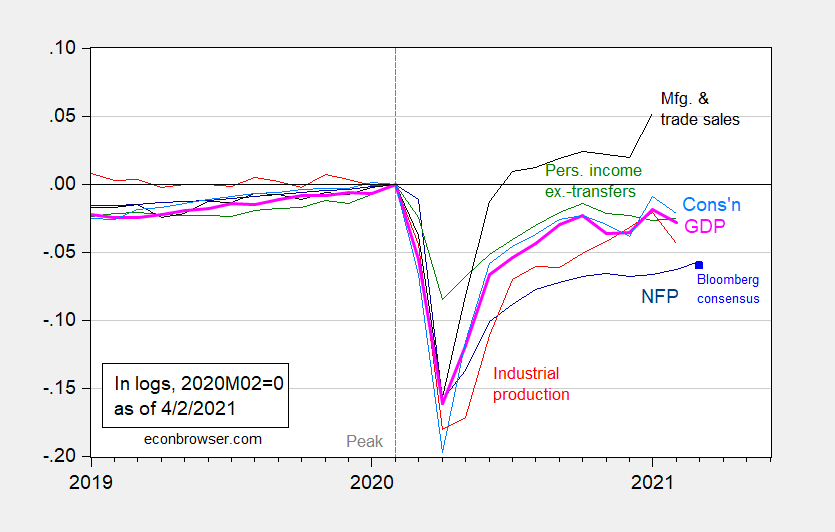
Figure 1: Nonfarm payroll employment (dark blue), Bloomberg consensus as of 4/1 for March nonfarm payroll employment (light blue square), industrial production (red), personal income excluding transfers in Ch.2012$ (green), manufacturing and trade sales in Ch.2012$ (black), consumption in Ch.2012$ (light blue), and monthly GDP in Ch.2012$ (pink), all log normalized to 2020M02=0. Source: BLS, Federal Reserve, BEA, via FRED, IHS Markit (nee Macroeconomic Advisers) (3/1/2021 release), NBER, and author’s calculations.
On the strength of the labor market, see Baum and Klein at EconoFact.
The Bloomberg consensus is for an increase of 674 thousand jobs in March (GS says 775K). That’s heady news, offsetting the somewhat less upbeat news from the estimate of February monthly GDP released by IHS Markit today – a decrease of 0.9% after upward revision in January’s figure by 0.3% (not annualized). Even if expectations are met, employment will still be 5.8% below that recorded at the NBER peak in February 2020. In the context of key macro indicators followed by the NBER Business Cycle Dating Committee:
A common assertion made by those opposed to public health measures such as lockdowns was that suicides were rising markedly – see e.g., Carney/Washington Examiner via AEI, Arthur Laffer and Stephen Moore, and blog commenters like sammy. The data are in. This article indicates suicides actually went down in 2020, 5.6% relative to 2019.