Expect prolific and extensive citation of “alternative facts” going forward:

Source: Search term: “alternative facts”, Google Trends accessed 8:17 PM CST 1/22/2017.
EconoFact is a non-partisan publication, online starting today, designed to bring key facts and incisive analysis to the national debate on economic and social policies. It is written by leading academic economists from across the country who belong to the EconoFact Network, and published by the Edward R. Murrow Center for a Digital World at The Fletcher School at Tufts University. The co-editors are Michael Klein and Edward Schumacher-Matos.

Source: NYT.
Today we are pleased to present a guest contribution written by James Kwak, professor at the University of Connecticut School of Law. He is the author of Economism: Bad Economics and the Rise of Inequality, and contributor to The Baseline Scenario.
Civilian employment and nonfarm payroll employment both decline.
…because he thought he knew better.
From the CBO yesterday:
CBO and JCT estimate that enacting [H.R. 3762, the Restoring Americans’ Healthcare Freedom Reconciliation Act of 2015, which would repeal portions of the Affordable Care Act (ACA) eliminating, in two steps, the law’s mandate penalties and subsidies but leaving the ACA’s insurance market reforms in place] would affect insurance coverage and premiums primarily in these ways:
- The number of people who are uninsured would increase by 18 million in the first new plan year following enactment of the bill. Later, after the elimination of the ACA’s expansion of Medicaid eligibility and of subsidies for insurance purchased through the ACA marketplaces, that number would increase to 27 million, and then to 32 million in 2026.
- Premiums in the nongroup market (for individual policies purchased through the marketplaces or directly from insurers) would increase by 20 percent to 25 percent—relative to projections under current law—in the first new plan year following enactment. The increase would reach about 50 percent in the year following the elimination of the Medicaid expansion and the marketplace subsidies, and premiums would about double by 2026.
Here is one estimate of how many people additional people are dying each year because of 25 states opting out of Medicaid expansion, as implemented under the ACA. I don’t know of a calculation for what happens if legislation like H.R. 3762 is implemented.
Today, we present a guest post written by Jeffrey Frankel, Harpel Professor at Harvard’s Kennedy School of Government, and formerly a member of the White House Council of Economic Advisers. A shorter version appeared on January 13th in Project Syndicate.
From Wells Fargo Economics Group today, data relevant to Donald J. Trump’s comments regarding Congressman John Lewis’s district:
Continue reading
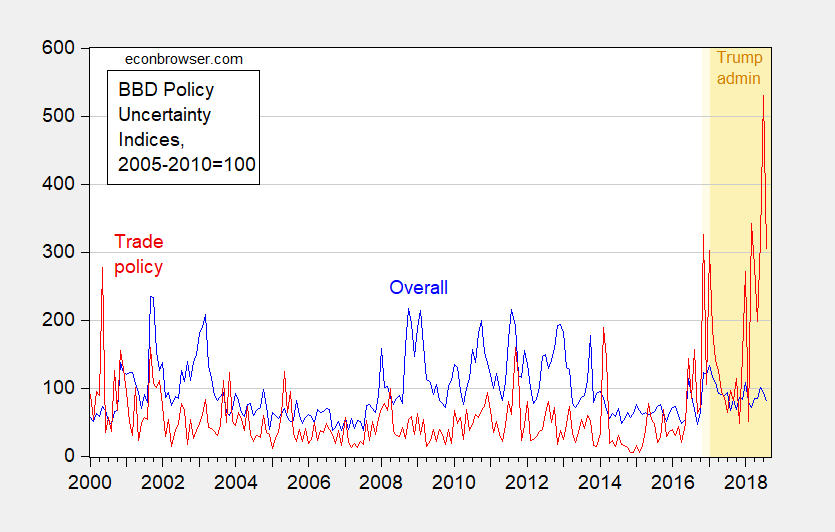
Economists have had a lot of interest recently in whether uncertainty itself may have measurable effects on the economy. Last week I participated in a session devoted to economic research on this question at the meetings of the Allied Social Science Association in Chicago. Here I relate some of the comments I made there.
Continue reading