Some are greeting Friday’s employment report as an all-clear signal. But my advice is, keep your helmet on– they’re still shooting real bullets out there.
Employment, Hours, and Estimated Output
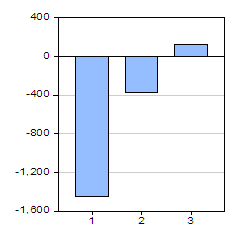
Some observations on the employment situation and other economic indicators: (1) Not only is nonfarm payroll employment slowing its rate of descent, so is private employment; (2) but perhaps more dramatically the decline of aggregate hours halted last month; (3) the rate of decrease has diminished even faster for civilian employment measured by the household survey, and indeed; (4) the household (research) series adjusted to conform to the payroll series is now improving; and (5) a first “estimate” of July GDP supports the case for stabilization of output.
Pricing of interest rate risk in fed funds futures contracts
Do current fed funds futures prices signal a belief by market participants that the Fed may begin raising interest rates early next year? My latest
research paper
suggests not.
China’s Impact on the Global Economy: A Symposium
As attested to by the large amount of coverage of the recent US-China Strategic and Economic Dialog [0] [1], [2], [3], [4],[5] China looms large in any discussion of the world economy. One of the most important contributors to the informed discussion on this subject was Brad Setser, at the Council on Foreign Affairs and before that at RGE Monitor. Unfortunately, Dr. Setser will be leaving the blogosphere, so his insights will be missed (although fortunately for us, he’ll be adding his input at the NEC, where we all wish him well).
So now, there’ll be even a greater need for reasoned analysis. One addition to the discussion is a Symposium on China’s impact on the global economy just published in Pacific Economic Review (August 2009). From my introductory chapter to the symposium:
Over the past decade, China’s presence in the global economy has grown
increasingly large. Along many dimensions, China is, rightly or wrongly,
perceived to have an enormous impact. In the trade arena, China is now widely
considered to be the world’s workshop, displacing some traditional exporters
of labour-intensive goods, even as its economy is ever more closely woven into
the fabric of the increasingly fragmented chain of production….
Current economic conditions
July auto sales might be viewed as the first solid indicator of an improving U.S. economy. But what does it really tell us?
Comparing the Current Recession and the “1980-82 Recession”
At least one observer has argued that the current recession is not as bad as that of the 1980-82 recession, when those two separate recessions (1980Q1-1980Q3; 1981Q3-1982Q4) are considered as one (see [1] [2]). Here is my interpretation of this assertion, updated to use the latest GDP data, and normalizing (log) GDP on the recession start dates.
Multipliers, under Differing Monetary Regimes
Here’s another installment in a series attempting to move the discussion from “my estimate vs. your estimate” (or “prior”, as the case may be) [1] [2] [3] [4] [5] [6] to something more constructive (and hopefully more nuanced). From the conclusion to “Expectations and Fiscal Stimulus” by Troy Davig and Eric M. Leeper:
This paper has embedded estimated Markov-switching rules for U.S. monetary and fiscal policy into an otherwise conventional calibrated DSGE model with nominal rigidities to deliver some quantitative predictions of the impacts of government
spending increases. When monetary and fiscal policy regimes vary — from active monetary/passive fiscal to passive monetary/active fiscal to doubly passive to doubly active — government spending multipliers can vary widely. An increase in government spending of $1 in present value raises output by $0.80 in present value under
[Active Money/Passive Fiscal] AM/PF, while it raises output by as much as $1.80 in present value when monetary policy is passive. In our simple model, this translates into a decrease in consumption of $0.20 in present value under AM/PF, but an increase in consumption of about $0.80 in present value under passive monetary policy.
Cash for clunkers
A victim of its own success?
Good News and Bad News from the GDP release
Some additional observations (see Jim Hamilton’s take, as well as others) on the GDP release: (1) the five year revision indicates that GDP was larger than we thought, but it also declined faster in 2009Q1; (2) GDP growth was lower throughout 2008 than earlier estimated; (3) GDP growth in 2008Q2 at 1.5% SAAR would have likely been at zero or negative in the absence of the January 2008 stimulus package in which case; (4) GDP q/q growth would have been negative from 2008Q1 to 2009Q2; (5) the case that ARRA directly affected 2009Q2 GDP is limited, in a mechanical sense since most of the increase in government spending is accounted for by defense spending; and (6) the US ex-oil ex-agricultural net exports to GDP ratio is back to where it was in 1998Q1.
Been down so long it looks like up
The Commerce Department reported today that the seasonally adjusted real value of the nation’s production of goods and services fell at a 1% annual rate during the second quarter. That’s about as bad as things ever got during the recession of 2001. But after the -5.4% and -6.4% growth rates that the Commerce Department now says characterized 2008:Q4 and 2009:Q1, some folks are cheering today’s news. Reminds me a little of how I’ve seen people in Minnesota take off their shirts for the first 40oF day of spring, a little shocking to a traveler from San Diego.