Confidence rises to 91.2, but below consensus (94.4), from downwardly revised level. Gallup also rises.
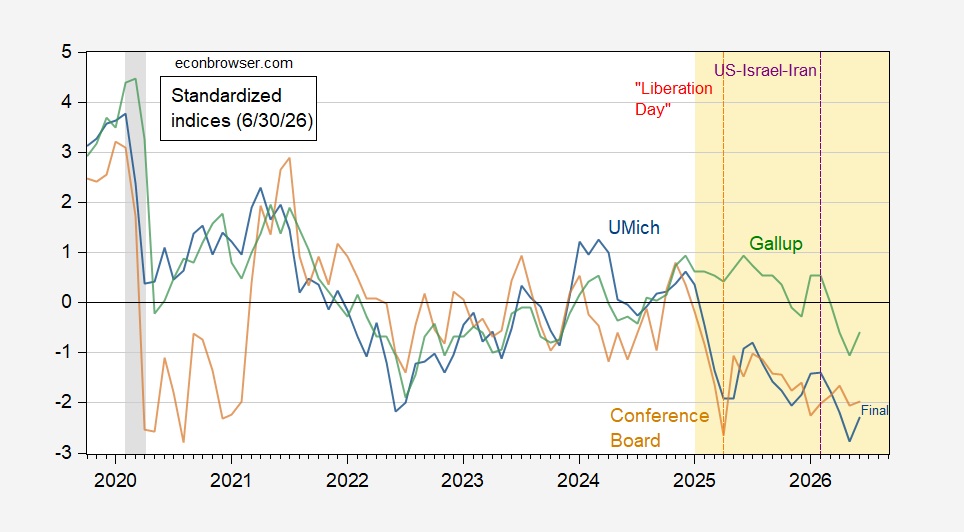
Figure 1: U.Michigan Economic Sentiment (blue), Conference Board Confidence Index (brown), Gallup Confidence level (green), all demeaned and divided by standard deviation 2021M01-2025m02. Red dashed line at “Liberation Day”; purple at US-Iran War. NBER defined peak-to-trough recession dates shaded gray. Source: UMichigan, Gallup, Conference Board, and author’s calculations.
Gallup highlights gasoline prices’ impact as a driver of confidence. The Conference Board mentions oil prices and inflation, but notes the deterioration in perceptions of the labor market prospects:
“Consumer confidence inched up in June as falling oil prices in recent weeks provided some relief to consumer inflation fears,” said Dana M Peterson, Chief Economist, The Conference Board. “Consumer appraisals of current business conditions were slightly more positive compared to last month. However, perceptions of the current labor market softened measurably as the percentage of consumers saying jobs were ‘hard to get’ rose to 22.5%, the highest level since January 2021 (22.8%). Moreover, consumers anticipate little change in the labor market six months from now. This was offset by improving expectations for business conditions and incomes.”
Note the downward revision in May’s number is noticeable:
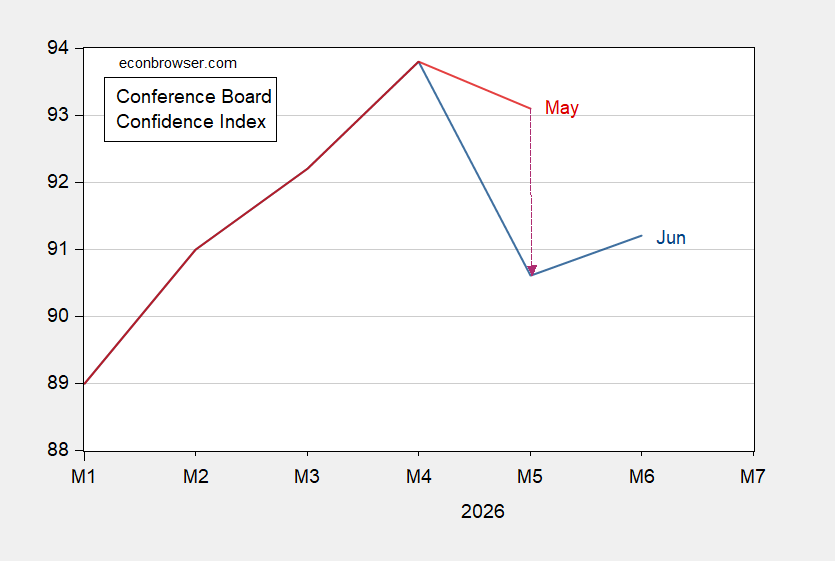
Figure 2: Conference Board Confidence Index from Jun (blue), from May (red). Source: Conference Board.
Expectations 6 months hence rose, perhaps reflecting the MOU penned during the month.
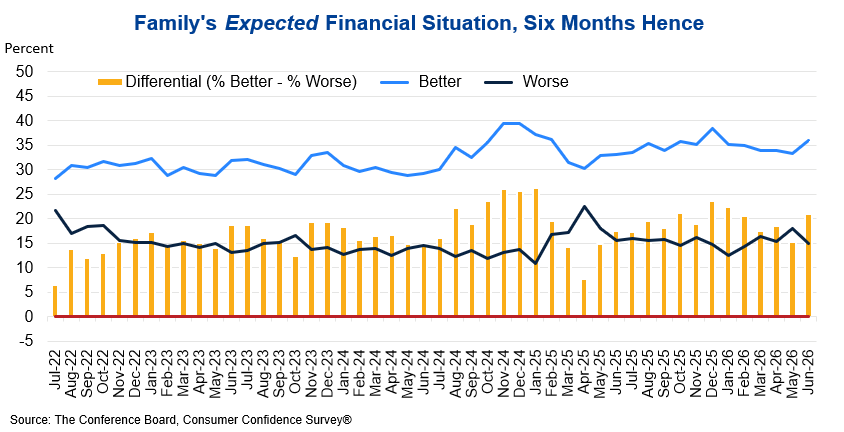
Source: Conference Board, June release.
Joel Wertheimer has a post up in the Silver Bulletin: “Is the vibecession real — or is the survey broken? A shift to online polling and undersampling of Republicans are skewing America’s most-cited measure of consumer sentiment.” The analysis looks strong to me, and the conclusion is that:
“… most of the participants are relying on a broken survey, the University of Michigan’s consumer sentiment survey (“Index of Consumer Sentiment” or “ICS”), that is in dire need of being repaired. Failure to correct for these issues has led to plenty of pet theories — but they explain a trend that may not even exist.”
The shift from phone to web polling in late 2024 caused the excess of Democratic to Republican respondents to go from a range of roughly 0 – 10% up to 30%, and that, combined with partisan outlooks on the economy, causes almost all the drop we see in the index around the start of 2025. He rebalanced the results by partisanship and the rebalanced results would put the index pretty much on the zero line, roughly where it was midway in the jump at the beginning of 2024. It’s a good read.
Wertheimer is cribbing from other people’s homework; lawyers sometime are better at persuasion than at analysis. The idea that Republicans are underweighted in the Michigan survey has been around for awhile. There pretty obviously is a step change in level in Michigan indices, but that doesn’t make the wider vibecession issue evaporate.
If underweighting Republicans were the problem, then the Republican and Independent indices should be doing OK, while Democrats drag the overall index lower. That’s not the case. The independent index is not as low as the Democratic index, but it is much closer than to the Republican index. It is also lower than it was during the housing crash – maybe the phone survey? Also, while Republican sentiment is up from when Biden was President, it is well down from a year ago – the phine survey doesn’t account for that. Check here for the data and for an article from about a year ago on partisan responses:
https://data.sca.isr.umich.edu/
Yes, the Michigan index is particularly low, but other analysts, at least the good ones, have not ignored the Conference Board or other measures of confidence, and those measures are also low. It’s also notable, I think, that the felon-in-chief has the lowest average approval of any president since Gallop first began asking the question. That’s consistent with low consumer confidence.
On the other hand, there are probably plenty of republicans online that view the economy poorly. They are simply refusing to participate, so they dont need to admit a problem exists?
My view on the economy is that it has issues, but biden left a strong foundation that trump has been unable to unravel on day one. Eventually he will do irreparable harm. In fact he is doing so now. Technology and productivity have been stronger than the trump effect up until now. But trump seems determined to kill the economy before he leaves office. He despises the working class.
Off topic – Menzie recently asked whether there is a bubble in U.S. equity markets. Baffling, in response, asked whether the high cost of AI build-out can be recouped:
https://econbrowser.com/archives/2026/06/bubbles-or-regime-switching-in-gold-and-bitcoin#comment-323123
So, in 2024, Clifford Asness published a paper entitled “The Less-Efficient-Market Hypothesis”, arguing that equity prices have, over the past 30 years, become less efficient predictors of returns:
https://www.pm-research.com/content/iijpormgmt/51/1/68
If pricing is now less efficient, the there is greater potential for bubbles.
That paper has been a popular read, so naturally, it has generated additional research. Here’s a recent piece which mostly disagrees:
“The Impressive Markets Hypothesis: Prices (Still) Forecast Fundamentals”
https://www.pm-research.com/content/iijpormgmt/52/6
There’s a paywall, so here’s the gist, from Alpha Architect:
“Market prices have become significantly more accurate at predicting future revenue generation over time…”
“However, predictive power for profit margins has declined. The cost side of the income statement appears to be increasingly underpriced by the market.”
https://alphaarchitect.com/impressive-markets-hypothesis
So even if market pricing is generally efficient, pricing of future costs is less efficient. Ta Da! Good call, baffling.
I will point out that identifying cost as the problem is a logical inference, not an empirical result of the research. If revenue is accurately forecast, but margins aren’t, then it must be the cost side of the ledger that’s the problem.
Macroduck: “So even if market pricing is generally efficient, pricing of future costs is less efficient. Ta Da! Good call, baffling.”
What?! That has to be one of the stupidest statements I’ve seen in a while. The value of stocks is based on net earnings, not revenue. If the market is not including costs of revenue effectively, then the market is not efficient. It is mispricing stocks. Arness is right.
Every farmer knows this. If crop yields are up but costs of seed, fertilizer, machinery and labor are up faster, that’s bad.
You can’t say that market pricing is “generally efficient” if they are only counting revenue.
So, I think you’ve misunderstood who said what. I don’t have a dog in the fight between the two papers, and any suggestion that I have is, well, stupid. All I did was point out a disagreement in recent literature and baffling’s good point.
This isn’t the first time you’ve tossed around insults based on your misunderstanding what was being said. For instance, back when the Fed was hiking rates back in 2022, I said that increased volatility in Treasuries would probably mean higher yields in future, you interpreted that as me saying “sell Treasuries” when I had said no such thing. Your impulse to go for the “gotcha” ended up making you look, well, there’s that word again – stupid.
Here’s what I’d suggest: Read the papers I linked. You could learn something, brush up your reading skills at the same time, and maybe avoid looking stupid next time.
Here are your words: “So even if market pricing is generally efficient, pricing of future costs is less efficient. Ta Da! Good call, baffling.”
The argument is that 1)the market is pricing revenue efficiently but 2) not pricing costs efficiently. And your conclusion is that therefore “market pricing is generally efficient.”
That”s a stupid conclusion from the two premises. If that is not what you meant to say, then perhaps you should learn to speak more clearly.
Oh, you so want to win one, don’t you, little guy?
What you are quoting is my summation of the positions offered by the papers I link to. You desperately want the ideas I reflect to be mine, but they aren’t, as I think could have been obvious to any reader not itching for a “gotcha!” and I certainly made clear when I said I don’t have a dog in this fight.
You’ve let your ego get ahead of your brain. Stupid thing to do.
You said: “So even if market pricing is generally efficient, pricing of future costs is less efficient. Ta Da! Good call, baffling.”
“Ta Da! Good call, baffling.”
What is that supposed to mean? Like I said, if that is not what you meant, then you need to learn to speak more clearly. You shouldn’t blame readers for misinterpreting.
Off topic – The repo market as a constraint in Fed balance sheet size:
https://www.federalreserve.gov/econres/feds/beyond-reserves-the-federal-reserves-balance-sheet-and-the-repo-market.htm
The paper considers non-bank demand for reserves is an important factor in the Fed’s control of overnight rates. Money-market funds inject funds into the repo market. Repo lending, as we know, drives rates across a wide range of fixed income assets. This looks like a pretty important addition to modeling the Fed’s control of rates.
The upshot of this finding works out pretty intuitively – in an ample-reserve system, when policy is tight, repo markets require less Fed liquidity, so the Fed can run a smaller balance sheet. When policy is easy, a larger balance sheet is needed.
Problem is, this implies either active balance-sheet management or a larger-than-necessary balance sheet when rates are higher; the current Fed chair(man) wants neither. So the new guy may find controlling overnight rates harder than it has been till now.
The Fed doesn’t have to run an ample reserve system, but as long as it does, this looks like a problem. And at a guess, transition out of an ample reserve system could be bumpy.
One more thing about the repo market. The authors focus on the influence of quantitative tightening, but make the point that Treasury supply in general induces repo demand. Presumably, that means massive structural deficits create a need for more repo, which creates a need for a growing Fed balance sheet.
There is, to my knowledge, one principled reason to object to a large central bank balance sheet – excessive debt monetization. Fair enough, but there seems to be a purely dogmatic objection in some quarters. It’s silly to insist that the Fed shouldn’t be meddling in private fixed-income markets when the Fed is foundational to fixed income markets. The rational goal is a technocratic one – to run monetary policy as well and as smoothly as possible, balancing objectives.
Today’s jobs report was just OK. Payroll gains slowing, but gains, nevertheless. Households continue to report job losses. The jobless rate fell because participation fell. Wage gains lag inflation.
Just one picture I’d like to offer:
https://fred.stlouisfed.org/graph/?g=1X0HY
Foreign-born employment is down, which must mean native-born employment is up, right? Sadly, no. These data are from the household survey, so aren’t comparable to the headline payroll count, but still, the whole “jobs for white guys” thing isn’t working out.
OK, I kinda think this is bad:
https://www.cnbc.com/2026/07/01/trump-usmca-canada-mexico-trade-treaty.html
The felon-in-chief has decided not to renew NAFTA II (USMCA). The treaty will lapse on July 1. Let’s keep in mind, this is his treaty, which he claimed to be a big improvement over NAFTA, despite mostly cosmetic changes.
Why do this?
1) Always be bullying.
2) The Iran war was partly meant as a distraction from the Epstein files, partly from the economy, and now the felon needs a distraction from both, and from the Iran war.
3) This looks like doing something about the economy, even though the result – if there is one – is likely to be inflationary.
the rejection of nafta by trump, who struck this deal in his last term, is maddeningly insane. why did trump strike such a disastrous deal in the first place? it is not that the deal is bad, but he needs a distraction. has there ever been a deal that trump made and actually followed through with? seams like every deal he makes is aborted in some shape or fashion. this whiplash is terrible for our economy and country. he has complete disregard for how his actions affect others.