Here is a graph of the front-month futures (July 2019, expires 12th) for soybeans:
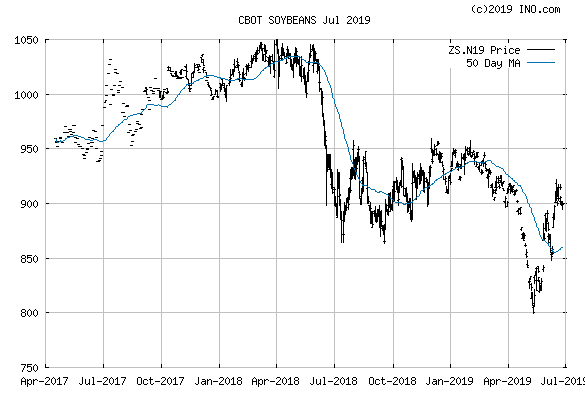
Source: ino.com, accessed 6/26/2019 10AM Pacific.
Here is a graph of the front-month futures (July 2019, expires 12th) for soybeans:
Source: ino.com, accessed 6/26/2019 10AM Pacific.
On this day, in 1982, at the height of the hysteria focused on competition from Japan, two unemployed auto workers chased down Vincent Chin — celebrating his bachelor’s party — and beat him senseless with a baseball bat (he subsequently died from his injuries). As we re-establish Camp Sill as an internment/detention/concentration camp (you pick the term), and the deportation campaign — real or imagined — is announced, it’s perhaps time to recall the warning signs:
In context:
Industrial production, personal income ex-transfers, and Macroeconomic Advisers’ monthly GDP are all below recent peak; manufacturing and trade industry sales and nonfarm payroll employment are still rising (although barely, in the latter case). Here’s a graph of these five indicators.
From Ben White in Politico today:
President Donald Trump is firing up his economic Wayback Machine in an effort to boost markets, the economy and his own political fortunes heading into his reelection campaign.
Economists warn that Trump’s approach, with its roots in 19th century mercantilism and 1980s Reaganism, risks back-firing on him in potentially significant ways.
Keep on saying that we’re winning, and maybe it’ll come true. For the rest of us grounded in reality, soybean prices are falling again, and soybean stocks are rising (and estimates of end FYMY2018/2019 stocks have just been revised upward).
Reader CoRev continues to voice skepticism about the predictive ability of soybean futures. He asks for
proof, with successful predictions, of the validity of…your soybean price model….BTW, we are getting closer to the model’s magic validation date.
I saw this Seattle Times article while visiting my hometown, and it struck me as relevant, as the Trump administration is now deporting veterans, willy nilly. From the article.
When the [Second World] war began, the United States government had not yet repealed the Chinese Exclusion Act of 1882, the nation’s first immigration ban on a specific ethnic group. The law severely limited Chinese immigrants from entering the country and becoming naturalized citizens for more than 60 years, until the end of 1943.
This meant that while up to 20,000 Chinese Americans served in the military during World War II, about 40% were not even granted citizenship, according to the Chinese-American World War II Veteran Congressional Gold Medal Act.
Today, we present a guest post written by Jeffrey Frankel, Harpel Professor at Harvard’s Kennedy School of Government, and formerly a member of the White House Council of Economic Advisers. A shorter version appeared in Project Syndicate on June 14th, and in The Guardian.
Perusing the last issue of the Economist, I noted that among advanced economies, only Greece (180 bps), Spain (87 bps), Australia (133 bps), South Korea (112 bps) and Chile (108 bps) had larger declines in the ten year yields than the US (81 bps).
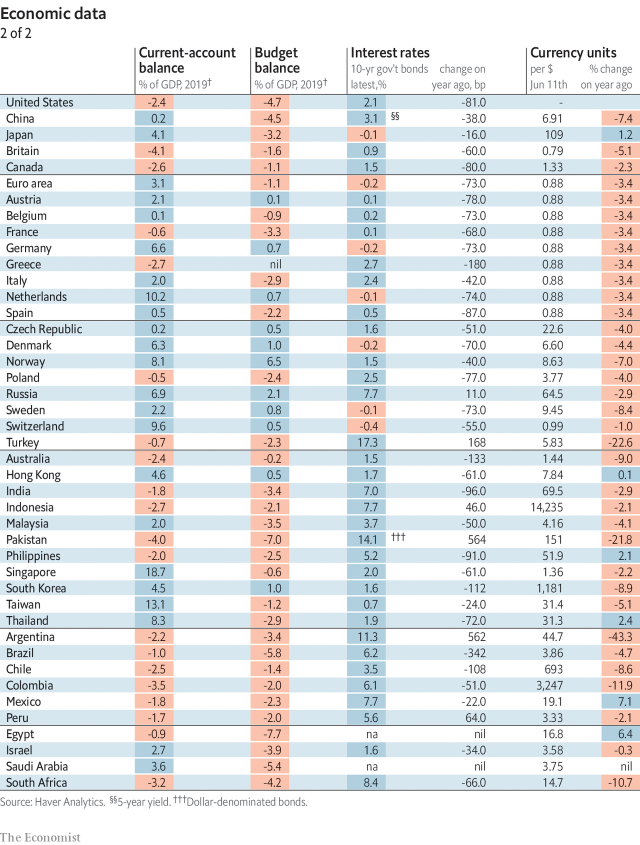
Of these, one could argue Greece and Spain declines were attributable to a decline in default risk, leaving only Australia, South Korea and Chile.
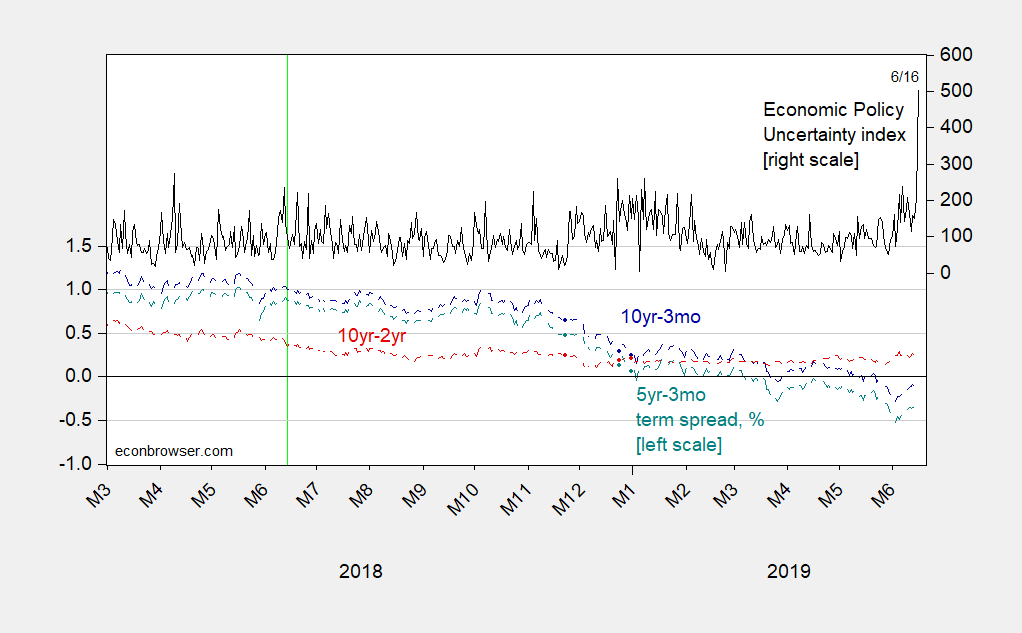
Figure 1 below illustrates what has happened to 10yr-3mo, 10yr-2yr and 5yr-3mo spreads over the past year (indicated by vertical green line)
Today, we present a guest post written by Jeffrey Frankel, Harpel Professor at Harvard’s Kennedy School of Government, and formerly a member of the White House Council of Economic Advisers.