according to PredictIt as of 4:35PM Central.
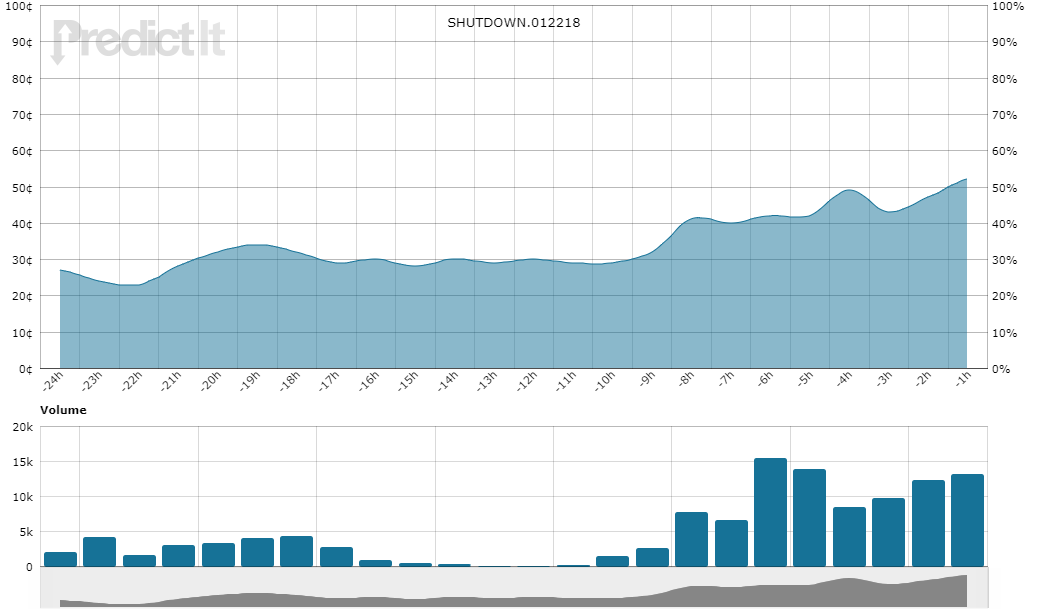
according to PredictIt as of 4:35PM Central.
Today, we present a guest post written by Jeffrey Frankel, Harpel Professor at Harvard’s Kennedy School of Government, and formerly a member of the White House Council of Economic Advisers..
In response to my quote of CRFB’s assertion that average growth acceleration under the Tax Cuts and Jobs Act relative to baseline will be only between 0.01-0.02 percent (shown below),
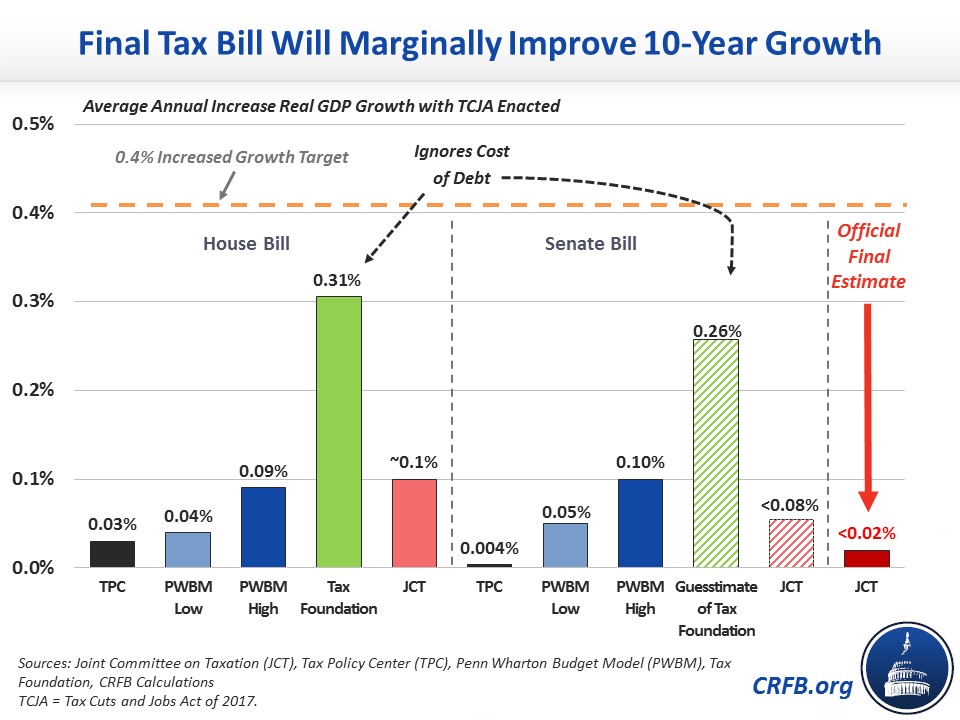
Source: Committee for a Responsible Federal Budget (Jan. 3, 2018).
Reader Vivian Darkbloom writes:
I’m asking myself how an average increase of only 0.01 percent to 0.02 percent in GDP growth over a decade could result in an average of increase in the level of GDP output of 0.7 percent of that same ten-year period as reported by the CFRB and Menzie.
and continues:
Either you need to justify it (and the related text regarding the assertion that it is 1/20th to 1/40th of the McConnell estimate), or retract it.
Not lying so much as willfully misleading.
I had the misfortune to watch Stephen Moore debating approval ratings for Trump by African Americans. From RawStory:
…you have to look at [Trump’s] record when it comes to civil rights not necessarily what he said or is alleged to have said,” Moore answered. “Brooke, if this man is a racist, why is it that his approval rating, among blacks, has increased while he has been president? It’s because of his record, not what he says.”
Once again I’m going to save Donald Trump some time in writing up the legislation. Here is some handy-dandy text borrowed from the Chinese Exclusion Act of 1882.
What does it mean for economic activity?
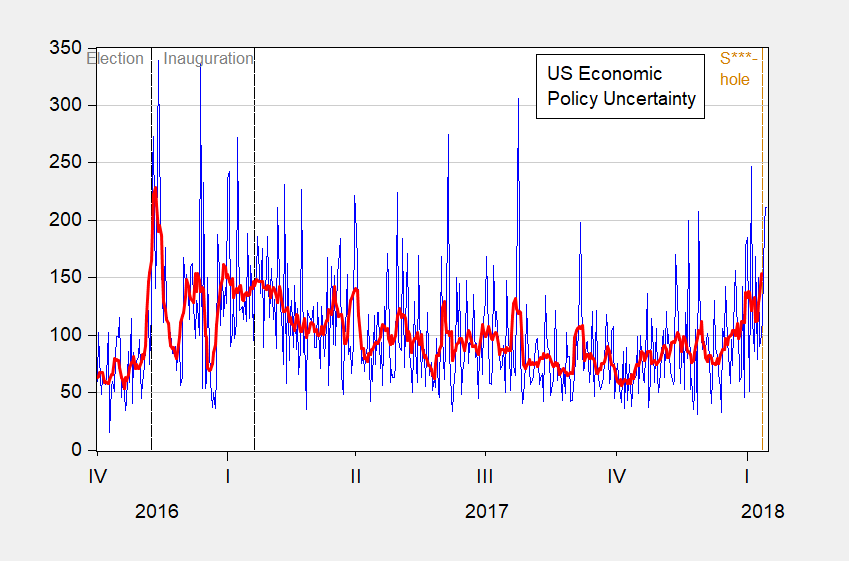
Figure 1: Daily US Economic Policy Uncertainty Index (blue), and centered 7 day moving average (bold red). Source: policyuncertainty.com accessed 1/15/2018, and author’s calculations.
Does economic policy uncertainty matter for real activity. In a new CEPII brief, Laurent Ferrara, Stéphane Lhuissier & Fabien Tripier review the evidence in “Uncertainty Fluctuations: Measures, Effects and Macroeconomic
Policy Challenges”.
Their Lesson #3 is particularly interesting.
The effectiveness of economic stabilization
policies depends on the state of uncertainty and should
then be adapted accordinglyBeside the role of public authorities in stabilizing political,
economic and financial uncertainty, the channel of
transmission of macroeconomic policies is likely to be
impaired by uncertainty. Under conditions of high uncertainty,
the effectiveness of fiscal and monetary policies is damaged,
and thus economic actors (households, firms, and investors)
become less inclined to respond to policy impulses. …
Entire brief here.
More on uncertainty, relating to Brexit, here, JIMF-BdF-UCL conference here, at ASSA here.
Now at 29%, according to PredictIt, for 1/22 (CR ends midnight this Friday).
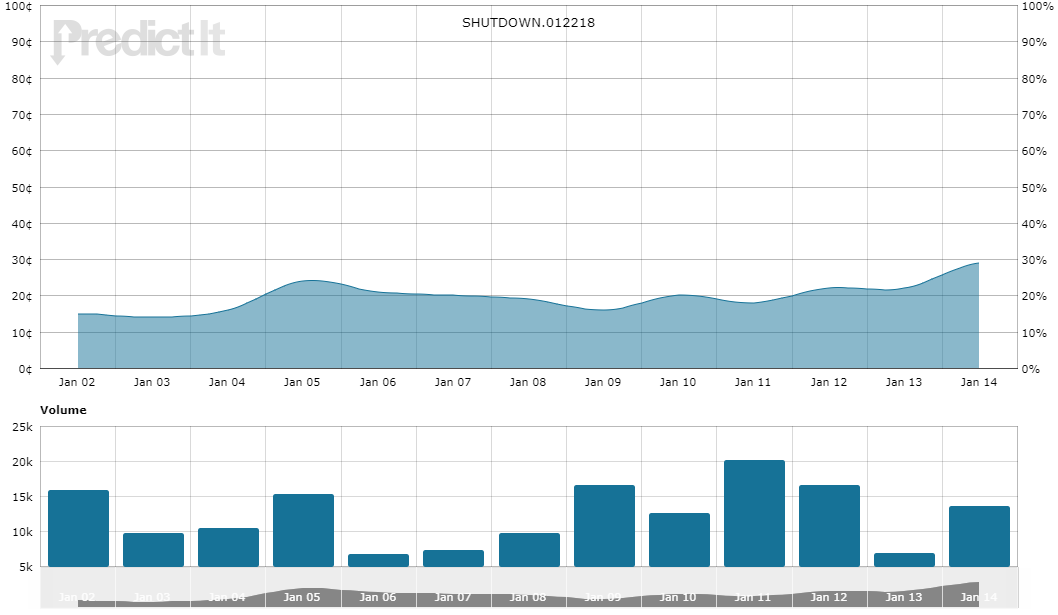
Source: PredictIt.
So we’re back to this again? From CNN:
“They can pay for it indirectly through NAFTA,” Trump said Thursday in an interview with The Wall Street Journal. “We make a good deal on NAFTA, and, say, ‘I’m going to take a small percentage of that money and it’s going toward the wall.’ Guess what? Mexico’s paying.”
From Reuters:
U.S. Treasury Secretary Steven Mnuchin said on Friday he believed the Republican tax cuts will ultimately become revenue neutral over 10 years due to higher growth, but the Treasury will likely ask Congress for more money to implement the plan.
We tell our students not to read too much into the strength or weakness of a currency. However, the dollar’s trajectory since November 2016 is quite striking.
Continue reading