Again.
Author Archives: Menzie Chinn
The Financial Regulatory Policies of Senator Sanders…Again
The ironies abound
Guest Contribution: “Stagnant incomes of white workers do not explain Trump”
Today we are pleased to present a guest contribution written by Jeffrey Frankel, Harpel Professor of Capital Formation and Growth at Harvard University, and former Member of the Council of Economic Advisers, 1997-99.
Wisconsin’s Dependence on Exports
On the eve of the primary votes in Wisconsin, where protectionists are set to make some inroads, it’s of interest to consider the state’s reliance on exports — including those to China (a target of both Senator Sanders and Mr. Trump) and Mexico [1].
What Is “Solid Economic Reasoning”?
Writing in The Nation, Robert Pollin asserts:
All of [Bernie Sanders’s] major proposals are grounded in solid economic reasoning and evidence.
US-China Trade Policies: the Nuclear — and Near-nuclear — Options
Substantial attention has been devoted to the disasterous effects of implementing a Donald Trump agenda of imposing 45% tariffs on imports of goods from China. To gain some perspective, consider the implications for prices of goods imported from China if such a tariff were imposed (and a large country assumption used, so that only half of the tariff increase manifested in increased prices).
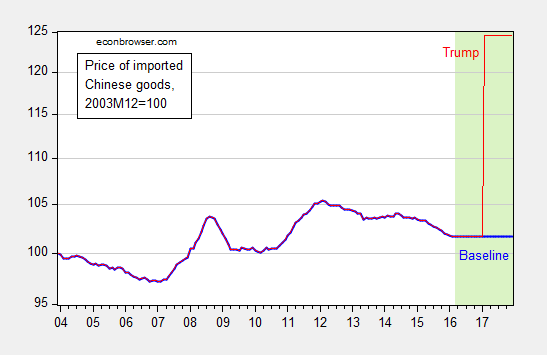
Figure 1: Price of Chinese commodity imports, 2003M12=100, with 2016M03 values at 2016M02 values (bold blue), and a 22.5% higher price level as of 2017M02 assuming the half of incidence falls on the US (red). Light green shaded area denotes projection period. Vertical axis is logarithmic. Source: BLS, and author’s calculations.
Obviously, drop the large country assumption, and the resulting price increase can be up to 45%.
Wisconsin Employment Still Lags (Quelle Surprise!)
BLS just released state level data. Wisconsin employment nonfarm payroll employment is up, but remains below what is expected given the historical relationship between US and Wisconsin employment — by 63.2 thousand…
Guest Contribution: “Inequality: Diagnoses and Prescriptions”
Today we are pleased to present a guest contribution written by Jeffrey Frankel, Harpel Professor of Capital Formation and Growth at Harvard University, and former Member of the Council of Economic Advisers, 1997-99. This is an extended version of one published in Project Syndicate.
Text of Executive Order 9066
From The Hill:
Republican presidential front-runner Donald Trump echoed rival Ted Cruz on Tuesday in calling for patrols of Muslim neighborhoods in the U.S., and said the country must begin torturing terror suspects to get information out of them.
“The End of Research in Wisconsin”
That’s the title of a Slate article documenting the implications of recent policy actions implemented in the state of Wisconsin.