In light of the provision to sell off power plants in Wisconsin under no-bid contracts, this photo caught my eye:
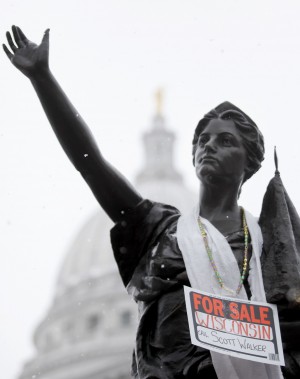
Source: Capital Times
In light of the provision to sell off power plants in Wisconsin under no-bid contracts, this photo caught my eye:
Source: Capital Times
The Economic Report of the President, 2011 is out. The topical chapters are:
Two Items Regarding Fiscal Policy
US GDP and the Stimulus Package
The 2nd release for US GDP revealed a downward revision BEA; CR reports the breakdown. What is interesting is that the downward revision is due in part to a greater than previously estimated decline in the state and local government spending contribution. Something useful to keep in mind as state and local governments move to rely solely upon spending cuts instead of revenue increases as means to reduce budget deficits (e.g., as in Wisconsin).
My colleague, Charles Engel, has a new paper entitled The Real Exchange Rate, Real Interest Rates, and the Risk Premium, in which he tries to identify what characteristics an exchange rate model must possess in order to explain two stylized facts.
…The well-known interest parity puzzle in foreign exchange markets finds … the high interest rate country tends to have the higher expected return in the short run. The second stylized fact concerns evidence that when a country’s relative real interest rate rises above its average, its currency tends to be stronger than average in real terms.
Following up on Walker says National Guard is prepared (2/11), from Wisconsin State Journal:
Madison — As large labor protests continue at the Capitol, the Wisconsin National Guard has toured more than one prison in the state, a spokeswoman said Tuesday.
The Journal Sentinel reported Monday that National Guard members last week had toured Redgranite Correctional Institution with its security director. On Tuesday, Lt. Col. Jackie Guthrie, spokeswoman for the National Guard, confirmed that other prisons had been visited as well.
Econbrowser reader Bob_in_MA has argued that Governor Walker’s [the] (edit 7:50am 2/22) desire to strip collective bargaining rights from Wisconsin public employees is derived in part from the high labor costs, hidden in part by large unfunded liabilities (e.g. pensions) in the state. This might be an apt characterization for Massachusetts. It is not for Wisconsin. From the Pew Center for the States:
Some states are doing a far better job than others of managing this bill coming due. States such as Florida, Idaho, New York, North Carolina and Wisconsin all entered the current recession with fully funded pensions.
[Executive board president of the Wisconsin Law Enforcement Association] Tracy Fuller writes, “I am going to make an effort to speak for myself, and every member of the Wisconsin State Patrol when I say this … I specifically regret the endorsement of the Wisconsin Trooper’s Association for Gov. Scott Walker. I regret the governor’s decision to ‘endorse’ the troopers and inspectors of the Wisconsin State Patrol. I regret being the recipient of any of the perceived benefits provided by the governor’s anointing. …
From Milwaukee Sentinel Journal:
…The Walker statement was in response to a statement earlier Saturday from [State senator] Erpenbach, who said he had been informed that all state and local public employee unions had agreed to the financial aspects of Walker’s budget-repair bill. Erpenbach added in his statement that the groups wanted, in turn, for Walker to agree to let labor groups bargain collectively, as they do now.
From Congressional Budget Office, in a letter dated today:
…CBO and JCT [Joint Committee on Taxation] estimate that, on balance, the direct spending and revenue
effects of enacting H.R. 2 would cause a net increase in federal budget
deficits of $210 billion over the 2012-2021 period ….
From the Legislative Fiscal Bureau, roughly analogous to the Congressional Budget Office, an assessment (p.11) that notes the tax revenue implications of three bills implemented under the current Administration: