By Assaf Razin
Today, we’re fortunate to have Assaf Razin, Friedman Professor of International Economics at Cornell University, and Professor Emeritus at Tel Aviv University, as a Guest Contributor.
By Assaf Razin
Today, we’re fortunate to have Assaf Razin, Friedman Professor of International Economics at Cornell University, and Professor Emeritus at Tel Aviv University, as a Guest Contributor.
From the just-released Kauffman Economic Outlook, authored by Tim Kane, an indicator of what some economists thought the ARRA accomplished, in terms of unemployment.
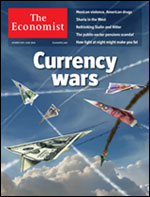
With the cover page of the Economist [1] [2] worrying about currency wars, and various analysts arguing whether the US can or cannot win such a “war” (see Naked Capitalism for a discussion), I thought it would be useful to see where we now stand, in terms of “competitiveness”, as understood by open economy macroeconomists.
I’ve been lecturing on the government sector in my macro course. In updating my lecture notes, I plotted out some interesting graphs, which link up nicely with this previous post. The following four figures highlight: (1) normalized Federal outlays are not much higher than in 1986; (2) government consumption to GDP is back up to 1991 levels; (3) the cyclically adjusted budget deficit is only 2 ppts larger than that recorded in 1987; and (4) Federal consumption remains far below the previous peak in 2007.
That was the title of a seminar at the annual IMF-World Bank meetings I participated in last Thursday (agenda here).
Today, we’re fortunate to have Mark Copelovitch, Assistant Professor of Political Science and Public Affairs at the University of Wisconsin, as a Guest Contributor. He is also author of The International Monetary Fund in the Global Economy: Banks, Bonds, and Bailouts (Cambridge University Press, 2010).
As we ponder the plight of the over-$250K household income group (see the poignant story here), I think it worthwhile to examine the unemployment and underemployment rates for lower-income households. In researching statistics for our forthcoming book, Lost Decades, Jeff Frieden and I stumbled upon this study by Andrew Sum and Ishwar Khatiwada, with Sheila Palma, of Center for Labor Market Studies at Northeastern University. They characterized the mid-2010 employment situation as “A Truly Great Depression Among the Nation’s Low Income Workers Amidst Full Employment Among the Most Affluent”.
From an article in the newest issue of GlobalAsia:
Only a few months ago, policymakers around the world were confronted with a series of challenges that, while substantial, seemed relatively well defined. International organizations such as the International Monetary Fund and the Organization for Economic Cooperation and Development highlighted the challenges of a two-speed recovery: emerging markets racing ahead, advanced economies plodding along. Global financial imbalances, particularly in current accounts, were a worry, but there were promising signs that growth and rebalancing in the United States and China would prove durable.
The prospects for a sustained global recovery now seem much less certain. …
Or at least, WEO Chapters 3 and 4.
Chapter 3 is entitled “Will It Hurt? Macroeconomic Effects of Fiscal Consolidation”, and Chapter 4 is “Do Financial Crises Have Lasting Effects on Trade?”. Also online are Chapters 3 and 4 from the IMF Global Financial Stability Report.
Frank Warnock, an expert on US capital flows and stocks, has just written a piece for CFR entitled Two Myths About the U.S. Dollar. In it, he examines “two factors that could substantially alter the long-run value of the U.S. dollar: the dollar’s reserve status and the sustainability of U.S. international debt.”