President Obama’s trip to China has returned to scrutiny the role of China’s currency and macroeconomic policies in perpetuating global imbalances. [0] [1] [2]
Author Archives: Menzie Chinn
GDP: Revisions and Forecasts
There’s been some discussion of how the GDP estimates for 2009Q3 might be revised downward in light of the September trade release [1]. e-Forecasting has presented its latest estimates up to October, and Macroeconomic Advisers through September. Macroeconomic Advisers writes:
Assessing the Impact of Government Policy on Widget Consumption and Widget Sector Capital Usage
Let supply and demand for widgets (y) be given by the following two equations, respectively:
(1) yt = αt + β x t + ε t
(2) yt = γ + δ x t + Γ z t + u t
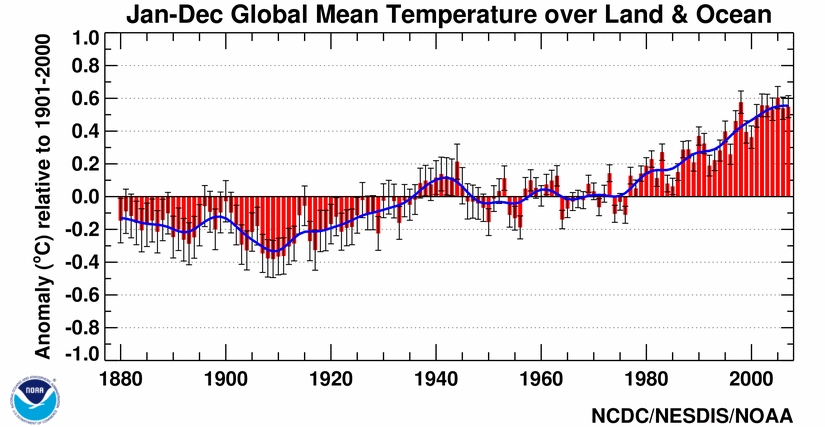
The Global Surface Temperature Anomaly
Politico Does Economic Analysis…
Be afraid; be very afraid.
From “‘Created or saved’ doesn’t add up”, by Joseph Lawler:
…[t]he “created or saved” numbers are meaningless. The administration purposefully devised the metric to be nebulous. Without a counterfactual, showing the trend of unemployment in the absence of the stimulus, it is impossible to know how many jobs the stimulus saved.
“Where’s the Consumption Disaster?”
Casey Mulligan asks:
So a year later, in September 2009, after living through a year of “disaster,” how did real consumption expenditure (one economists’ favorite measures of living standards) compare to what it was in September 2008?
Guest Contribution: The Liquidity Trap Does Not Make Monetary Policy Ineffective
By Joseph E. Gagnon
Today, we’re fortunate to have Joe Gagnon, senior fellow at the Peterson Institute for International Economics, as a guest contributor.
Some Thoughts Elicited by Reading Some Calibration Papers
(Warning: Might be considered “wonky” by some) In many economic analyses, one wants to isolate the “business cycle” component of macroeconomic series. Here is one such series, which has had a detrending technique applied to it. Try to guess what it is.
Prospects for Employment under Differing Econometric Specifications
Most economists are projecting a slow recovery in terms of employment. What do historical correlations imply?
On Revisions and on Conditioning
Both have to be “handled with care”.
Revisions
We’re all tempted to make predictions on the basis of the last data point. And even more difficult to resist is the temptation to make definitive statements on the basis of data that are sure to be revised. For instance, we see this question from Casey Mulligan, “Where’s the GDP Disaster?”.
Last October, when we were told that spending and incomes were about to collapse, I predicted that “real GDP will not drop below $11 trillion (chained 2000 $).”