I was interviewed on the weekly newsmagazine Here and Now today about Mr. Trump’s tariffs on steel and aluminum:

Regarding Wisconsin, cheese was not on the Hit List, but motorcycles and cranberries were.
I was interviewed on the weekly newsmagazine Here and Now today about Mr. Trump’s tariffs on steel and aluminum:
Regarding Wisconsin, cheese was not on the Hit List, but motorcycles and cranberries were.
which should give you pause for thought about national-security-rationalized tariffs. Output stable, real prices up.
Ed Hanson asserts that by showing a plot of monthly data constructed as an average of daily data, I am changing the message of the data. In order to assure people that the Trilateral Commission/the Illuminati/CigaretteSmokingMan haven’t “gotten to me” to manipulate the data, I’m going to show permutations of the Baker/Bloom/Davis Economic Policy Uncertainty (EPU) data, news based index.
The answer is “yes”.
Remember those quaint notions of policy uncertainty holding back growth? Well, what to make of recent moves in uncertainty and risk indices, given all the talk of trade wars?
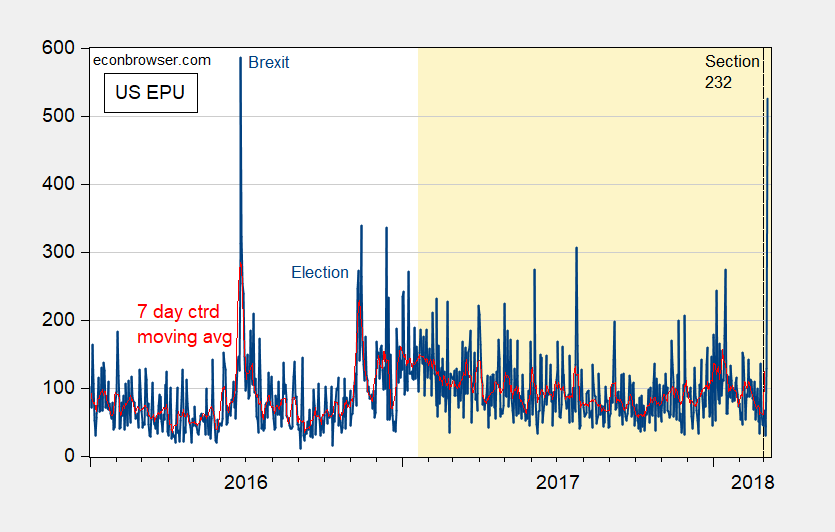
Figure 1: US daily Economic Policy Uncertainty index from Baker, Bloom and Davis (dark blue), and seven day centered moving average (red). Orange shading denotes Trump Administration. Source: policyuncertainty.com, and author’s calculations.
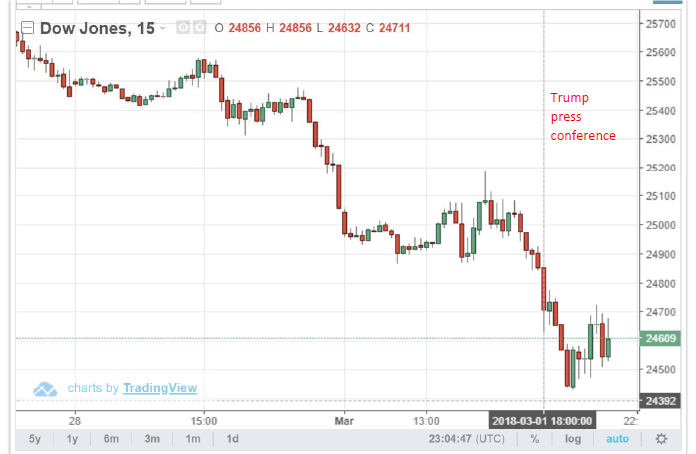
Figure 1: Dow Jones, 15 minute increments. Source: TradingEconomics.

Mr. Trump has stated his intention of raising tariffs on steel and aluminum, based on national security grounds. See this post on the specious aspects of this argument, and this recent EconoFact column on the hits to the economy that would result from steel tariffs. The EU has hinted at striking at Wisconsin cheese in retaliation (Wisconsin is the second largest state exporter). This makes perfect sense from a strategic perspective – agriculture is America’s comparative advantage, and Wisconsin’s Representative Paul Ryan is Speaker.

Figure 1: Goods trade balance (blue), and trade balance (red), in billions of $, SAAR. Orange shading denotes 2017M01-onward. Source: BEA/Census, author’s calculations.
I think I’ve had enough of “winning so much”.
That’s the title of a paper with David Greenlaw, Managing Director of Morgan Stanley, Ethan Harris, head of global economics research at Bank of America Merrill Lynch, and Kenneth West, professor of economics at the University of Wisconsin, which we presented at the U.S. Monetary Policy Forum annual conference in New York on Friday.
Continue reading
Today, we present a guest post written by Jeffrey Frankel, Harpel Professor at Harvard’s Kennedy School of Government, and formerly a member of the White House Council of Economic Advisers. This is an extended version of a column that appeared at Project Syndicate on February 22nd.