Now at 29%, according to PredictIt, for 1/22 (CR ends midnight this Friday).
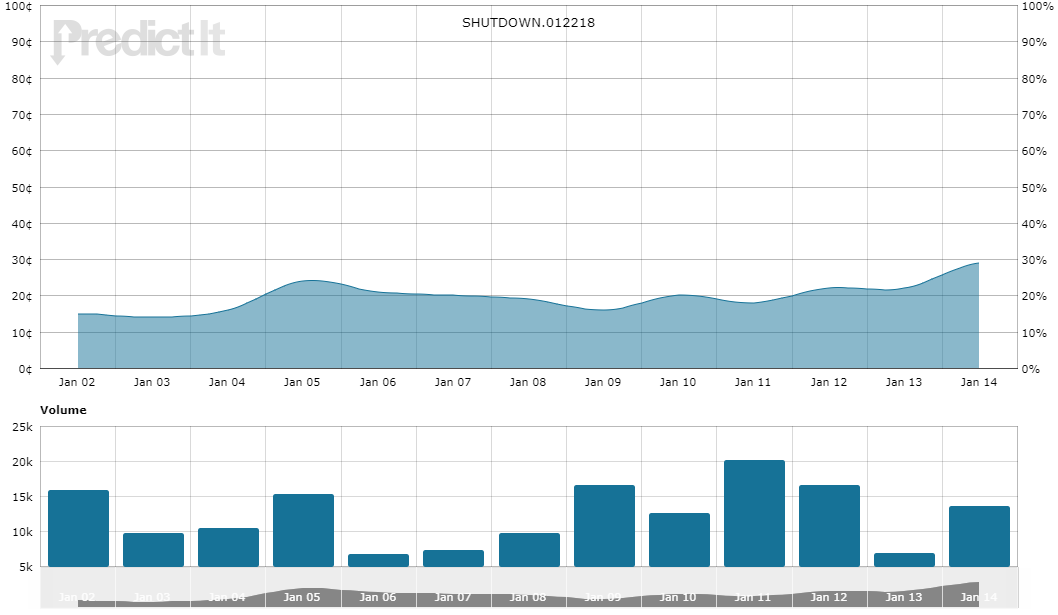
Source: PredictIt.
Now at 29%, according to PredictIt, for 1/22 (CR ends midnight this Friday).
Source: PredictIt.
So we’re back to this again? From CNN:
“They can pay for it indirectly through NAFTA,” Trump said Thursday in an interview with The Wall Street Journal. “We make a good deal on NAFTA, and, say, ‘I’m going to take a small percentage of that money and it’s going toward the wall.’ Guess what? Mexico’s paying.”
From Reuters:
U.S. Treasury Secretary Steven Mnuchin said on Friday he believed the Republican tax cuts will ultimately become revenue neutral over 10 years due to higher growth, but the Treasury will likely ask Congress for more money to implement the plan.
We tell our students not to read too much into the strength or weakness of a currency. However, the dollar’s trajectory since November 2016 is quite striking.
Continue reading
Never have so many simulations been ignored in favor of faith in tax cuts. Here’s the CRFB’s run down on growth impacts from the tax legislation as passed.
Today, we present a guest post written by Jeffrey Frankel, Harpel Professor at Harvard’s Kennedy School of Government, and formerly a member of the White House Council of Economic Advisers. This is an extended version of a column that appeared at Project Syndicate.
A few years ago, most economic models presumed that interest rates were subject to a lower bound of zero. Why lend a dollar to someone who only promises to pay you back 99 cents, when you could just hold on to the dollar yourself? But we now have several years of experience from Sweden, Denmark, Switzerland, Japan, and the European Central Bank in which the central bank successfully induced negative interest rates in hopes of stimulating a greater level of spending on goods and services. We have enough data now to take a look at how much that seems to have accomplished, and update my earlier discussion of this topic.
Continue reading
That’s a title of a July 28 piece in IBD. He writes:
According to the Energy Information Administration, which tracks energy use in production on a monthly basis, the single largest source of electric power for the first half of 2017 was…coal.
Or statistical incompetent, just for the record for the new year.