Last week I discussed the tools that the Federal Reserve will be using to raise short-term interest rates as we enter the next phase of U.S. monetary policy. In brief, the Fed plans to use interest on reserves and reverse repurchase agreements as an offer to borrow back Federal Reserve deposits at an annual rate between 25 and 50 basis points (0.25% to 0.50% interest per year). That offer from the Fed puts an effective floor under the fed funds rate, which is the rate at which institutions would lend these funds overnight to other banks. When the Fed raises its offering rate, the fed funds rate should go up with it. Today I look at the implications of these new procedures for the Fed’s balance sheet.
Continue reading
Guest Contribution: “Emerging Markets Facing Higher U.S. Interest Rates: Smooth Sailing or Perfect Storm?”
Today we are pleased to present a guest contribution written by Carlos Arteta, M. Ayhan Kose, Franziska Ohnsorge, Marc Stocker, and Lei Sandy Ye, all of the World Bank. This blog represents the views of the authors and does not necessarily represent World Bank Group views or policy.
Merry Christmas from Econbrowser
We wish all our readers the best of everything this season.
Guest Contribution: “The Paris Agreement on Climate Change, C’est Bon”
Today we are fortunate to have a guest contribution written by Jeffrey Frankel, Harpel Professor of Capital Formation and Growth at Harvard University, and former Member of the Council of Economic Advisers, 1997-99. An earlier version was published by Project Syndicate.
Continue reading
Implementing monetary policy in 2016
On Wednesday the Federal Reserve announced that it is increasing its target for the fed funds rate to a new range of 25 to 50 basis points (0.25% to 0.5% annual rate). How does the Fed plan to accomplish this, and what does it mean for other interest rates?
Continue reading
Guest Contribution: “U.S. Monetary Expectations and Emerging Market Debt Flows”
Today we are fortunate to have a guest post written by Eric Fischer, PhD candidate at the University of California, Santa Cruz.
Links for 2015-12-13
Quick links to a few items I found interesting.
Continue reading
Guest Contribution: “Does legislating a rule for the Federal Reserve make sense?”
Today we are fortunate to have a guest contribution written by Carl E. Walsh, Distinguished Professor of Economics at the University of California, Santa Cruz.
Estimating Shock Dependent Exchange Rate Pass-Through
We propose a new focus: incorporating the underlying shocks that cause exchange rate fluctuations when evaluating how these fluctuations ‘pass through’ into import and consumer prices.
Mass Shooting Casualties, by Religion of Perpetrator: Muslim vs. Non-Muslim
Update, 6/12/2016, 4:15PM Pacific:
Here are two figures, with data updated to 6/12.
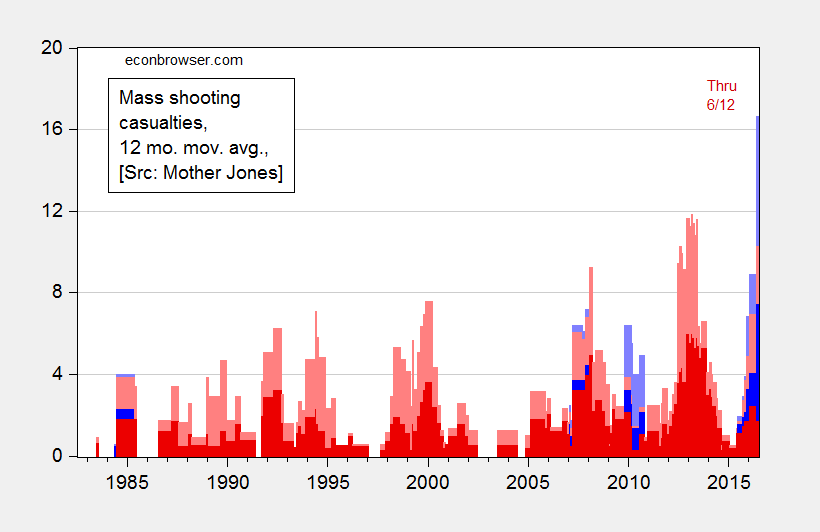
Figure 0a: 12 month moving average of mass shooting casualties; deaths inflicted by non-Muslims (dark red), wounded inflicted by non-Muslims (pink), deaths inflicted by Muslims (dark blue), wounded inflicted by Muslims (light blue). June observation for data through June 12. Source: Mother Jones, news reports for June 2016 and author’s calculations. Tabulations of religion of perpetrator by author.
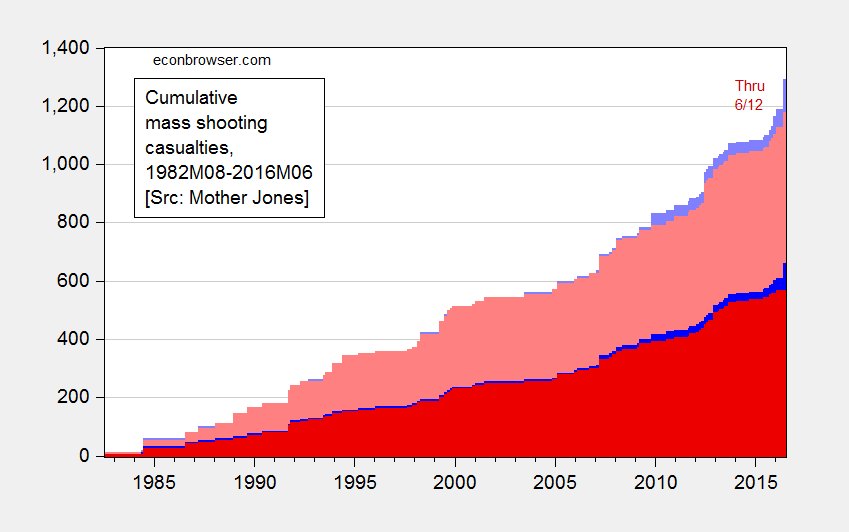
Figure 0b: Cumulative sum of mass shooting casualties, beginning in 1982M08; deaths inflicted by non-Muslims (dark red), wounded inflicted by non-Muslims (pink), deaths inflicted by Muslims (dark blue), wounded inflicted by Muslims (light blue). June observation for data through June 12. Source: Mother Jones, news reports for June 2016 and author’s calculations. Tabulations of religion of perpetrator by author.