One key question in determining the impact of instability in Libya and elsewhere on world oil markets is how much other countries can and will increase production to offset the shortfall. Here I review the critical role of Saudi Arabia in past disruptions and discuss the current situation.
Dispatches (VIII): A Dog’s Life in Wisconsin
Or, don’t lose your dog in Wisconsin.
Just one of the odd bits of legislation winding through Madison, WI. From AB40:
SECTION 2704. 174.13 (2) of the statutes is amended to read:
174.13 (2) Any officer or pound which has custody of an unclaimed dog may
release the dog to the University of Wisconsin System, the University of
Wisconsin–Madison, the Medical College of Wisconsin, Inc., or to any other
educational institution of higher learning chartered under the laws of the state and
accredited to the University of Wisconsin System or University of
Wisconsin–Madison, upon requisition by the institution.
The Challenges of Long Term Unemployment
The composition and implications of long term unemployment has been vigorously debated over the last year. The most recent informed commentary (skipping non-evidence based assessments [1]) includes Macroblog and SF Fed (earlier discussion here and here). Two conferences on the subject will be held at the University of Wisconsin-Madison, this Friday, and later at the end of April.
The magnitude of the phenomenon can be illustrated by inspecting mean unemployment duration, and number of unemployed over 27 weeks.
The 25 best financial blogs
Time magazine has a list of the 25 best financial blogs, in which they included blog reviews written by other bloggers. Here’s what I said about my favorite blog:
If you only follow one economics blog, it has to be Calculated Risk, run by Bill McBride. The site provides concise and very accessible summaries of all the key economic data and developments. One of the reasons McBride is able to do this so well is that he has an almost uncanny knack of recognizing which facts really matter. He began the blog in 2005 because he saw a disaster brewing in the form of the housing bubble, and tried his best to warn the rest of us of what was coming. I’ve followed him closely ever since, and I don’t know if he’s ever been wrong. My advice is, if you’ve come up with a different conclusion from McBride on how economic developments are going to unfold, you’d be wise to think it over again!
Velocity of Federal Reserve deposits
I’ve been emphasizing that the U.S. Federal Reserve has not been printing money in the conventional sense of creating new dollar bills that have ended up in anybody’s wallets. Instead, the Fed has been creating new reserves by crediting the accounts that banks maintain with the Fed. Today I’d like to offer some further observations on how those reserve balances mattered for the economy historically, how they matter in the current setting, and how they may matter in the future.
Dispatches (VII): WWBD?
Or, “What Would Bob (La Follette) Do?”
Since I teach in the Robert M. La Follette School of Public Affairs, this WSJ article “‘Fighting Bob’ Fights Right On” caught my eye. From the article:
Protesters’ signs and online discussions have repeatedly invoked La Follette, a turn-of-the-20th century Wisconsin governor and U.S. senator. His bust has become a locus of the protest, with demonstrators draping flowers around its neck and festooning its pedestal with signs saying “Long Live La Follette” and “What Would Bob Do?”
Good news from autos– for now
The price of oil rose from $80 a barrel in September 2007 to average $134 in June 2008. The toll this took on the U.S. auto industry was in my mind an important factor that contributed to the first year of the Great Recession in 2007:Q4-2008:Q3. Given the recent concerns about oil supplies in North Africa and the Middle East, it’s useful to review what happened three years ago and relate it to where we stand at the moment based on the February auto sales data that were just released.
Crowding Out Watch, Updated
I’m teaching the concept of portfolio crowding out in my intermediate macro course (handout with algebra here) now, and as I was going through the notes, I observed that last I had checked, there was (still!) little evidence of crowding out. Here’s the graph, updated with data through 2/25 (that is, pretty much the same story as last time I discussed this, despite the hysterics).
Dispatches (VI): Where Do Those Budget Numbers Come From?
Wisconsin Governor Walker has been stating that if his “budget repair bill” is not passed, then the state will lose $165 million dollars. It is unclear what exactly would be “lost” if the bill is not passed. From the New York Times:
“One day left to save the state $165 million,” said the governor’s office on Monday, announcing the latest deadline.
If Democrats do not return by Tuesday, taxpayers would lose an option to save that money through a “refinancing,” the governor’s office said, citing the Wisconsin Legislative Fiscal Bureau, a nonpartisan agency that conducts budget analysis.
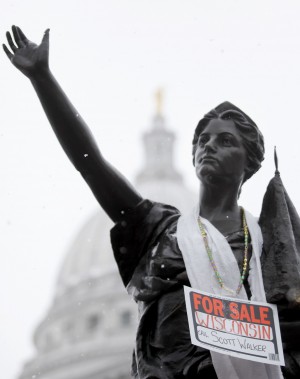
Dispatches (V): Wisconsin – Open for Business or For Sale?
In light of the provision to sell off power plants in Wisconsin under no-bid contracts, this photo caught my eye:
Source: Capital Times