There’s been a debate over the cause of the trade flow drop-off, with varying explanations being offered. Broadly speaking, the explanations are (1) trade credit and credit crunch more broadly, (2) enhanced vertical specialization implying higher income elasticities, and (3) compositional effects (the trade dependent sectors were those most highly affected in the latest recession). Without necessarily offering definitive evidence one way or the other, I wanted to quantify the extent to which income elasticities had to be higher in order to rationalize the movements observed in US data.
Should the Fed be the nation’s bubble fighter?
That’s a question recently taken up by
the Wall Street Journal. Here are my thoughts.
College football playoffs
Employment Bounceback?
From Peter Hooper, Torsten Slok, Christine Dobridge, “Robust growth needed to avoid jobless recovery,” Deutsche Bank Global Economic Perspectives (Dec. 9) [not online]:
Commodity prices and the Fed
I’ve been discussing possible explanations for the recent tendency of the dollar prices of commodities to move together. On Friday we received a very useful data point for distinguishing between the different hypotheses.
Exchange Rate Policies
My colleague Charles Engel has a new paper circulated by the Dallas Fed entitled “Exchange Rate Policies”, which brings theory to bear on the topic. From the introduction:
Deficit links
Some quick excerpts of what others are saying.
The Employment Situation in Graphs
…and an initial read on monthly GDP.
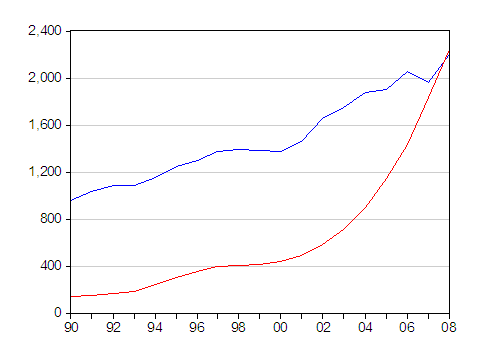
Interesting Picture of the Day
Politico American Spectator’s Joseph Lawler Goes Nihilist
Be afraid, be very afraid…again. From Joseph Lawler
… I take yesterday’s CBO report as affirmation both that … the number of jobs created by the stimulus cannot be determined without making judgment calls about the underlying economic model …