The Paranoic Impulse in Current Discourse

Or, “return of the black helicopters”

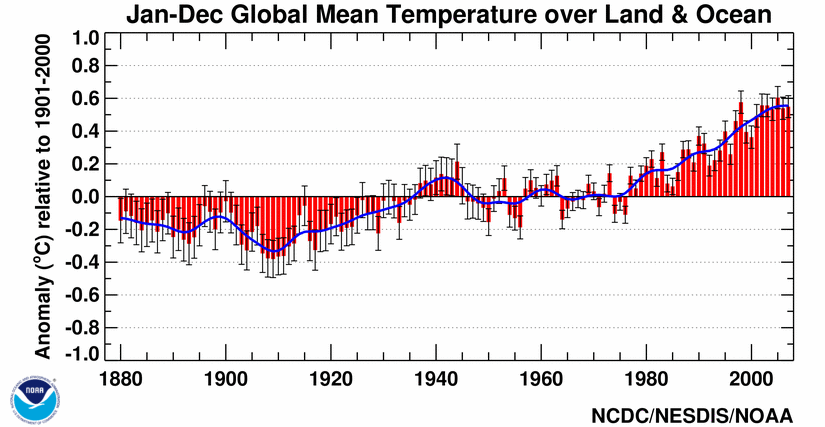
Plenty of examples of hyperbole in current policy discussions, but here I want to return [0] to the specific topic of whether several key data series examined by economic analysts can be trusted, or whether in fact they are deliberately manipulated by government bureaucrats. Case in point is Econbrowser reader DickF‘s comments:

The government thinks it can run the economy on data that is years old and inaccurate at best. Also any time numbers are manipulated by government there is a political element involved. The whole reason the numbers are manipulated is to the will be “more normal” but who decides what is normal? In the government political bureaucrats who know their jobs depend on pleasing the politically connected. This is just another reason why centrally planned economies always fail. The hubris in government economic circles is enormous.

I am not saying that the agencies are manipulating data to make “each respective Administration look good.” Sometimes they manipulate date to make an Administration look worse than it actually is. It depends on their political inclination.

Continue reading

Exchange Rates: New Papers

During the summer, I had the good fortune to attend two excellent conferences focused on new findings in exchange rate economics (yes, not all economic research is focused on the financial crisis and recession). The first was a Bank of Canada-European Central Bank conference Exchange rates: The global perspective, and the second was the NBER International Finance and Macroeconomics Summer Institute session “Exchange Rates and Relative Prices”.

Continue reading

Links for 2009-08-10

I spent the last week of July as a visiting scholar at the Federal Reserve Bank of Atlanta, home to Macroblog and a number of superb economists. Their Center for Quantitative Economic Research is now going to be reporting my GDP-Based Recession Indicator Index, as you’ll see from following the link.

Jeff Miller has been looking carefully into the BLS birth-death adjustments (
[1],
[2],
[3]).

And I was interested in this story from the Wall Street Journal:

Houston-based Apache Corp. [APA] has agreed to provide natural gas for export to Asia through a proposed project in Canada, the latest sign that huge gas discoveries in North America are reshaping global energy markets. Kitimat LNG Inc., the Canadian company planning to build the liquefied-natural-gas export terminal in Kitimat, British Columbia, will announce Monday that Apache has become the second major North American gas producer to sign on to the project. Last month, another Houston-based gas producer, EOG Resources Inc., signed a similar deal….

“We’re confident that there’s going to be plenty of gas available for export for a long time,” said Greg Weeres, vice president of Pacific Northern Gas Ltd., which is planning to build a pipeline to supply gas to the Kitimat facility.

Employment, Hours, and Estimated Output

Some observations on the employment situation and other economic indicators: (1) Not only is nonfarm payroll employment slowing its rate of descent, so is private employment; (2) but perhaps more dramatically the decline of aggregate hours halted last month; (3) the rate of decrease has diminished even faster for civilian employment measured by the household survey, and indeed; (4) the household (research) series adjusted to conform to the payroll series is now improving; and (5) a first “estimate” of July GDP supports the case for stabilization of output.

Continue reading

China’s Impact on the Global Economy: A Symposium

As attested to by the large amount of coverage of the recent US-China Strategic and Economic Dialog [0] [1], [2], [3], [4],[5] China looms large in any discussion of the world economy. One of the most important contributors to the informed discussion on this subject was Brad Setser, at the Council on Foreign Affairs and before that at RGE Monitor. Unfortunately, Dr. Setser will be leaving the blogosphere, so his insights will be missed (although fortunately for us, he’ll be adding his input at the NEC, where we all wish him well).

So now, there’ll be even a greater need for reasoned analysis. One addition to the discussion is a Symposium on China’s impact on the global economy just published in Pacific Economic Review (August 2009). From my introductory chapter to the symposium:

Over the past decade, China’s presence in the global economy has grown
increasingly large. Along many dimensions, China is, rightly or wrongly,
perceived to have an enormous impact. In the trade arena, China is now widely
considered to be the world’s workshop, displacing some traditional exporters
of labour-intensive goods, even as its economy is ever more closely woven into
the fabric of the increasingly fragmented chain of production….

Continue reading