A previous post on mass shooting casualties has been widely circulated. Here I update to include recent data, and to normalize by population. An upward trend indicates the incidence of casualties is rising.
Author Archives: Menzie Chinn
Manufacturing and the Dollar’s Value
New industrial output numbers, including for manufacturing, confirm a slowdown in at least part of the tradables sector.
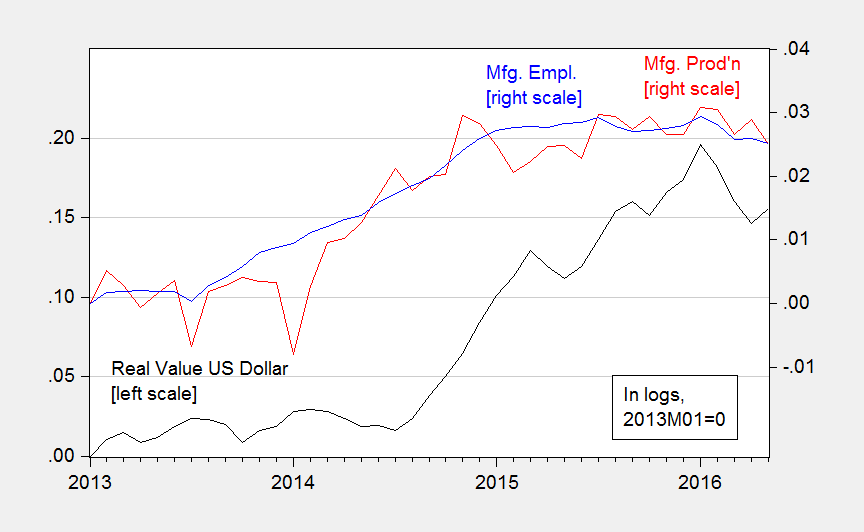
Figure 1: Real value of the US dollar against broad basket (black, left scale), manufacturing production (red, right scale), manufacturing employment (blue, right scale), all in logs, 2013M01=0. Source: Federal Reserve Board, BLS, and author’s calculations.
Both production and employment now on a slight downturn, despite recent dollar depreciation. The dollar is 14% higher in log terms relative to mid-2014.
Kansas in (Technical) Recession
The BEA released quarterly state GDP figures today. As of 2015Q4, Kansas has just experienced two consecutive negative GDP growth, a distinction shared with only three other states — Alaska, Oklahoma and Wyoming (North Dakota experienced three quarters of negative growth, but experienced positive growth in Q4). Over the past five quarters, Kansas has experienced four quarters of negative GDP growth.
Recession Risks: The View from Wall Street Economists
The Wall Street Journal‘s June survey of economists is out. Interestingly, no one’s mean forecast is for two quarters of negative growth in 2016Q2-Q3 (or even one quarter!), but the assigned probabilities of recession remain elevated.
Data Paranoia Watch: Employment Edition
Which one of these texts is drawn from a real article?
Thinking about Wages, Inflation and Productivity… and Capital’s Share
On the release of the Productivity and Costs release, the WSJ reports “Weak Productivity, Rising Wages Putting Pressure on U.S. Companies: Economists fret how trends may affect inflation and broader growth”.
Recession Watch, June 2016
Since Friday’s employment release, [1] there’s been a surge in articles discussing the possibility of a recession.
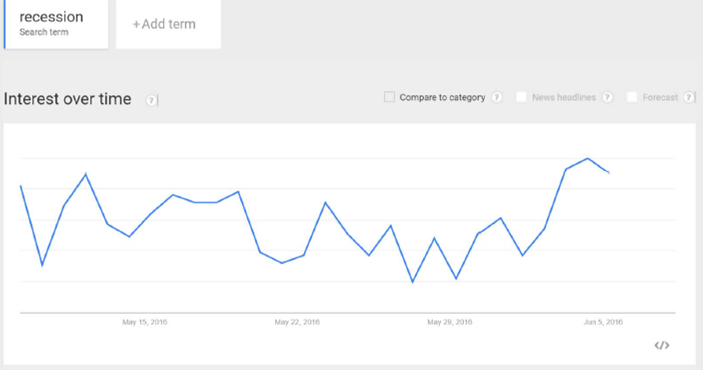
Figure 1: Google Trends index for “Recession”, last 30 days, in Business and Finance category. Source: Google, accessed 6/7, 11PM Pacific.
Time for a look at some key indicators the NBER Business Cycle Dating Committee [1] has looked at in the past.
Guest Contribution: “China Should Rebalance by Following the Fed”
Today we are pleased to present a guest contribution written by Gunther Schnabl, Professor of Economics and Business Administration at Leipzig University.
Currency Misalignment, 2016: FEER vs. Penn Effect
The Peterson Institute for International Economics’ William Cline has just published estimates of equilibrium exchange rates for May 2016; the USD is 7% overvalued, while the Chinese yuan (CNY) is at its “FEER level”.
A Conspiracy So Vast…
One of the craziest posts I have read in recent years alleges that the US government has deliberately set out to destabilize the world economy in order to … lower Federal financing costs!