Re-visiting Mitt Romney’s “We should be seeing numbers in the 500,000 jobs created per month.” [1]
Author Archives: Menzie Chinn
Wisconsin Economic Metrics: Entrepreneurship
From the Wisconsin Economic Development Corporation (WEDC) website:
We’ve [WEDC] put a greater focus on supporting high-growth entrepreneurs in Wisconsin. The Seed Accelerator program is supporting veterans, inner city Milwaukee and water technology businesses; and helping entrepreneurs get their ideas off the ground. …
One Department to Rule Them All
Not my idea! With apologies to JRR Tolkein.
One the Regents candidates nominated by Governor Walker (from Wisconsin Public Radio):
Gov. Scott Walker’s latest appointment to the University of Wisconsin Board of Regents told a state Senate panel on Thursday that the UW should consider eliminating duplicative degree programs on some campuses.
Assessing the Rational Agent Response to Elimination of Tenure in Wisconsin State Statute
Thinking about “Exit, Voice and Loyalty” in Wisconsin
The Joint Finance Committee motion to remove tenure from state statute. Winners of the most competitive research awards the University of Wisconsin–Madison provides to its scholars have made a statement, found here.
A Parsimonious Error Correction Model of Kansas Economic Activity
Or “Kansas macro crash…and burn”
Patrick Marvin argues that Kansas is doing fine, and the tax cuts just need a bit more time to kick in to spur the economy. My reading of the data and estimates suggest otherwise.
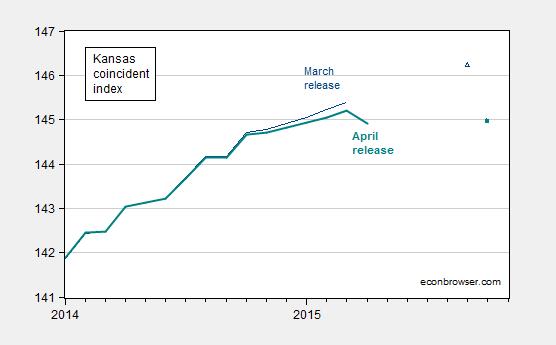
Figure 1: Coincident index for Kansas, March release (dark blue), April release (bold teal). Dark blue triangle (solid teal box) denote corresponding forecasts from March and April releases of leading indices. Source: Philadelphia Fed (coincident), Philadelphia Fed (leading), and author’s calculations.
Guest Contribution: “Inflation Expectations Spur Consumption Expenditure”
Today we are fortunate to have a guest contribution by Michael Weber, assistant professor at the University of Chicago’s Booth School of Business. This post is based upon a paper, co-authored with Francesco D’Acunto and Daniel Hoang.
Kansas Macro and Fiscal Crash
Economic activity stalls, and the Republicans conclude that higher taxes are necessary for higher tax revenue.
[with update 6/2 on the April forecast]
Wisconsin GOP Targets Faculty Tenure
From Greg Neumann/WKOW:
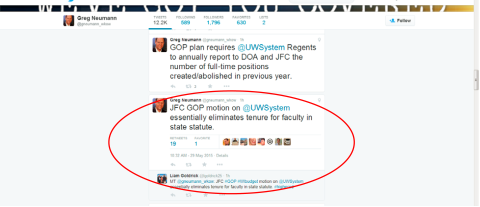
“JFC” is Joint Finance Committee. The text of the motion is here. Stein and Herzog/Journal Sentinel here. The article notes the following contrast: “Minnesota raised taxes with part of the new revenue set aside for higher education.”
“Crony Capitalism”: Wisconsin Edition
RightWisconsin writes:
…crony capitalism is currently wreaking havoc on the conservative Republican brand of free markets and limited government.
Interest Rate Parity and Exogeneity
One of the enduring puzzles of international finance is the fact that the joint hypothesis of uncovered interest parity and rational expectations is consistently rejected, as evidenced by the coefficient estimates in the Fama regression.