Those are the topics covered tomorrow (Friday, 10/14) at the 5th annual West Coast Workshop in International Finance 2016, taking place at Santa Clara University. As usual, these look like a set of fascinating papers, and a must-see for those interested in international finance/open economy macro (A post discussing last year’s conference proceedings is here).
Rookie Economist Errors II
Yet more cautionary notes for my students.
More Volatility in the Pound
From Bloomberg a few minutes ago:
The pound gained, halting a four-day slide against the dollar, after U.K. Prime Minister Theresa May accepted that Parliament should be allowed to vote on her plan for taking Britain out of the European Union, but asked lawmakers to do it in a way that gives her space to negotiate.
Re-Writing the (International) Textbook: Interest Parity Conditions
Literally.
Prosaic Observation of the Day: Republican Outreach to Asian Americans Falters
As noted earlier, in the aftermath of the 2012 election, the Republican Party dedicated itself to reaching out to Asian Americans (in addition to other ethnic groups). Thus far, the progress appears to be limited.
U.S. elections
The most valuable resource for tracking the U.S. elections is Nate Silver’s 538.
Continue reading
Elections and Asset Prices
One interesting correlation, as pointed out by Clines in the NYT, is between the Mexican peso’s value against the USD and the probability that Donald J. Trump will win, as judged by the markets.
No Kidding: “Hard Brexit has haunted the sterling.”
Ron Alquist brings my attention to this ongoing story:
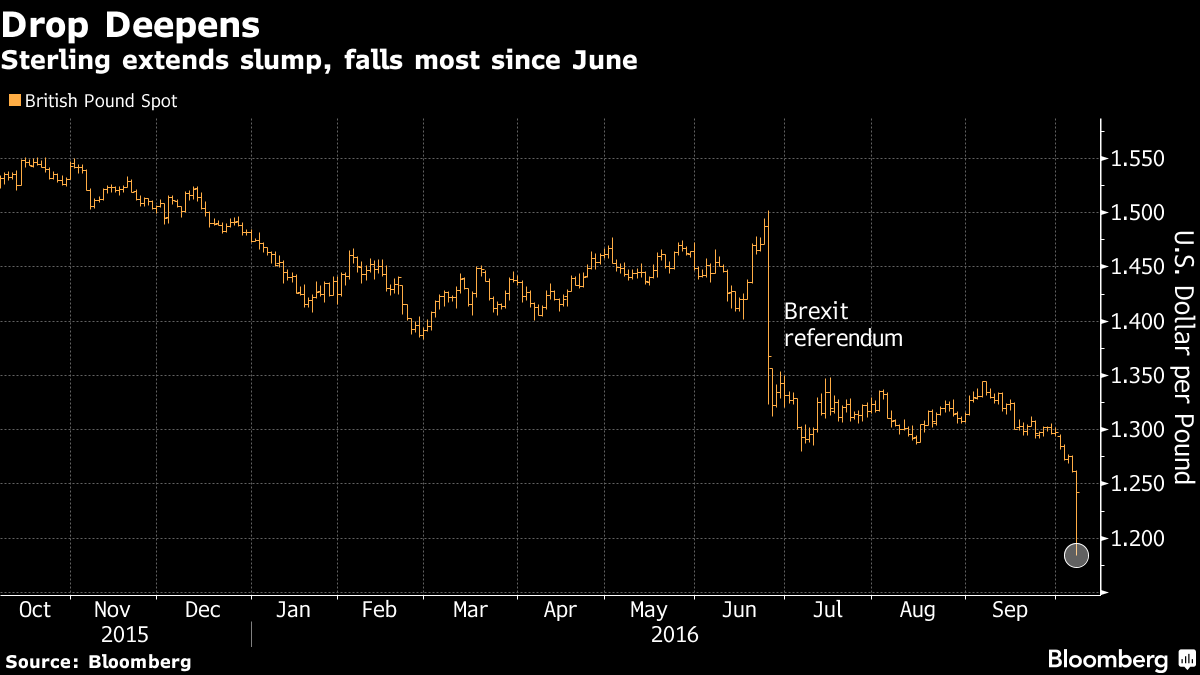
Source: Bloomberg 10/6/2016.
IMF World Economic Outlook, October 2016
Today, the IMF released forecasts of substantially downwardly revised growth estimates for the US. UK 2017 growth revised down 1.1 percentage points relative to pre-Brexit forecast (World Economic Outlook).
OPEC production cut
The Wall Street Journal reported on Thursday:
OPEC said its members agreed that they need to cut crude output to reduce the world’s supply glut, a shift for the 14-member group that was enough to send oil prices higher, even though reaching a deal remains far from certain.
Members of the Organization of the Petroleum Exporting Countries said they reached an understanding after a six-hour gathering in the Algerian capital, but deferred until November the fraught task of finalizing a plan to make those cuts. OPEC officials said a committee would be formed to determine how much each country would have to cut and then report to the group at its next meeting on Nov. 30 in Vienna.