The Bureau of Economic Analysis reported today that U.S. real GDP grew at a 2.2% annual rate during the first quarter, down from the 3.0% growth of 2011:Q4, and below the 2.4-2.9% range that the FOMC indicated yesterday it is anticipating for 2012 as a whole. I see some reasons to agree with the Fed that the rest of the year may be slightly better than the first quarter.
Labor Market Interventions and Learning from Other Countries
As documented in Box 1-2 in the IMF’s latest World Economic Outlook, unemployment in the advanced economies remained persistently high. That brings to the fore how to best deal with adjusting the labor force so as to bring down structural unemployment (although obviously higher aggregate demand would help). In my view, there is the “are there no poorhouses?” approach (cut unemployment benefits, etc. and thus reduce the natural rate of unemployment). The other is to use evidence-based approaches to improve the labor force quality, and improve job matching, thereby decreasing structural unemployment. This alternative is discussed in a recent La Follette Policy Report, by Robert Haveman, Carolyn Heinrich, and Timothy Smeeding, entitled “Policy Responses to the Recent
Poor Performance of the U.S. Labor Market”:
More on speculation
In addition to my discussion last week on the role of speculation in oil markets, let me call attention to commentary from some of my academic colleagues on the same topic:
University of Michigan Professor Lutz Kilian
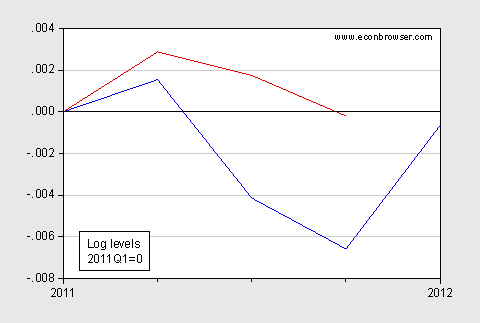
What Are These Two Time Series?
The geography of unemployment
Some quick remarks on the unevenness of the U.S. economic recovery.
Gasoline Price Trends According to Futures
From the WSJ yesterday:
After a sizzling start to the year, gasoline futures prices are sliding, easing pressures on drivers and the U.S. economy and raising the prospect that prices at the pump could be headed lower still.
Recovery and Rebalancing
Several new items regarding assessing recoveries, here and abroad; and the prospects for rebalancing.
A ban on oil speculation?
Joseph P. Kennedy II, former Congressional Representative from Massachusetts, and founder, chairman, and president of Citizens Energy Corporation, has a proposal to make energy affordable for all. All we have to do, Kennedy claims, is “bar pure oil speculators entirely from commodity exchanges in the United States.”
A Little Less Unscorable
In a previous post, I noted that Governor Romney’s budget plan was essentially unscorable (as he himself stated [0]) because he was so vague on the tax expenditures he was going to eliminate. That fog of obfuscation lifted slightly yesterday, with Governor Romney’s not-for-public attribution comments to donors. From Sara Murray, in the WSJ:
The current recovery in historical context
Or why Ed Lazear should have heeded R&R a bit more.
From “Credit: A Starring Role in the Downturn,” by Òscar Jordà, based on an examination of 14 advanced economies over 140 years:
We are unlikely to learn how the United States will recover from the Great Recession by examining other post-World War II downturns. In the United States, the past six decades have completely lacked another financial event like the one experienced from 2007 to 2009. …