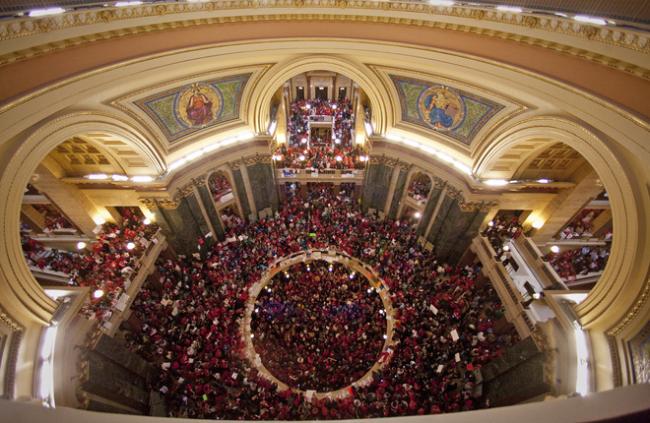
Analogy Watch: “Cairo has come to Wisconsin”?

mjs-bill_-nws_-lynn_-14-bil.jpg

Day 3 in the Wisconsin State capitol rotunda. Source: Milwaukee Sentinel Journal

From National Journal:

In an interview on MSNBC’s Morning Joe today, Rep. Paul Ryan, R-Wis., said the cuts were necessary to get Wisconsin back in the black.

“State workers who have extremely generous benefits packages, [Walker’s] asking that they contribute 12 percent to their health care packages. It’s not a lot, it’s about half of what private-sector employees pay, and he’s getting riots. It’s like Cairo has come to Wisconsin,” Ryan said. “People should be able to express their way, but we’ve got to get this deficit and debt under control in Madison.”

Continue reading

Intermediate Macro Exercise: How to Construct a Maximally Contractionary Budget Deficit Reduction

Consider an economy called Käseland, with gross output equal to approximately $475 billion, and unemployment rate of 7.5%, so considerable underemployment of factors of production exists; consistent with this interpretation, the general nonfarm wage rate has been relatively constant, growing at only 1.2% on a 12 month basis through 2010, and the price level has risen by about 1.5% from the second half of 2009 to second half of 2010.


Suppose there is a budget deficit, that you wish to close. How do you maximize the negative impact on output?

Continue reading

Dispatches

This caught my eye. From Chicago Tribune:

Walker says National Guard is prepared

MADISON, Wis. — Gov. Scott Walker says the Wisconsin National Guard is prepared to respond wherever is necessary in the wake of his announcement that he wants to take away nearly all collective bargaining rights from state employees.

Continue reading

Saudi oil reserves may be overstated by 40%

Stuart Staniford calls attention to this story from the Guardian:

The U.S. fears that Saudi Arabia, the world’s largest crude oil exporter, may not have enough reserves to prevent oil prices escalating, confidential cables from its embassy in Riyadh show.

The cables, released by WikiLeaks, urge Washington to take seriously a warning from a senior Saudi government oil executive that the kingdom’s crude oil reserves may have been overstated by as much as 300bn barrels– nearly 40%.

Stuart also notes that in his own independent forensic analysis conducted in May 2007 (to which we called the attention of Econbrowser readers at the time), he estimated that remaining reserves in Ghawar (by far the Saudis’ biggest and most important oil field) were overstated by 40%.