By Assaf Razin
Today, we’re fortunate to have Assaf Razin, Friedman Professor of International Economics at Cornell University, and Professor Emeritus at Tel Aviv University, as a Guest Contributor.
By Assaf Razin
Today, we’re fortunate to have Assaf Razin, Friedman Professor of International Economics at Cornell University, and Professor Emeritus at Tel Aviv University, as a Guest Contributor.
From the just-released Kauffman Economic Outlook, authored by Tim Kane, an indicator of what some economists thought the ARRA accomplished, in terms of unemployment.
I earlier discussed several of the presentations at the monetary policy conference at the Federal Reserve Bank of Boston last week. But missed in the popular coverage of the conference was an insightful discussion by Columbia Professor Richard Clarida that expressed very nicely the conclusions that I have come to as well on the events that led us into these problems.
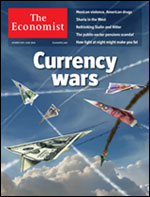
With the cover page of the Economist [1] [2] worrying about currency wars, and various analysts arguing whether the US can or cannot win such a “war” (see Naked Capitalism for a discussion), I thought it would be useful to see where we now stand, in terms of “competitiveness”, as understood by open economy macroeconomists.
Having earlier reviewed some of the reasons in favor of additional quantitative easing (QE2), I’d like to acknowledge some of the dissenting views.
One theme that emerged from the monetary policy conference at the Federal Reserve Bank of Boston on Friday and Saturday is that, as I stressed in my discussion of the recent FOMC minutes, the Fed is not thinking of large-scale asset purchases as the only tool available in the current environment.
I’m in Boston today at a conference at the Federal Reserve Bank. Fed Chair Ben Bernanke spoke this morning and this afternoon I presented results from my research with Cynthia Wu. I hope to have time later this weekend to say a little more about some of the presentations and discussion. But for now let me provide a link to an interview with CNBC on some of these issues.
I’ve been lecturing on the government sector in my macro course. In updating my lecture notes, I plotted out some interesting graphs, which link up nicely with this previous post. The following four figures highlight: (1) normalized Federal outlays are not much higher than in 1986; (2) government consumption to GDP is back up to 1991 levels; (3) the cyclically adjusted budget deficit is only 2 ppts larger than that recorded in 1987; and (4) Federal consumption remains far below the previous peak in 2007.
Most observers now seem convinced that the Federal Reserve will shortly implement QE2, a second round of quantitative easing. It’s worth taking a look at what QE2 is and is not expected to accomplish.
That was the title of a seminar at the annual IMF-World Bank meetings I participated in last Thursday (agenda here).