For people who want an impartial survey of multipliers, see Patrick Van Brusselen, “Fiscal Stabilisation Plans and the Outlook for the World Economy”. It’s a useful antidote to the blogposts that cherry-pick multipliers from a given model to make a given point. The survey ranges over US, euro-area, and Japan; and structural macroeconometric models, DSGEs, and VARs.
Pre-ARRA, How Badly Did Macroeconomic Forecasters Overpredict GDP and Employment in 2009Q1?
There’s been a lot of breast beating over the fact that the Administration underestimated the severity of the downturn. From this has come a lot of confused argument — sometimes not internally consistent — over whether this invalidates the usefulness of the stimulus package, whether the stimulus worsened the economic outlook, etc. I’ll dispense with the clearly economically illogical arguments and try to tease out what is the “surprise” element in the 2009Q1 figures, and from that infer how much worse the economy was relative to what private sector forecasters predicted, conditional upon the passage of the ARRA.
Links for 2009-07-12
A very neat interactive graphic from the NYT showing changes in same-store sales for different establishments. (Click on the store name at the left, and tip your hat to Economix).
Keith Hennessey, who used to have Larry Summers’ job in the Bush White House, on the challenges facing the White House in framing discussion of the effectiveness of the existing stimulus package. See Obama’s apparent answer here.
And a hilarious story via Calculated Risk on why Wells Fargo is suing itself.
Ed Lazear on the Stimulus Package
From the WSJ editorial page:
Only a small share of the spending will occur in 2009, even though Keynesians would argue that stimulus spending should be frontloaded to kick-start growth. The Congressional Budget Office estimates that the largest share of the spending will occur in 2010, with the amount in 2011 being slightly larger than in 2009. Again, the timing exacerbates the problem: It will be tough to cut back on spending written into budgets as far out as 2011.
Guest Contribution: Index Funds and Commodity Prices… Here We Go Again
By Scott Irwin
Econbrowser is pleased to host another contribution from Scott Irwin, who holds the Laurence J. Norton Chair of Agricultural Marketing at the University of Illinois, and today offers some insights from his research on the current debate concerning commodity speculation.
Global Financial Stress
Several months ago, I discussed the indicators of financial stress developed by the IMF in two posts [1] [2]. The working paper documenting and extending the results in the World Economic Outlook has just been released.
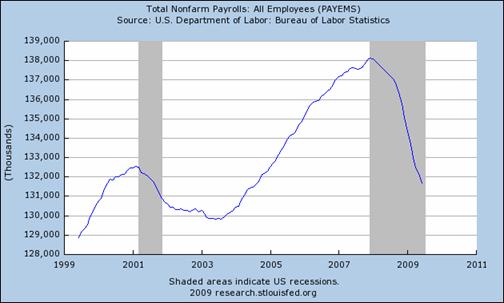
Back where we started
BLS reported that the total number of Americans employed in June on nonfarm payrolls came to 131.7 million workers on a seasonally adjusted basis. That’s below the June 2000 figure of 131.8 million with which we started the decade.
 |
The Informational Content of the OECD Leading Indicators
Sunday’s NYT had a great interactive graphics by Amanda Cox detailing the dynamics of recessions and recoveries. One interesting graph pertained to the OECD Leading Indicators:
Off-balance-sheet federal liabilities
Just how much has the U.S. government promised to pay?
Waxman-Markey and the Great Depression II?
“With the passage of Cap and Trade there is a good chance that unemployment will be worse than 1933 by the end of 2010.”
So writes an Econbrowser reader. Well, anything can happen, but that is not the outcome I predict. Nor the CBO, EPA, and other informed analysts.