There’s plenty of coverage of the bailout package [0] [1], but here’s the graphic depiction (from NYT):
Author Archives: Menzie Chinn
Quantifying Macro Spillovers
In a post regarding the transmission of financial turmoil from Europe to the US last week, I noted my research with Kristin Forbes on the determinants of the strength of financial market linkages. A more recent and extensive survey of the macroeconomic — as opposed to financial — linkages is provided by a recent released working paper coauthored by Ashoka Mody and Alina Carare at the IMF.
More on the Deepwater Horizon
From Peter Coy and Stanley Reed in Bloomberg:
Should the heaviest portion of the spill come ashore, it may cause damage rivaling the 1989 wreck of the Exxon Valdez in Alaska’s Prince William Sound, despoiling the breeding grounds of species in the fragile coastal-buffer zone that provides hurricane protection.
Nonfarm Payroll Employment: The Tide Has Turned (For Now)
From the April 2010 employment situation release: Nonfarm payroll employment trends strongly upward; previous months’ figures are revised upward; not seasonally adjusted figures move upward as well; the upward movement is not driven by government employment; the experimental household based quasi-payroll employment series moves upward even more strongly; and aggregate hours is now 1% higher than the level at 2009M06.
Euro Area to US Contagion?
I was wondering why the Reuters website wasn’t loading on my computer. Then I got a phone call from a reporter asking about the US stock market meltdown in response to Greece…which struck me as an odd linkage. It still strikes me as an odd linkage.
“Reminbising China’s Assets”
From a paper written by Yin-Wong Cheung (UCSC), Guonan Ma (BIS), and Robert McCauley (BIS):
…Recent policies adopted by the Chinese authorities
can be interpreted as allowing the rest of the world to denominate debt in renminbi. But if trading
partners consider that the renminbi is subject to big jump risk, then prospects for its
internationalisation are weak. …
What Are the Externalities of “Drill, Baby, Drill”?
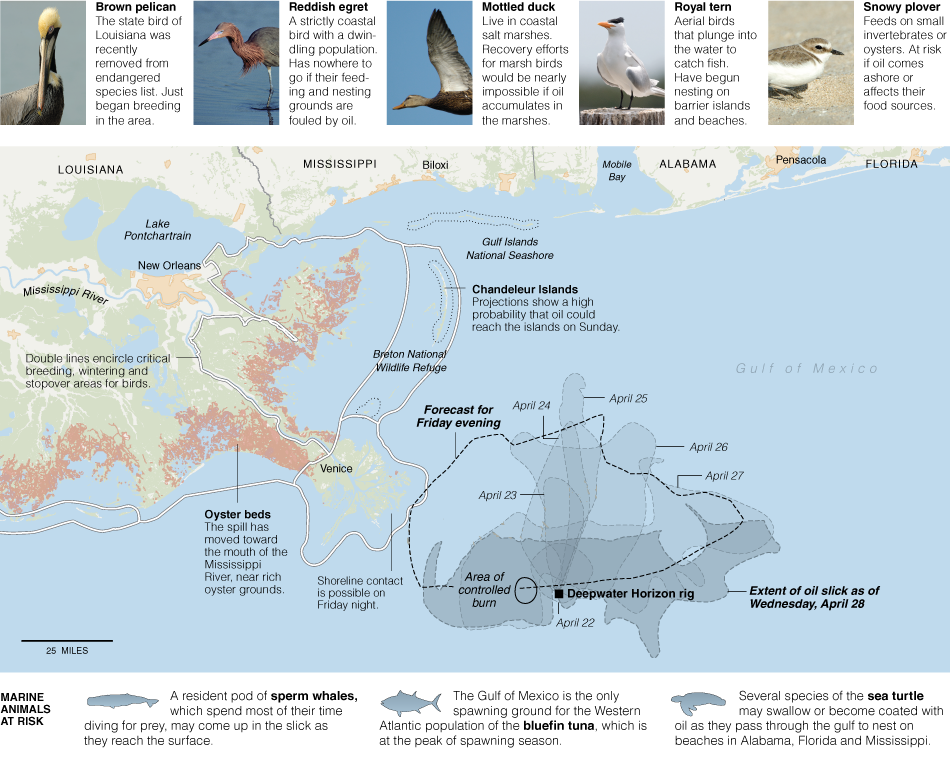
From NYT, “Size of Spill in Gulf of Mexico Is Larger Than Thought”, the extent of the spill in the Gulf of Mexico:
Employment Bounceback?
Dobridge, Hooper and Slok in “Jobless Recovery III Seems Unlikely” Global Economic Perspectives (April 21, 2010) [not online]:
The sluggish performance of payroll employment and
jobless claims in recent months despite well-above-trend
growth in output has raised the specter of another jobless
recovery. …
China and Latin America: Re-evaluating Macro Linkages
Last week, I attended a conference organized by Eduardo Fernandez-Arias and Alessandro Rebucci at the Inter-American Development Bank. One of the panels focused on the impact of China on Latin America’s economy.
Non-Economic Question of the Day: Should I Take My (US) Passport If I Visit Arizona?
Reading this factsheet pertaining to SB 1070, I think the answer is yes.