Today, we are fortunate to present a guest contribution written by Laurent Ferrara (Banque de France, Head of the International Macro Division) and Clément Marsilli (Banque de France, Economist at the International Macro Division). The findings, interpretations, and conclusions expressed in this article are entirely those of the authors. They do not necessarily represent the views of the Banque de France.
Wisconsin Employment Surge “Benchmarked” Away
Wisconsin private nonfarm payroll employment only 112.6 thousands (45%) below Governor Walker’s goal of 250,000 net new jobs.
U.S. oil production still surging
The EIA is now reporting that U.S. field production of crude oil averaged almost 8.7 million barrels a day in 2014. That’s up 1.2 mb/d from 2013, and is only 0.9 mb/d below the all-time U.S. peak in 1970.
Continue reading
Some Empirics Regarding Right to Work Laws
Wages in right to work states are lower than those others. After controlling for various factors, the gap remains.
Is the United States Protected from the European Debt Crisis?
For those of you in San Diego I wanted to call attention to a roundtable discussion this Friday March 6 on some of the ongoing concerns about European sovereign debt. I’ll be appearing along with Jeffrey Frieden from Harvard (who will be quite familiar to regular readers of Econbrowser) and David Leblang of the University of Virginia. Details on how to register for the event can be found here.
Guest Contribution: “Analyzing Recent Trends in the U.S. Wealth Distribution”
Today we are fortunate to present a guest contribution written by Ricardo T. Fernholz, Assistant Professor of Economics at Claremont McKenna College.
Some Government Workers Will Get Pay Raises in Wisconsin
From State troopers who protect Governor given $4 an hour pay raise:
Just after Republican lawmakers announced they were rejecting raises for rank-and-file state troopers, Gov. Scott Walker’s administration granted $4-an-hour raises to the State Patrol officers
responsible for protecting the governor.…
What is the new normal for the real interest rate?
The yield on a 10-year Treasury inflation protected security was negative through much of 2012 and 2013, and remains today below 0.25%. Have we entered a new era in which a real rate near zero is the new normal? That’s the subject of a new paper that I just completed with Ethan Harris, head of global economics research at Bank of America Merrill Lynch, Jan Hatzius chief economist of Goldman Sachs, and Kenneth West professor of economics at the University of Wisconsin, which we presented at the U.S. Monetary Policy Forum annual conference in New York on Friday.
Continue reading
The Measurement and Display of Data Series
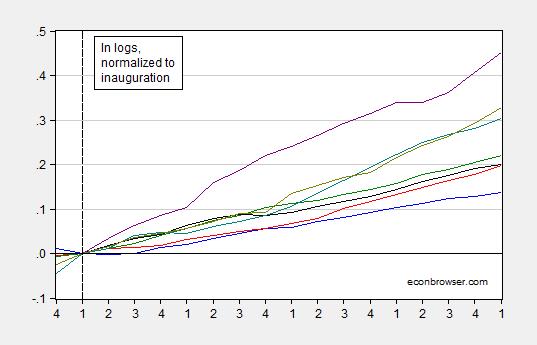
(Not) The Leader of the Pack, Again: Wisconsin and Her Neighbors
Political Calculations criticizes me for comparing Wisconsin economic performance against Minnesota, but not other neighbors.
Normally, we’re entertained by Chinn’s analysis, since it frequently involves comparisons of the job growth between Wisconsin and its western neighbor Minnesota since Walker was sworn into office in January 2011, which we find funny because of all the states surrounding Wisconsin, the composition of Wisconsin’s economy is much less similar to Minnesota than it is to any of the states with which the state shares waterfront footage on Lake Michigan, which is something that one might think an economics professor at the University of Wisconsin-Madison would know.
[Update, 3/1] I have calculated a similarity index for MN, IL, MI vs. WI, based on output composition. It’s an unweighted measure of absolute sector differences, (Σ|xWI-xi|)/n . The indices are 0.010, 0.013, 0.007, for MN, IL, MI, respectively. In other words, MI is the most similar to WI, MN next. And, interestingly, MI far outpaces WI, in Figure 1 below.
Continue reading