Dispatches (VII): WWBD?

Or, “What Would Bob (La Follette) Do?”

Since I teach in the Robert M. La Follette School of Public Affairs, this WSJ article “‘Fighting Bob’ Fights Right On” caught my eye. From the article:

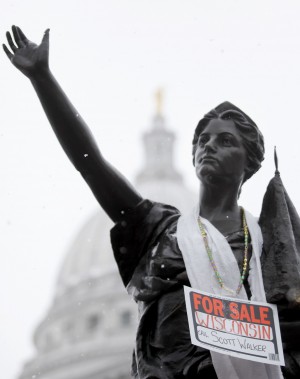
Protesters’ signs and online discussions have repeatedly invoked La Follette, a turn-of-the-20th century Wisconsin governor and U.S. senator. His bust has become a locus of the protest, with demonstrators draping flowers around its neck and festooning its pedestal with signs saying “Long Live La Follette” and “What Would Bob Do?”
Continue reading

Good news from autos– for now

The price of oil rose from $80 a barrel in September 2007 to average $134 in June 2008. The toll this took on the U.S. auto industry was in my mind an important factor that contributed to the first year of the Great Recession in 2007:Q4-2008:Q3. Given the recent concerns about oil supplies in North Africa and the Middle East, it’s useful to review what happened three years ago and relate it to where we stand at the moment based on the February auto sales data that were just released.

Continue reading

Dispatches (VI): Where Do Those Budget Numbers Come From?

Wisconsin Governor Walker has been stating that if his “budget repair bill” is not passed, then the state will lose $165 million dollars. It is unclear what exactly would be “lost” if the bill is not passed. From the New York Times:

“One day left to save the state $165 million,” said the governor’s office on Monday, announcing the latest deadline.

If Democrats do not return by Tuesday, taxpayers would lose an option to save that money through a “refinancing,” the governor’s office said, citing the Wisconsin Legislative Fiscal Bureau, a nonpartisan agency that conducts budget analysis.

Continue reading

CBO on the Stimulus Package, and Still No Expansionary Fiscal Contraction in UK

Two Items Regarding Fiscal Policy

US GDP and the Stimulus Package

The 2nd release for US GDP revealed a downward revision BEA; CR reports the breakdown. What is interesting is that the downward revision is due in part to a greater than previously estimated decline in the state and local government spending contribution. Something useful to keep in mind as state and local governments move to rely solely upon spending cuts instead of revenue increases as means to reduce budget deficits (e.g., as in Wisconsin).

Continue reading

Exchange Rates: Two Stylized Facts and Yet Another (Consequent) Puzzle

My colleague, Charles Engel, has a new paper entitled The Real Exchange Rate, Real Interest Rates, and the Risk Premium, in which he tries to identify what characteristics an exchange rate model must possess in order to explain two stylized facts.

…The well-known interest parity puzzle in foreign exchange markets finds … the high interest rate country tends to have the higher expected return in the short run. The second stylized fact concerns evidence that when a country’s relative real interest rate rises above its average, its currency tends to be stronger than average in real terms.

Continue reading

Brent-WTI spread

Lots of action in oil prices today, as the unrest has spread from Tunisia and Egypt– which produce relatively modest amounts of crude oil— to Libya, the country sandwiched between them, and producer of over 2% of the world’s crude oil supply. Rather than try to guess where those developments are going to lead, I wanted today to try to make sense of another equally striking development in oil markets over the last 6 weeks– the disparity between the price of oil in the Midwest United States and that elsewhere in the world.

Continue reading