Today, we present a guest post written by Jeffrey Frankel, Harpel Professor at Harvard’s Kennedy School of Government, and formerly a member of the White House Council of Economic Advisers.
Author Archives: Menzie Chinn
How’s Wisconsin’s Economy Doing?
Employment underperforming the February Budget forecast; output too. Philadelphia Fed indices say activity is flat. A time series forecast using forward-looking indicators implies a continued rise in the unemployment rate.
Defining Crowding Out in an Open Economy
Gavin Ekins argues that it’s Time to Shoulder Aside “Crowding Out” As an Excuse Not to Do Tax Reform. From the introduction:
Ethnic Diversity Measured
In trying to explain why Canada has lower gun death rates than the US, Bruce Hall boldly asserts that Canada is more ethnically homogenous than the US. I wonder in this data-rich era why people make bold assertions like this.
Cumulative Mass Shooting Casualties in America as of November 6th
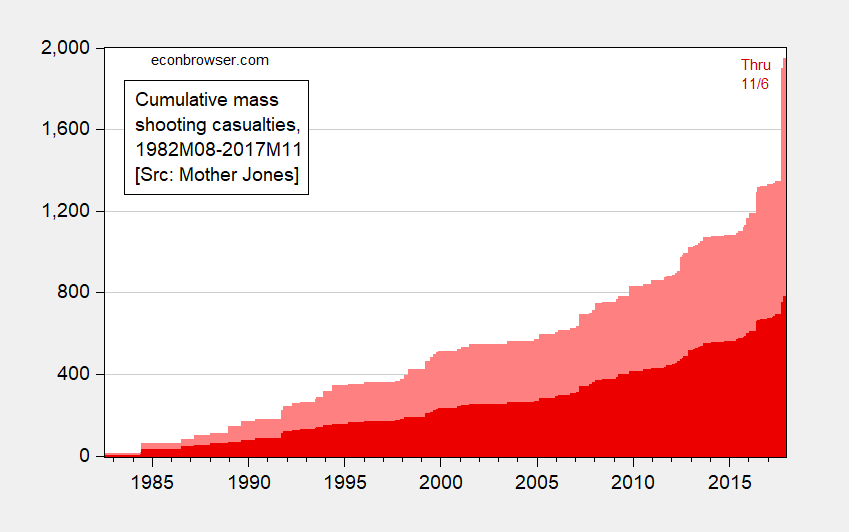
Figure 1: Cumulative sum of mass shooting casualties, beginning in 1982M08; deaths (red), wounded (pink). October observation for data through 11/6. Source: Mother Jones.
Crimes against Economic Analysis
Well, Sam Clovis is no longer under consideration to be the top scientist at USDA (a good thing given he has no scientific credentials). But Bill Beach is nominated to be Commissioner of Labor Statistics, i.e., heading BLS.
A Modest Proposal (to Boost Growth): Wisconsin Edition
Certain individuals (even on this weblog) have highlighted the decline in labor force growth as a factor in stagnant economic growth in Wisconsin. Wisconsin State Representative Scott Allen has the following public policy proposal, as recounted in The Hill:
Federal Debt under the Tax Cut and Jobs Act
It (the debt picture under the Tax Cut and Jobs Act, H.R.1) is not pretty, especially after taking into account the accounting gimmicks (that change the “reported” number but not the actual numbers).
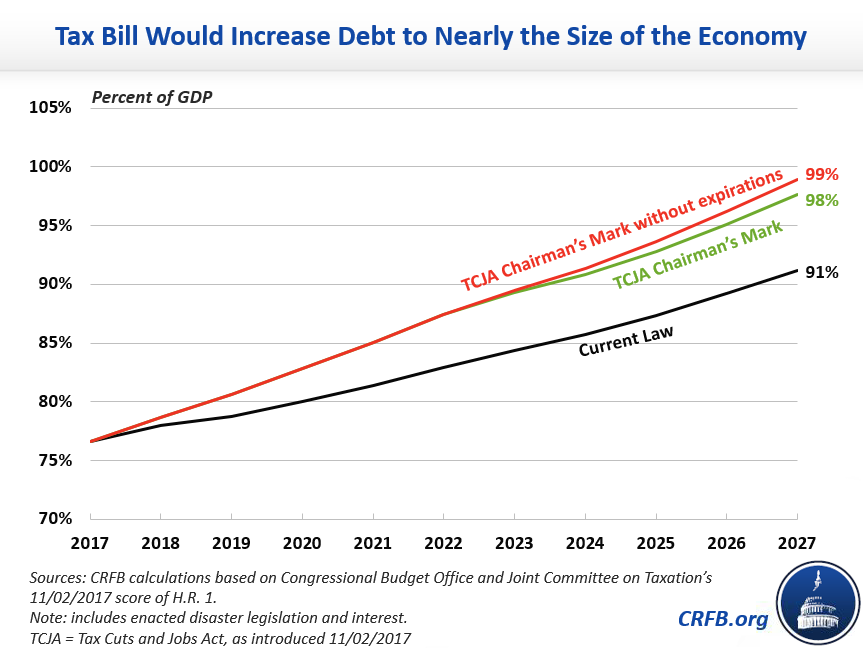
Source: Committee for a Responsible Federal Budget (Nov. 3, 2017).
Note that plausible dynamic scoring is unlikely to change the trajectory of debt-to-GDP substantially.
Did Lower Relative Manufacturing Wages Lead to Greater Manufacturing Activity in Wisconsin?
As suggested here. Maybe. It might depend on the measure of economic activity.
“West Coast Workshop in International Finance 2017”
Taking place today, this is the fifth in the series, with topics this year on exchange rates and monetary policy, macroprudential policy, credit and business cycles (sponsored by UC Santa Cruz Economics, Santa Clara Economics, and Federal Reserve Bank of San Francisco, organization chaired by Helen Popper at SCU and Grace Weishi Gu at UCSC).
The website is here with links to papers, conference agenda here.