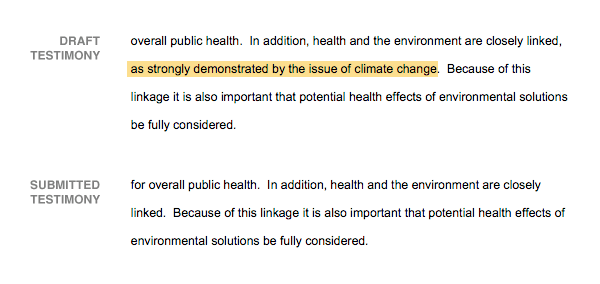
From the New York Times (reg.req.):
White House Cuts to Climate Testimony Raise Questions
An example of one of the changes made to Julie L. Gerberding’s testimony. Source: NYT.
From the New York Times (reg.req.):
White House Cuts to Climate Testimony Raise Questions
An example of one of the changes made to Julie L. Gerberding’s testimony. Source: NYT.
Thanks to our many friends around the world who’ve asked if we’re ok. We are indeed, and, if you’re curious, here’s our story.
From the IMF’s September Global Financial Stability Report:
I had the privilege of attending a conference in St. Louis this week on Monetary Policy under Uncertainty at which I presented a paper on the response of interest rates to changes in the fed funds target. One of the interesting themes that came up in some of the other papers concerned whether the public’s interests are best served when monetary policy follows mechanical rules as opposed to responding to events in a discretionary way. Here I report on some of the discussion of this issue from the conference.
In updating a graph of the projected debt-to-GDP ratio, I was only slightly surprised to see that the out-years (still) look pretty grim.
What is the significance of the fact that the most recently issued subprime mortgages are the ones that are running into the biggest problems?
From Bloomberg, an anodyne to happy talk:
The Wall Street Journal describes it as a “superconduit”,
the New York Times refers to it as a “super-SIV”,
and the Washington Post is calling it a
“Master-Liquidity Enhancement Conduit”. Whatever you call it, does it make any sense?
In glancing at Table 4 the last issue of the Economist (sub. req.), I was surprised that so many countries had downward sloping yield curves. Should we worry?
I recently completed a new research paper studying how interest rates of different maturities change with market expectations of what the Fed is going to do next.