Today, we present a guest post written by Jeffrey Frankel, Harpel Professor at Harvard’s Kennedy School of Government, and formerly a member of the White House Council of Economic Advisers. A shorter version appeared on November 9th in Project Syndicate.
Author Archives: Menzie Chinn
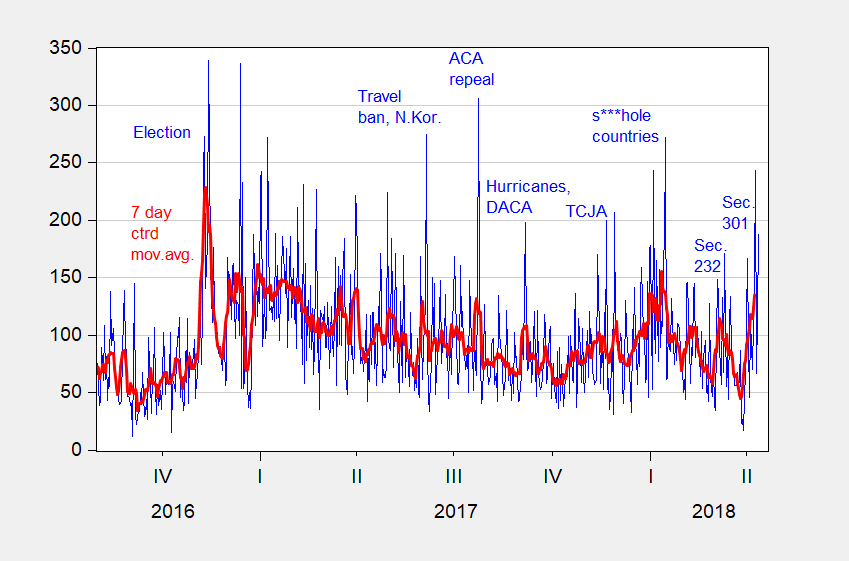
Economic Policy Uncertainty, November 14

Figure 1: Daily economic policy uncertainty (blue), and centered 7 day moving average (red). Source: PolicyUncertainty, accessed 14 Nov 2016, and author’s calculations.
Today’s value (sure to be revised) exceeds that recorded on 9/18/2001, the previous high in the sample running from 1985 to today.
Thank Goodness We Solved that Problem of Elevated Economic Policy Uncertainty Depressing Growth!
As of today, measured economic policy uncertainty hit 468.
Continue reading
At Long Last, the Feared (Portfolio) Crowding Out Has Materialized
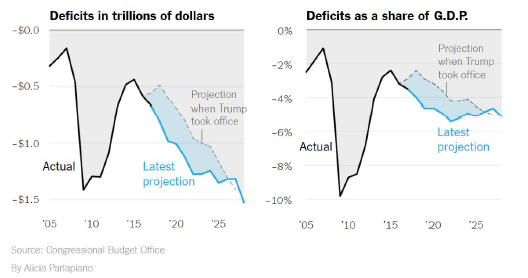
The implication of a (massive) revision to the expected path of government debt relative to baseline is an increase in the slope of the yield curve. Some portion comes from the expectations hypothesis of the term structure, some from an increase in the risk premium. [lecture notes on portfolio crowding out] [lecture notes on expectations hypothesis of term structure]

Figure 1: Yield curve as of 8 November (blue), and 9 November (green). Source: US Treasury.
Today, and Eight Years Ago
Here are graphs of employment, industrial production, personal income ex.-transfers, manufacturing and trade sales, and real GDP (five indicators that the NBER Business Cycle Dating Committee has focused on in the past) depicting the state of the macroeconomy, given what we know today, and compared to eight years ago.
Guest Contribution: “Economists Sign Letter Opposing Trump”
Today, we present a guest post written by Jeffrey Frankel, Harpel Professor at Harvard’s Kennedy School of Government, and formerly a member of the White House Council of Economic Advisers.
Wisconsin Growth Prospects
At least Kansas makes Wisconsin look good.
Guest Contribution: “Battling Unemployment: A Clear Win for the ‘Cycs'”
Today we are fortunate to have a guest contribution written by Zidong An (American University) and Prakash Loungani (IMF).
The Trilemma, Nuanced
I’ve just finished up the Mundell-Fleming model in my int’l finance course, and ended the section with a discussion of the “International Trilemma”, also known as “the Impossible Trinity”, which states that a given country can at any given time fully achieve only two out of three objectives of exchange rate stability, monetary autonomy, and financial integration (full capital mobility) at a time.
With a Program of Sufficiently Regressive Tax and Spending Cuts, America Can Be Like Kansas
Figure 1: Log coincident index for Missouri (blue), Kansas (red), and US (black), all 2011M01=0. March 2017 observation implied from leading indices. Source: Philadelphia Fed and author’s calculations.
Update: More on Governor Brownback’s information program, here.