Category Archives: recession

Collapsing Confidence in Public Health/Macroeconomic Management

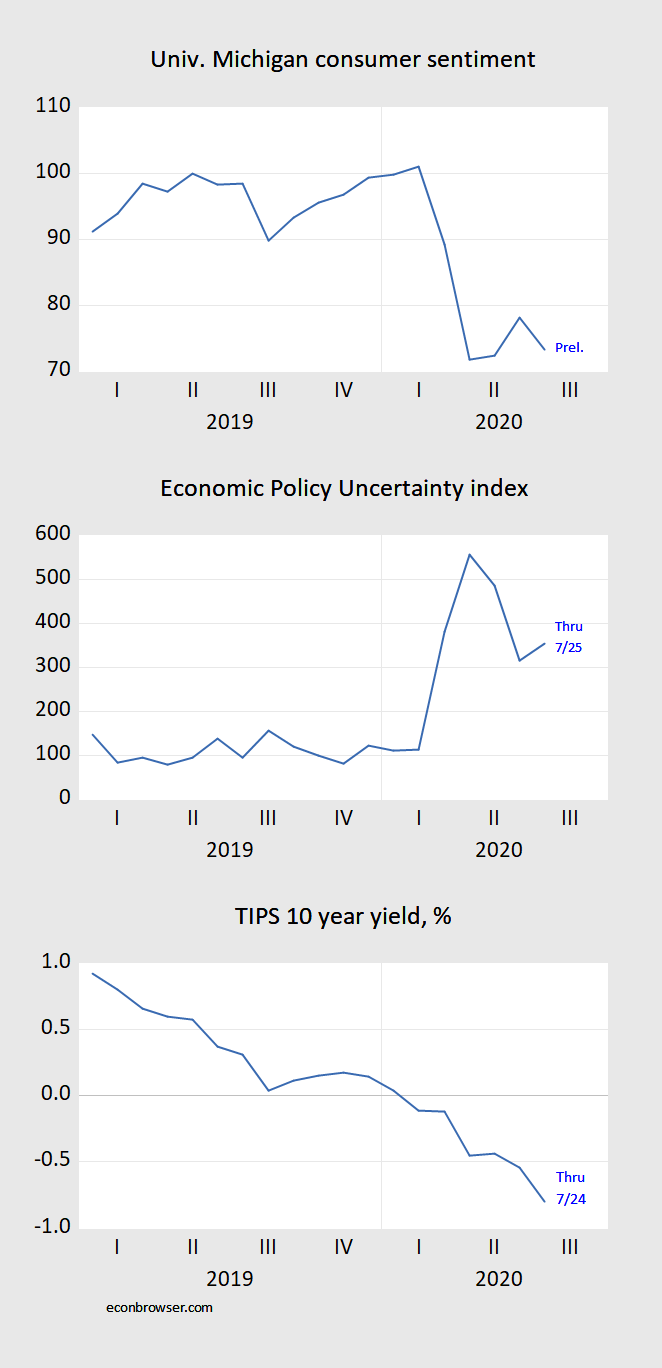
Consumer sentiment declines; economic policy uncertainty on the rise; real interest rates declining. It’s all in the graph below.

Figure 1: University of Michigan consumer sentiment (top), Economic Policy Uncertainty Index (middle), TIPS 10 year constant maturity yield, % (bottom). U Mich sentiment is preliminary for July, EPU in July is thru 7/25/2020, TIPS in July is thru 7/24/2020. Source: University of Michigan and Treasury via FRED, policyuncertainty.com. 

Congressional Research Service: “Fiscal Policy and Recovery from the COVID19 Recession”

From the summary of the document, which reviews the literature and current macroeconomic state of play. Some key findings are germane to the current intra-Republican party debate over how to proceed with the current recovery package. I know it is the triump of hope over experience to think they will accede to expertise, but here goes.

Continue reading

Business Cycle Indicators, 24 July 2020

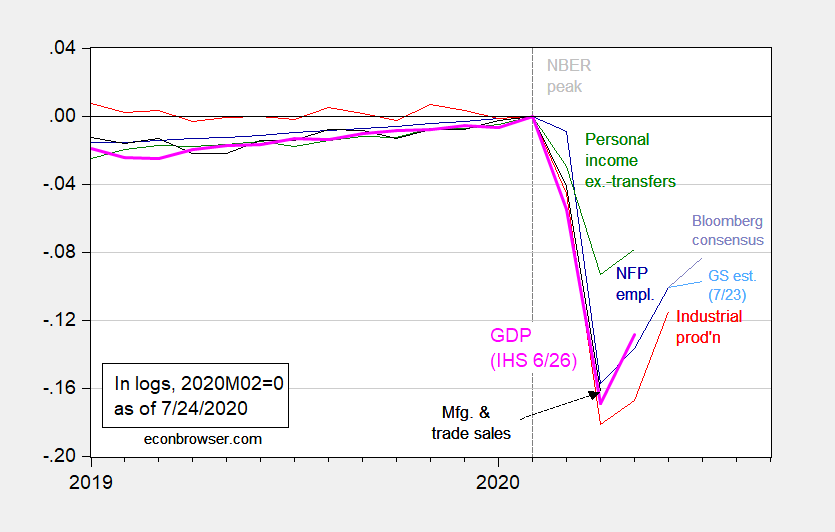
Reverse radical or V-ish (or W?)

Figure 1: Nonfarm payroll employment (blue), industrial production (red), personal income excluding transfers in Ch.2012$ (green), manufacturing and trade sales in Ch.2012$ (black), and monthly GDP in Ch.2012$ (pink), Bloomberg consensus estimate at 7/24 (blue gray), Goldman Sachs Employment Tracker estimate based on data thru 7/7 (sky blue), all log normalized to 2019M02=0. Source: BLS, Federal Reserve, BEA, via FRED, Macroeconomic Advisers (6/26 release), Bloomberg, Goldman Sachs (7/23/2020), NBER, and author’s calculations.

Business Cycle Indicators as of 15 July 2020

Industrial production numbers are out today. Here are five key indicators referenced by the NBER’s Business Cycle Dating Committee.
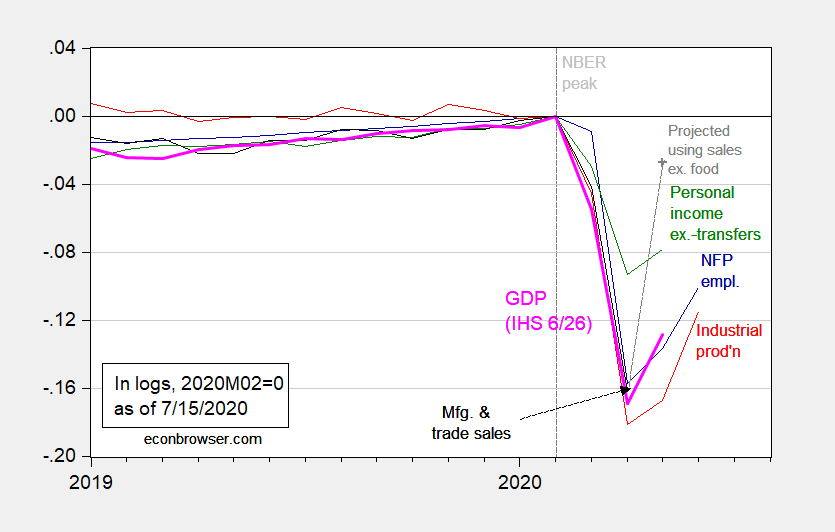
Figure 1: Nonfarm payroll employment (blue), industrial production (red), personal income excluding transfers in Ch.2012$ (green), manufacturing and trade sales in Ch.2012$ (black), and monthly GDP in Ch.2012$ (pink), all log normalized to 2019M02=0. May observation for manufacturing and trade sales projected using log-linear regression of sales on retail sales ex.-food services over the 2019-20M04 period. Source: BLS, Federal Reserve, BEA, via FRED, Macroeconomic Advisers (6/26 release), NBER, and author’s calculations.

If one were convinced that these indicators (along with many others) were going to continue to trend upwards, one could imagine a recession declared as starting in 2020M02 (NBER peak) and ending in 2020M04 (trough). However, if there were to be a relapse in some of the indicators in July-August (see discussion here), one could imagine a longer contraction eventually being declared (some accounts say there’s an increasing view in the Fed along these lines).
Lessons from the Past (i.e., the Last Recession)

Remember “austerity” and “expansionary contraction” stories? Well, if you don’t, then gird yourself for another round of claims (primarily by non-macroeconomists) about how state and local governments need to tighten up their finances, by cutting spending (and cutting taxes to necessitate further spending cuts). Perhaps, we should consider expanding federal transfers to the states and localities…From the fourth round survey of the IGM/Fivethirtyeight Covid-19 panel:

Continue reading

Downward Revision in GDP and Consumption Outlook

Goldman Sachs observes, over the weekend:

The US has experienced a dramatic resurgence of Covid over the last two weeks, with confirmed daily new cases surpassing 50,000. In response, officials have paused or reversed reopening in states containing more than half the population.

A combination of tighter state restrictions and voluntary social distancing is already having a noticeable impact on economic activity. States with the most severe deterioration in the Covid situation saw declines in consumer and workplace activity at the end of June that will likely continue into July, and activity flattened in other states.

The healthy rebound in consumer services spending seen since mid-April now appears likely to stall in July and August as authorities impose further restrictions to contain virus spread. The ongoing recovery in manufacturing and construction should be largely unaffected, however.

Continue reading