My guess [1] is it’s gonna rise again (not that it’s particularly low right now)

Figure 1: Categorical Economic Policy Uncertainty — (blue), Trade Policy Uncertainty (red), 2005-2010=100. Source: PolicyUncertainty, accessed 9/3/2018.
My guess [1] is it’s gonna rise again (not that it’s particularly low right now)

Figure 1: Categorical Economic Policy Uncertainty — (blue), Trade Policy Uncertainty (red), 2005-2010=100. Source: PolicyUncertainty, accessed 9/3/2018.
Fixed nonresidential investment is rising at a rapid clip. However, there are some nuances to the headline story.

Figure 1: Nonresidential fixed investment, in billions of Ch.2012$ (blue), and in billions of dollars (red), both SAAR, both on log-scale. Source: BEA, 2018Q2 2nd release.
Some sizable portion of recent investment is associated with the mining/drilling/fracking phenomenon.

Figure 2: Contributions to overall nonresidential fixed investment growth of structures investment in mining (red), and all else (blue). Source: BEA, 2018Q2 2nd release, and author’s calculations.
For the moment, investment looks like it should be sustained. However, should oil prices decline, or the spigot of cash diminish (see McLean/NYT today), then the support coming from this sector might disappear. (This article discusses light tight oil (LTO) sector cash flow, financing, and prospective capital investment.)
In addition, investment in equipment, while rising overall, is declining in the industrial sector.

Figure 3: Contributions to overall equipment investment growth of industrial equipment investment (red), and all else (blue). Source: BEA, 2018Q2 2nd release, and author’s calculations.
Right now, increased investment demand coming from the accelerator is more than offsetting the drag coming from higher policy uncertainty. As the effects of the tax cuts wear off, we should expect the balance to shift.

Figure 1: GDP (blue), GDO (red), and GDPPlus (green), q/q SAAR growth calculated as log diferences, and GDPNow (blue square) and NY Fed Nowcast (blue open triangle). Source: BEA 2018Q2 2nd release, Philadelphia Fed, Atlanta Fed (8/30),
NY Fed (8/31), and author’s calculations.
Two points from the 2018Q2 2nd release: GDO is smoother, and a breakout has not yet appeared.
The demolishment of technocratic and research groups continues.
Continue reading
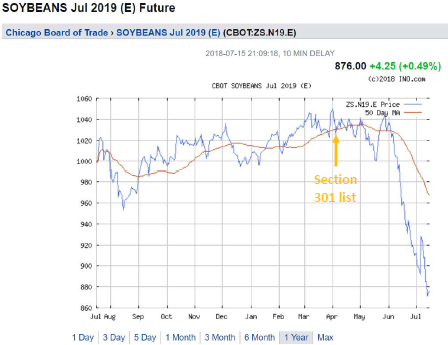
Soybean harvesting begins soon, with the new market year (9/1-), and it was thought by some observers that as China would have to eventually access American soybeans, so prices would recover. That event has not occurred.
Continue reading
Today, we present a guest post written by Jeffrey Frankel, Harpel Professor at Harvard’s Kennedy School of Government, and formerly a member of the White House Council of Economic Advisers. This column is based on “The Next Economic Crisis,” remarks on a panel at the 2nd annual retreat of the American Enterprise Institute in Jackson Hole, Wyoming, August 13. A shorter version appeared in Project Syndicate.
From Ascertainment of Estimated Excess Mortality from Hurricane Maria in Puerto Rico, commissioned by the government of Puerto Rico, released today:
Total excess mortality post-hurricane using the migration displacement scenario is estimated to be 2,975 (95% CI: 2,658-3,290) for the total study period of September 2017 through February 2018.
Holding to the Old Faith

Figure 1: Ten year-3 month Treasury yield spread (bold dark blue), and ten year-two year Treasury yield spread (bold dark red), and projections at current pace using 2017M01-18M08 sample (light blue and pink lines), in percentage points. August 2018 observation through August 27th. NBER defined recession dates shaded gray. Light orange denotes Trump administration. Source: Federal Reserve Board via FRED, Bloomberg, NBER, author’s calculations.
Continue reading
I’ve recently read some commenters talking about consumption behavior as if it’s a settled matter, particularly with respect to theory. Let me just put that idea to rest.
Continue reading